
Why Prescription Drug Prices Are So High in the United States
 Dec, 28 2025
For the same pill, made in the same factory, Americans pay three times what people in Canada, Germany, or the UK pay. That’s not a typo. It’s the reality for millions of people filling prescriptions every month. Why does this happen? It’s not because U.S. drugmakers are better at innovation. It’s not because research costs are higher here. It’s because the system is designed this way - and it’s working exactly as intended for the people who profit from it.
The System Was Built to Let Drug Companies Set Any Price
In most developed countries, the government negotiates drug prices directly with manufacturers. In the U.S., that’s illegal for Medicare - the largest health program in the country. The Medicare Modernization Act of 2003 banned the government from negotiating prices for Part D drugs. That decision created a vacuum. With no one pushing back, drugmakers could raise prices with almost no consequences.
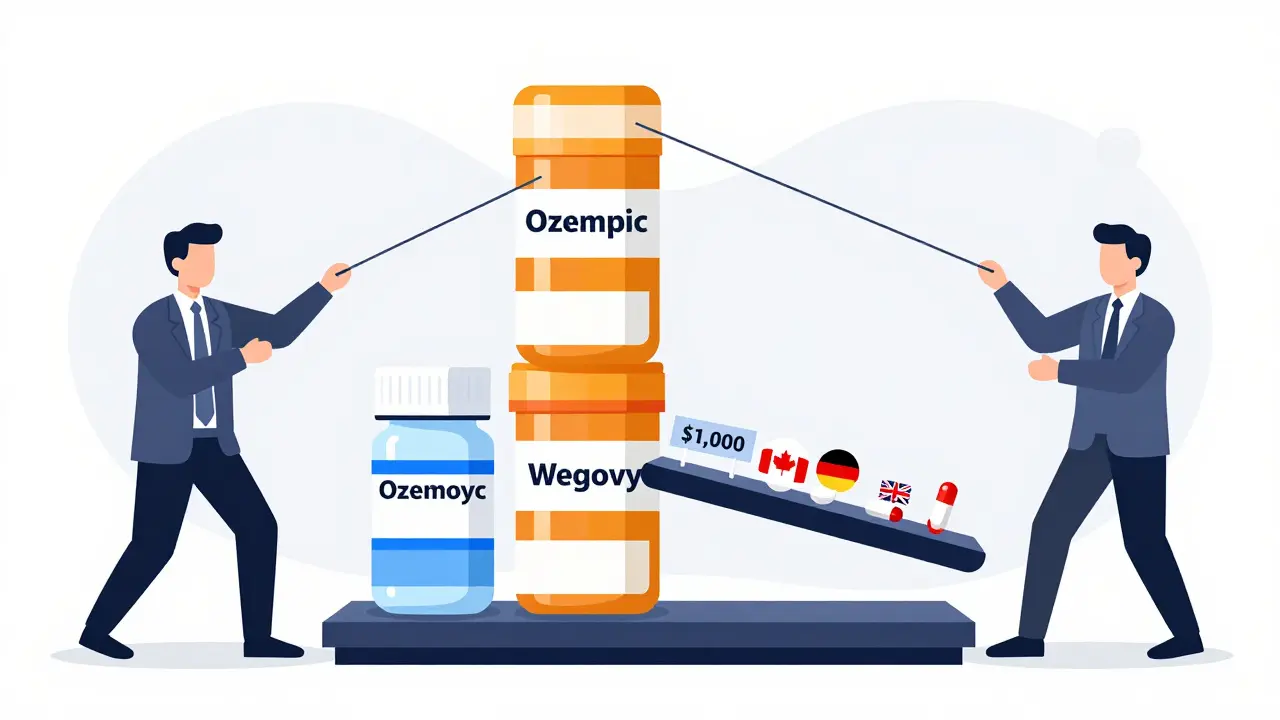
Since then, prices have climbed steadily. In 2024, net drug prices in the U.S. jumped 11.4%, up from just 4.9% the year before. The biggest drivers? New drugs for diabetes and obesity - drugs like Ozempic and Wegovy. These aren’t cheap to develop, but they’re also not expensive to produce. The cost to make a single dose of Ozempic is estimated at less than $5. Yet in 2025, before any price cuts, it sold for over $1,000 a month. That’s not a reflection of cost. It’s a reflection of power.
Who’s Really in Charge? The Hidden Middlemen
It’s not just drug companies. There’s a whole chain of middlemen making money off the confusion. Pharmacy Benefit Managers, or PBMs, were supposed to be the good guys - third-party negotiators who help insurers get discounts. Today, most PBMs are owned by big insurance companies or pharmacy chains. Their business model? They get paid based on the list price of drugs, not the final price you pay. That means they benefit when list prices go up, even if the actual discount stays the same.
Imagine a drug with a $1,000 list price. The PBM negotiates a $200 rebate from the manufacturer. They keep $150 of that rebate as profit. Now the manufacturer raises the list price to $1,500. The rebate goes up to $300. The PBM keeps $225. You still pay the same copay - maybe $30. But now the system is making more money off you, even though the drug hasn’t changed.
One Drug, 1,555% Price Difference
Take Galzin, a drug used to treat Wilson’s disease - a rare genetic disorder. In the U.S., it costs $88,800 a year. In the United Kingdom? $1,400. In Germany? $2,800. That’s a 1,555% markup. The same chemical. The same pill. Same factory. Same patient. The only difference? Where you live.
This isn’t an outlier. The White House confirmed in late 2025 that Americans pay more than three times the price of brand-name drugs compared to other OECD countries - even after accounting for discounts. And these aren’t just niche drugs. Common medications for blood pressure, cholesterol, and insulin are priced at levels that make no sense globally.

The Inflation Reduction Act: A Start, But Not Enough
In 2025, the Inflation Reduction Act started to make changes. For the first time, Medicare could negotiate prices for a small number of drugs - ten in 2026, with more added each year. The first deals were announced in late 2025. Ozempic dropped from $1,000 to $350 a month. Wegovy went from $1,350 to $350. That’s a win for the 64 drugs included.
But here’s the catch: Medicare only covers about 65 million people. That’s less than 20% of the U.S. population. Private insurers still pay full price. And drugmakers are already finding ways around the rules - raising prices on non-negotiated drugs to make up for lost revenue. IQVIA reports that specialty drugs - cancer treatments, rare disease meds, endocrine therapies - are still driving 9-11% annual spending growth. These are the drugs most people can’t afford without insurance.
Why Politicians Keep Promising Change - And Failing
Every president since George W. Bush has promised to lower drug prices. Trump said he’d make sure Americans didn’t pay more than other countries. Biden said the Inflation Reduction Act was changing lives. Yet, according to Senator Bernie Sanders’ September 2025 report, 688 drugs went up in price after Trump took office. Even after he sent letters to drugmakers asking them to lower prices, 87 drugs increased by a median of 8%.
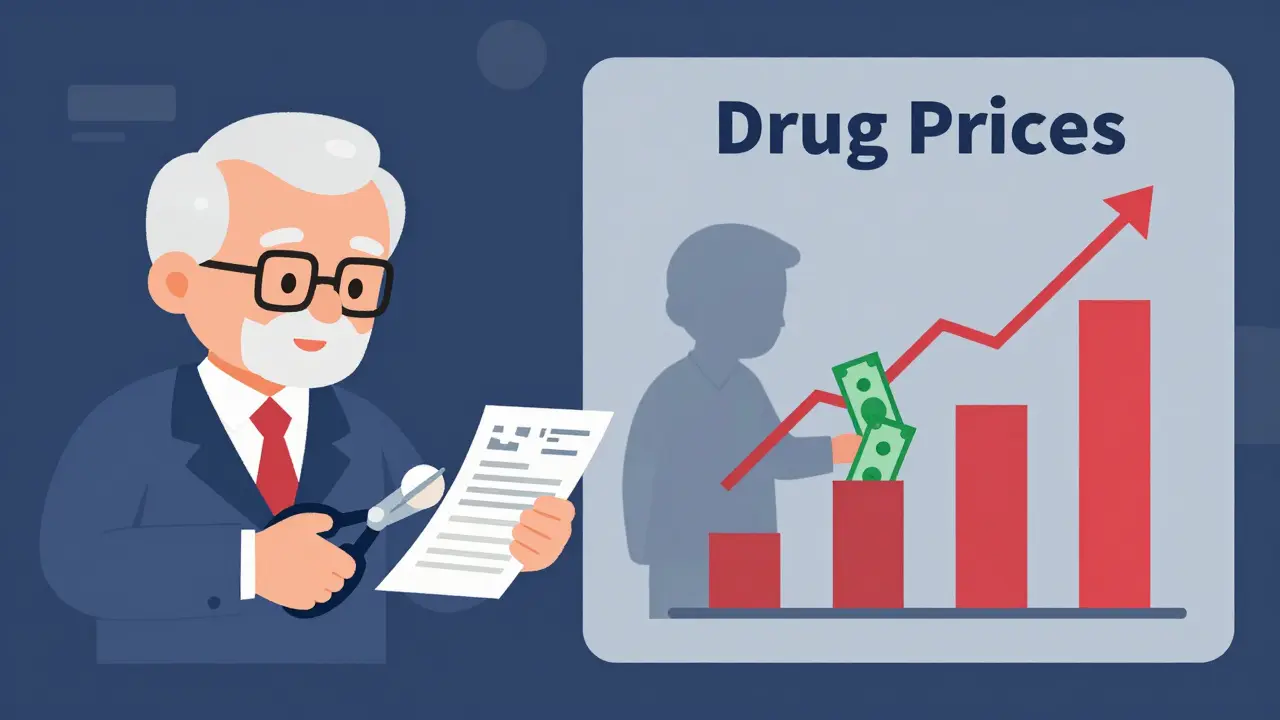
The reason? Lobbying. The pharmaceutical industry spent over $350 million on lobbying in 2024 alone. That’s more than any other industry. They fund campaigns, hire former lawmakers, and write legislation. The 2025 budget reconciliation bill, HR 1, weakened Medicare’s negotiation power and increased projected spending by $5 billion. That’s not an accident. It’s the system protecting itself.
What This Means for Real People
People are skipping doses. Cutting pills in half. Choosing between insulin and rent. One in five Medicare beneficiaries reports rationing their medications because of cost. The Inflation Reduction Act’s $2,000 annual out-of-pocket cap for Part D drugs will help - but only for those on Medicare. Millions of working-age Americans with private insurance still face high deductibles, surprise bills, and formulary changes that can make their meds unaffordable overnight.
And the threat is growing. Project 2025, a conservative policy blueprint, proposes replacing Medicare’s current drug program with one that would increase out-of-pocket costs for as many as 18.5 million seniors. That’s not speculation. It’s a documented plan.
The Real Cost Isn’t Just Money
High drug prices don’t just hurt wallets. They hurt health. People with diabetes who skip insulin end up in the ER. Cancer patients delay treatment because they can’t afford co-pays. Mental health meds get dropped because they’re too expensive. The result? Higher hospital bills. Longer recovery times. More deaths.
Other countries don’t have this problem because they treat medicine as a public good - not a profit center. They set prices based on value, not what the market will bear. They use reference pricing: if a drug costs $500 in France, it can’t cost $2,000 in Germany. The U.S. is the only wealthy country that doesn’t do this.
What Could Actually Fix This?
There are clear solutions - but they require political will, not just press releases.
- Let Medicare negotiate all drugs - not just ten. The savings would be massive.
- Cap out-of-pocket costs for everyone, not just seniors.
- End PBM rebates tied to list prices. Pay them based on savings, not markups.
- Allow importation of safe, FDA-approved drugs from Canada and other countries.
- Break patent monopolies for drugs that cost more than 200% of the global average price.
The Prescription Drug Price Relief Act, introduced in May 2025, would tie U.S. prices to the lowest prices in five major countries. It’s simple. It’s fair. And it’s been blocked every time it’s come up for a vote.
There’s No Mystery Here
Drug prices are high because the system lets them be. It’s not broken. It’s working exactly as designed - for the pharmaceutical industry, for PBMs, for investors. For patients? It’s a gamble. A gamble between health and bankruptcy.
Until the U.S. stops pretending this is about innovation and starts treating medicine like a basic human need, prices will keep climbing. And people will keep paying the price.
Kevin Lopez
December 29, 2025 AT 14:11PBMs are the real parasites here. Fee-for-service model tied to list price? That’s not negotiation-it’s incentive misalignment on steroids. They profit from inflation, not savings. Fix the PBM structure first, and you cut 30% of the markup before even touching pharma.
Medicare negotiation is a band-aid. Until we cap list prices outright, it’s just rearranging deck chairs on the Titanic.
Duncan Careless
December 29, 2025 AT 23:04just read this and thought of my mum back home-she gets her insulin for £20 a month here. over here it’s like buying a second car every year. not sure how we let this happen. the system’s broken, not the people.
ps: sorry for the typos, typing on phone after a long day.
Jasmine Yule
December 30, 2025 AT 21:15THIS. THIS. THIS.
I’m a diabetic. I’ve cut my pills in half. I’ve skipped doses. I’ve cried in the pharmacy parking lot because my copay went up $80 this month and I had to choose between my meds and my kid’s school lunch.
It’s not ‘market dynamics.’ It’s not ‘innovation.’ It’s greed wrapped in a white coat. And if you’re not angry, you’re not paying attention. 😤
Greg Quinn
December 31, 2025 AT 14:56There’s a deeper philosophical question here: when did healthcare stop being a social contract and become a commodity to be auctioned off?
We treat air, water, and medicine as if they’re luxury goods because we’ve normalized the idea that profit must precede care. But medicine isn’t a product-it’s a lifeline. And a society that lets its people die because they can’t afford a pill isn’t a free society. It’s a failed one.
Other countries get it. We’ve just forgotten how to be human.
Lisa Dore
December 31, 2025 AT 15:58Y’all, I know it feels overwhelming, but change IS possible. Look at what happened with insulin in Colorado-they capped it at $35. Now other states are following. Grassroots pressure works.
Join a patient advocacy group. Call your rep. Even if it feels small, it adds up. We’re not powerless. We just got told we were.
And hey-if you’re reading this, you’re already part of the solution. ❤️
Manan Pandya
January 1, 2026 AT 21:45Interesting analysis. However, one must consider the R&D cost distribution. While production cost of Ozempic is low, the clinical trials, regulatory compliance, and global safety monitoring are not. The U.S. system, despite its flaws, funds innovation that benefits the world.
Perhaps the solution lies in tiered pricing: higher prices in high-income nations to subsidize access in low-income ones. Not perfect, but pragmatic.
Aliza Efraimov
January 3, 2026 AT 16:34Let me tell you about my neighbor. She had stage 3 breast cancer. Her drug was $12,000 a month. Insurance covered 80%. She still paid $2,400. She lost her house. She lost her dignity. She died last winter.
Don’t talk to me about ‘innovation.’ Don’t tell me about ‘market forces.’ This isn’t economics-it’s a massacre. And the people in suits are smiling while they count the cash.
Someone needs to go to jail for this.
Nisha Marwaha
January 4, 2026 AT 16:58Pharma’s lobbying spend exceeds the GDP of 150+ countries. PBMs are structured as vertical monopolies-insurance → PBM → pharmacy chain. It’s a closed-loop extraction system. The only way to disrupt this is through public manufacturing of essential medicines or compulsory licensing.
Reference pricing isn’t ‘price control’-it’s market correction. The U.S. is the outlier, not the rest of the world.
Paige Shipe
January 6, 2026 AT 02:02Oh please. You think drug companies are the villains? What about the lazy Americans who won’t take responsibility for their health? Obesity. Diabetes. All preventable. Now you want someone else to pay for your poor choices?
And why are you all so mad? Canada and the UK have rationing. People wait years for surgeries. We get access. We get choice. We get innovation. You’re just jealous.
Stop whining. Get a job. Buy insurance. Stop blaming corporations for your lack of discipline.
Tamar Dunlop
January 7, 2026 AT 11:41As a Canadian who has lived in both systems, I can attest: the U.S. model is a grotesque anomaly. I once paid $12 CAD for a life-saving antibiotic in Toronto. A friend in Chicago paid $420 USD for the same prescription.
It is not merely a policy failure-it is a moral failure. When a nation places shareholder dividends above the sanctity of human life, it ceases to be a society worthy of the name.
Canada does not have perfect healthcare. But we do not let people die because they cannot pay.
With profound sorrow and respect,
Tamar
David Chase
January 9, 2026 AT 07:57AMERICA F***ING WINNED!!! 🇺🇸💥
Other countries are socialist garbage. We pay more because we’re #1. We fund ALL the innovation. You think Ozempic was invented in Germany? Nah. It was invented in the U.S.A. by real Americans who don’t take handouts!
And PBMs? They’re just doing their job. If you can’t afford it, don’t take it. Simple. Get a side hustle. Stop crying. This is capitalism, baby. You want free stuff? Move to Venezuela.
Also, I own stock in pharma. So yeah. I’m rooting for higher prices. 💰😎
Emma Duquemin
January 9, 2026 AT 10:52Let’s talk about the real magic trick here: the same pill, same factory, same scientist, same patent… but in the U.S., it’s a golden ticket. In Germany, it’s a lifeline. In Canada, it’s a right.
They say capitalism rewards innovation. But what if the innovation is just… pricing? What if the real breakthrough isn’t the molecule-it’s the invoice?
And here’s the kicker: the FDA approves these drugs. The DEA regulates them. The VA buys them at discount. But Medicare? Can’t negotiate. Why? Because the same people who wrote the law are the ones getting the campaign donations.
This isn’t a broken system. It’s a perfectly engineered extraction machine. And we’re all just rats in the wheel.
But hey-at least we’ve got a 12% discount on our Netflix subscription. 🤡