
Vitamin K-Rich Vegetables and Warfarin: Complete Food List and Safe Eating Guide
 Jan, 10 2026
Vitamin K Intake Calculator
Daily Vitamin K Intake Calculator
Track your vitamin K intake from vegetables and other foods to maintain consistent levels. This calculator helps you avoid INR fluctuations by showing how different portions affect your daily intake.
Daily Vitamin K Total
Your daily vitamin K intake
Why consistency matters
Stable vitamin K intake helps maintain consistent INR levels. Inconsistent intake can increase your risk of INR swings by up to 2.7 times.
Research shows that keeping your daily vitamin K intake within 35% of your average is crucial for stability.
Your Intake History
| Food | Amount | Micrograms | Actions |
|---|
Key guidelines
- Consistency is more important than quantity
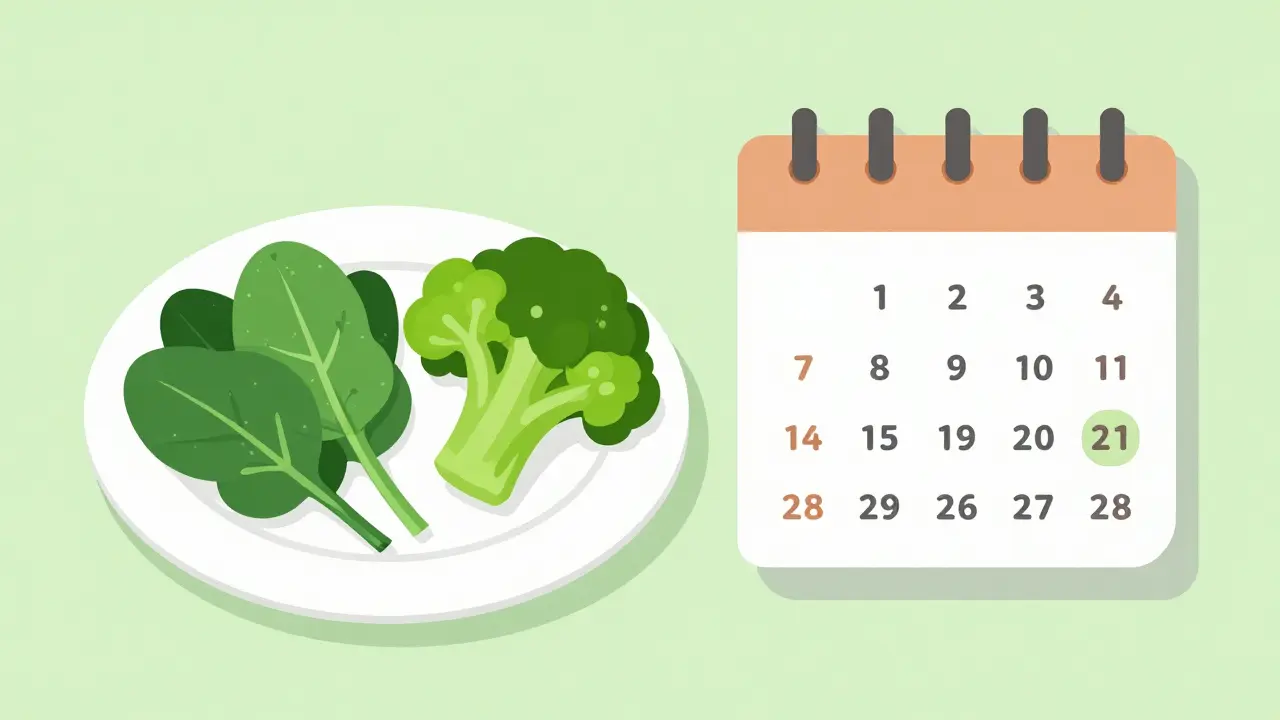
- Aim for 1-2 servings of vitamin K-rich foods daily at consistent amounts
- Avoid sudden changes in diet
- Never stop all greens when your INR is high
- Check food labels for hidden vitamin K sources
When you're on warfarin, your body is walking a tightrope. Too much vitamin K, and your blood clots too easily. Too little, and you risk bleeding. It’s not about cutting out greens - it’s about keeping them consistent. Thousands of people manage this perfectly every day. You can too.
How Warfarin Actually Works
Warfarin doesn’t thin your blood. It stops your liver from using vitamin K to make clotting proteins. Think of vitamin K as a key that unlocks the production of factors II, VII, IX, and X - the proteins that help your blood clot when needed. Warfarin jams that key. If you suddenly eat a big pile of kale or spinach, you flood your system with vitamin K. Your liver gets enough of the key to start making clotting factors again. Your INR drops. Your blood clots faster. That’s dangerous if you’re on warfarin for a clotting disorder or a mechanical heart valve.
Conversely, if you stop eating greens for a week, your vitamin K levels drop. Your liver can’t make enough clotting factors. Your INR spikes. You could bleed internally without warning. This isn’t theory - it’s why people end up in the ER.
The Real Rule: Consistency, Not Avoidance
Doctors used to tell patients to avoid vitamin K entirely. That advice is outdated - and harmful. A 2023 study from the American College of Chest Physicians found that patients who cut out all leafy greens had more INR swings than those who ate the same amount every day. The goal isn’t to eliminate vitamin K. It’s to keep your daily intake steady.
Research from the University of Iowa shows that people whose vitamin K intake varied by more than 35% from day to day were 2.7 times more likely to have unstable INR levels. That’s why the Mayo Clinic now recommends eating 1-2 servings of vitamin K-rich vegetables daily - as long as it’s the same amount, every day.
Complete List of Vitamin K-Rich Vegetables
Here’s the full list of vegetables with the highest vitamin K content, based on USDA FoodData Central (2023). All values are per standard serving:
- Kale (½ cup cooked): 547 mcg
- Spinach (½ cup cooked): 444 mcg
- Collard greens (½ cup cooked): 418 mcg
- Swiss chard (½ cup cooked): 299 mcg
- Turnip greens (½ cup cooked): 265 mcg
- Parsley (¼ cup fresh): 246 mcg
- Mustard greens (½ cup cooked): 210 mcg
- Brussels sprouts (½ cup cooked): 109 mcg
- Broccoli (½ cup cooked): 102 mcg
- Green cabbage (½ cup cooked): 82 mcg
- Asparagus (½ cup cooked): 70 mcg
- Romaine lettuce (1 cup shredded): 48 mcg
These aren’t just side dishes - they’re powerful. One cup of cooked kale has more than five times the daily recommended intake for women (90 mcg). That’s why even small changes matter.
Other Surprising Sources of Vitamin K
It’s not just greens. Many people don’t realize how much vitamin K is in other common foods:
- Beef liver (3 oz): 106 mcg
- Egg yolks (1 large): 25 mcg
- Commercial meal shakes (8 oz): 25 mcg (Boost, Ensure)
- Viactiv Calcium Chews (1 tablet): 25 mcg
- Dried seaweed (10g): 45-100 mcg
If you take a daily supplement - even a simple multivitamin - check the label. Many contain vitamin K. One study found that 32% of warfarin patients were taking supplements without telling their doctor. That’s a major risk.
What to Avoid Completely
Some foods don’t just change your vitamin K levels - they interfere with how warfarin works in your body.
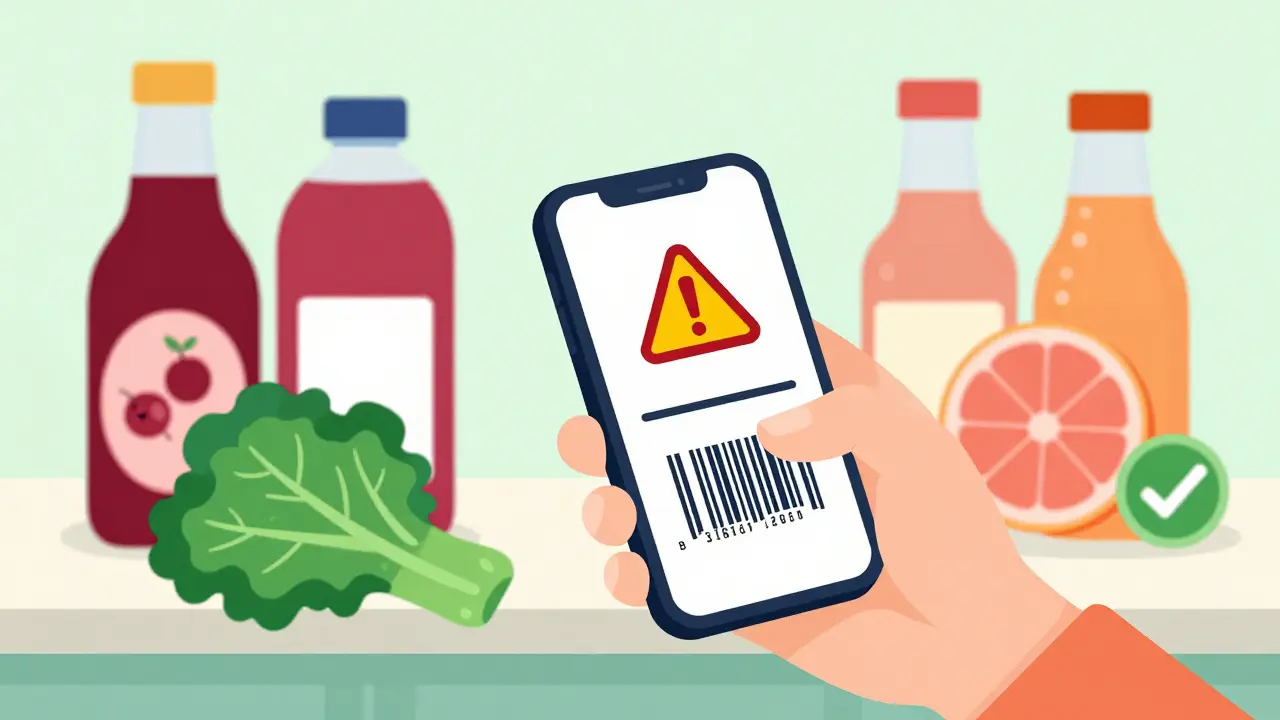
- Cranberry juice: Increases INR by 0.8-1.2 units in as little as 72 hours. Even one glass a day can push you into dangerous territory.
- Grapefruit juice: Blocks the enzyme (CYP2C9) that breaks down warfarin. This can raise your drug levels by 15-30%, increasing bleeding risk.
- Green tea (in large amounts): Contains vitamin K and may interact with warfarin. Stick to 1-2 cups daily if you drink it regularly.
Alcohol? One drink a day is usually fine - if you drink it every day. Skipping for a few days, then having three on Saturday? That’s a recipe for INR spikes.
How to Eat Smart: The 3-Step Plan
Here’s what actually works, based on real patient success stories and clinic protocols:
- Find your baseline. Track what you eat for 7 days. Use a food diary or a free app like the National Blood Clot Alliance’s Warfarin Food Guide. Calculate your average daily vitamin K intake. Most people eat 80-150 mcg/day without realizing it.
- Lock in your serving. Pick 1-2 vitamin K-rich foods you like. Eat the same amount every day. Example: ½ cup cooked spinach Monday through Friday. No more, no less. If you skip it one day, make up for it the next - don’t leave it out for a week.
- Watch for hidden changes. Seasonal shifts matter. In spring and summer, people eat more salads. That’s a common trigger for INR drops. Travel? Eating out? New meal replacement shakes? All can throw you off. Always check labels on packaged foods - many contain added vitamin K.
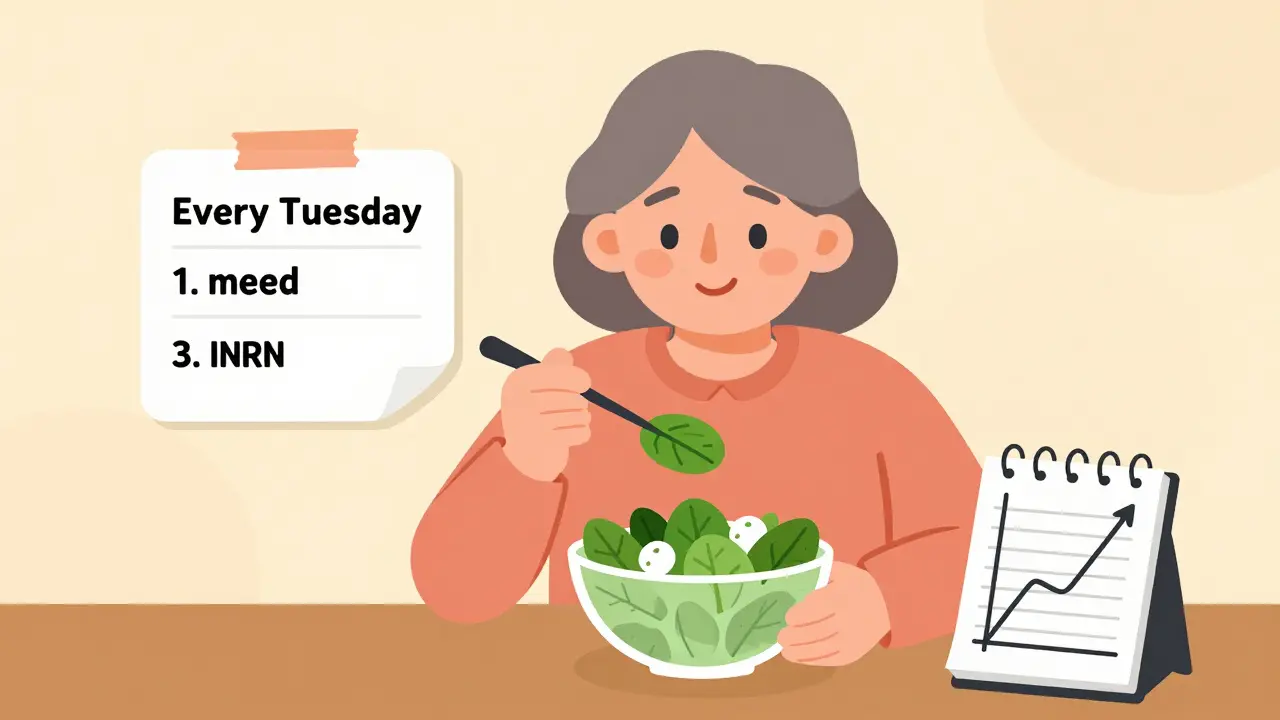
One patient, Mary T., 67, has kept her INR stable at 2.5 for five years by eating exactly one cup of spinach salad every Tuesday and Thursday. No other greens. No variations. Her clinic calls her a model patient.
What Not to Do
These are the top mistakes that land people in the hospital:
- Stopping all greens when your INR is high. That’s the #1 cause of dangerous swings. You think you’re helping - you’re hurting.
- Starting a new supplement without asking your doctor. Even “natural” products like vitamin K pills or green powders can wreck your INR.
- Changing your diet during illness. When you’re sick, you eat less. That’s a red flag. Talk to your anticoagulation clinic before you make any changes.
- Ignoring serving sizes. One cup of raw spinach is not the same as ½ cup cooked. Cooking concentrates vitamin K. Know your portions.
Tools That Help
You don’t have to guess. There are real tools made for this:
- Warfarin Food Guide app: Free, FDA-recognized, used by over 42,000 people. Lets you scan barcodes and log meals.
- Food diaries: Paper or digital - the Cleveland Clinic found they improve time in therapeutic range by over 12%.
- Consult a dietitian: Most anticoagulation clinics offer free sessions. You don’t need to be an expert. Just learn your baseline.
One clinic in North Carolina cut ER visits by 43% after requiring patients to take a photo of their meals for a week. Simple. Effective.
When You Should Worry
If you’ve had any of these in the last 7 days, call your doctor:
- Drank cranberry or grapefruit juice
- Started or stopped a supplement
- Ate a huge portion of kale, spinach, or liver
- Missed meals for more than 2 days
- Started a new antibiotic (some interfere with warfarin)
Don’t wait for symptoms. Bleeding can be silent. A sudden headache, bruising without injury, or dark stools could mean something serious.
What’s Changing in 2026
More people are switching to DOACs (like apixaban or rivaroxaban) because they don’t need diet tracking. But warfarin is still the only option for mechanical heart valves and some rare conditions. About 4.7 million Americans still take it - and most of them are over 65.
Future tools are coming. The NIH is testing apps that adjust your vitamin K intake based on your genetics and INR history. By 2027, 60% of warfarin users will likely use digital tracking. But right now, the best tool is still you - keeping your greens steady, knowing your numbers, and talking to your care team.
Can I eat spinach if I’m on warfarin?
Yes - but only if you eat the same amount every day. A half-cup of cooked spinach daily is safe for most people. The problem isn’t spinach itself - it’s inconsistency. If you eat spinach Monday and skip it Tuesday, your INR will swing. Stick to your portion, every day.
What happens if I eat a lot of kale one day?
You could see your INR drop within 24-48 hours. That means your blood clots faster, increasing your risk of stroke or clotting. One patient’s INR fell from 2.8 to 1.9 after eating 3 cups of kale in five days. That’s a dangerous drop. Don’t binge on greens - even if you think it’s healthy.
Do I need to avoid all green vegetables?
No. Avoiding all greens is a myth. Studies show patients who cut out vegetables had more INR instability than those who ate them consistently. The goal is balance, not elimination. Eat your greens - just keep the amount the same every day.
Can I take vitamin K supplements?
Only if your doctor recommends it. Some studies show that taking 100 mcg daily can actually stabilize INR in people with wild swings. But self-supplementing is dangerous. A single 500 mcg pill can throw off your INR for days. Never take vitamin K without medical supervision.
Why does my INR change when I’m sick?
When you’re sick, you eat less - and that means less vitamin K. Your INR can rise quickly, increasing bleeding risk. Also, some sicknesses and medications interfere with how your body processes warfarin. Always check with your clinic before making dietary changes during illness.
Should I switch to a DOAC instead of warfarin?
Maybe. DOACs don’t require diet tracking, but they’re not right for everyone. If you have a mechanical heart valve, antiphospholipid syndrome, or severe kidney disease, warfarin is still the only option. Talk to your cardiologist. The choice depends on your condition, not just convenience.
Final Tip: Track It, Don’t Guess It
Warfarin isn’t about fear. It’s about control. You don’t need to be a nutritionist. You just need to be consistent. Pick your greens. Eat the same amount. Log it. Check your INR. Talk to your team. That’s the whole game. Thousands of people do it every day. You can too.
Jennifer Littler
January 11, 2026 AT 23:24Just wanted to say this post saved my life. I was swinging between INR 1.8 and 3.9 every week until I started tracking my spinach like a science experiment. Now I eat exactly 1/2 cup cooked every single day - no exceptions. My warfarin doc says I’m the most stable patient she’s had in years. 🙌
Sam Davies
January 12, 2026 AT 07:39Oh wow, another ‘eat the same spinach every day’ manifesto. How revolutionary. Next you’ll tell me water is wet and gravity exists. I’m sure the FDA will award you a medal for this groundbreaking insight. 🤡
Alfred Schmidt
January 12, 2026 AT 13:06YOU’RE ALL MISSING THE POINT!!! I had a stroke last year because my INR dropped after I ate ONE BAG OF KALE SALAD AT THE GROCERY STORE!!! I didn’t even know it had that much vitamin K!! And now I’m paralyzed on my right side and you people are arguing about whether spinach is ‘healthy’?!?!?!! THIS ISN’T A DIET BLOG - IT’S A LIFE OR DEATH GUIDE!! STOP BEING LAZY AND START TRACKING!!!
Priscilla Kraft
January 13, 2026 AT 14:32Thank you so much for this!! 🙏 I’ve been on warfarin for 8 years and this is the first time I’ve seen a guide that doesn’t make me feel like a villain for liking salads. I’ve been eating 1/2 cup cooked collards every Tuesday and Thursday - same as Mary T. 😊 My INR’s been stable since January. Also, the Warfarin Food Guide app is a GAME CHANGER. You can scan barcodes on meal shakes and it auto-logs K content. Life-changing! 💚
Michael Patterson
January 14, 2026 AT 09:12Okay so I’ve been on warfarin for 12 years and I’ve read like 17 different guides and this one is… fine I guess. But you missed a ton of stuff like how fermented foods like natto have like 1000mcg per serving and no one talks about that. Also, you said ‘consistent’ but didn’t define what consistent means for people who eat 3 meals a day vs. intermittent fasting. And why no mention of vitamin K2? That’s the real villain. Also, you didn’t even mention that some antibiotics like cipro can make your INR spike even if you’re eating the same greens. This post is just surface level. I’m disappointed.
Matthew Miller
January 15, 2026 AT 17:23Wow. Just wow. Another ‘eat your greens’ cult post. You know what’s really dangerous? People who think they can ‘manage’ warfarin with a food diary. You’re not a nutritionist. You’re not a pharmacist. You’re just some guy who Googled ‘vitamin K’ and now thinks you’re an expert. I’ve seen 3 patients die because they thought ‘consistency’ meant ‘eating the same amount’ - not realizing their liver metabolism changed after a cold. This post is dangerous. Stop giving medical advice.
Adewumi Gbotemi
January 16, 2026 AT 05:57This is good. I am from Nigeria, I take warfarin for heart problem. I eat cocoyam leaf every day, small bowl. I do not change. My doctor say good. I do not know much English but I understand this. Consistency is key. Thank you.
Sean Feng
January 17, 2026 AT 09:25Why are we even talking about this? Just switch to Xarelto. Done. No more spinach math. Why are you all still on warfarin? Are you trying to make your life harder?
Christian Basel
January 19, 2026 AT 04:24Consistency is the only rule? Really? That’s it? You’re ignoring pharmacokinetic variability, CYP2C9 polymorphisms, and gut microbiome interactions that alter vitamin K absorption. The Mayo Clinic’s recommendation is a Band-Aid on a hemorrhage. If you’re not genotyping your patients or monitoring daily K intake via HPLC, you’re practicing guesswork medicine. This post is dangerously oversimplified.
Alex Smith
January 19, 2026 AT 06:26Look, I get it. You’re trying to help. But let’s be real - most people can’t stick to ‘half a cup of spinach every day.’ Life happens. Kids, work, travel, bad days. The real solution isn’t rigid consistency - it’s digital tools + regular INR checks. The app mentioned? Use it. Take a photo of your plate. Text your anticoagulation nurse. That’s the 2024 way. Stop making people feel guilty for eating a salad on Saturday. We’re not lab rats.
Roshan Joy
January 20, 2026 AT 21:48Great post! I’ve been on warfarin for 5 years and I eat 1 cup of raw spinach every morning with my smoothie. Same amount, every day. No stress. I use the app and my INR is always perfect. I also take my pills at 7pm every night - timing matters too. You’re not alone out there. Keep it steady. You got this. 💪❤️