
Sterile Manufacturing for Injectables: What You Need to Know About Contamination Control
 Jan, 13 2026
When you get a shot, you expect it to be safe. Not just effective - sterile. That’s not a guarantee you can take for granted. Behind every vial of insulin, vaccine, or chemotherapy drug is a highly controlled, incredibly expensive, and unforgiving process called sterile manufacturing. One mistake - one speck of dust, one airborne microbe - can turn a life-saving treatment into a deadly threat.
Why Sterility Isn’t Optional for Injectables
Oral pills go through your stomach, where acid and enzymes kill most invaders. Injectables don’t have that protection. They go straight into your bloodstream. A single bacterium can trigger sepsis. A single endotoxin can cause organ failure. That’s not theoretical. In 2012, a compounding pharmacy in Massachusetts shipped contaminated steroid injections. The result? 751 people infected, 64 dead. The CDC called it the largest fungal meningitis outbreak in U.S. history. This isn’t about being careful. It’s about math. The global standard for sterile injectables is a Sterility Assurance Level (SAL) of 10^-6. That means, statistically, no more than one contaminated product in a million. To hit that, every step - from the water used to the gloves worn - has to be engineered for zero compromise.Two Paths to Sterility: Terminal vs. Aseptic
There are two main ways to make sterile injectables, and the choice changes everything. Terminal sterilization is the simpler method. You fill the vial, seal it, then blast it with steam at 121°C for 15-20 minutes, or hit it with gamma radiation. This kills everything inside. It’s reliable. It’s cheaper. And it’s only possible for about 30-40% of injectables - the ones that can survive extreme heat or radiation. Most biologics - like monoclonal antibodies used for cancer or autoimmune diseases - will break down under these conditions. So for those, you need aseptic processing. Aseptic fill-finish is like performing surgery in a cleanroom. Nothing is sterilized after filling. Instead, you keep everything sterile from start to finish. This means:- Manufacturing in ISO 5 cleanrooms (Class 100), where fewer than 3,520 particles per cubic meter are allowed (0.5 microns or larger)
- Workers in full sterile gowns, moving slowly, minimizing air disturbance
- Equipment sealed inside RABS (Restricted Access Barrier Systems) or isolators - sealed, glove-port systems that keep humans out of the critical zone
- Continuous air monitoring, with microbial samplers that catch even one airborne colony-forming unit (CFU) per cubic meter
The Cleanroom: A Controlled Universe
You don’t just walk into a sterile manufacturing area. You go through layers. First, you change into regular clothes, then into a scrub suit, then into a full sterile gown - all in ISO 8 or ISO 7 areas. Then you enter the ISO 5 fill room. Air flows in one direction - like a waterfall - at 0.3 to 0.5 meters per second. It’s changed 20 to 60 times per hour. The pressure inside the fill room is 10-15 Pascals higher than the corridor. That means if a door cracks open, clean air flows out - not dirty air in. Temperature? 20-24°C. Humidity? 45-55%. Too dry, and static electricity attracts particles. Too humid, and microbes thrive. Every parameter is logged, monitored, and recorded. Even the water matters. You can’t use tap water. You need Water for Injection (WFI), purified to remove endotoxins - bacterial fragments that can cause fever and shock. WFI must have less than 0.25 Endotoxin Units per milliliter. Containers? They’re washed, rinsed, then baked at 250°C for 30 minutes to destroy any lingering pyrogens.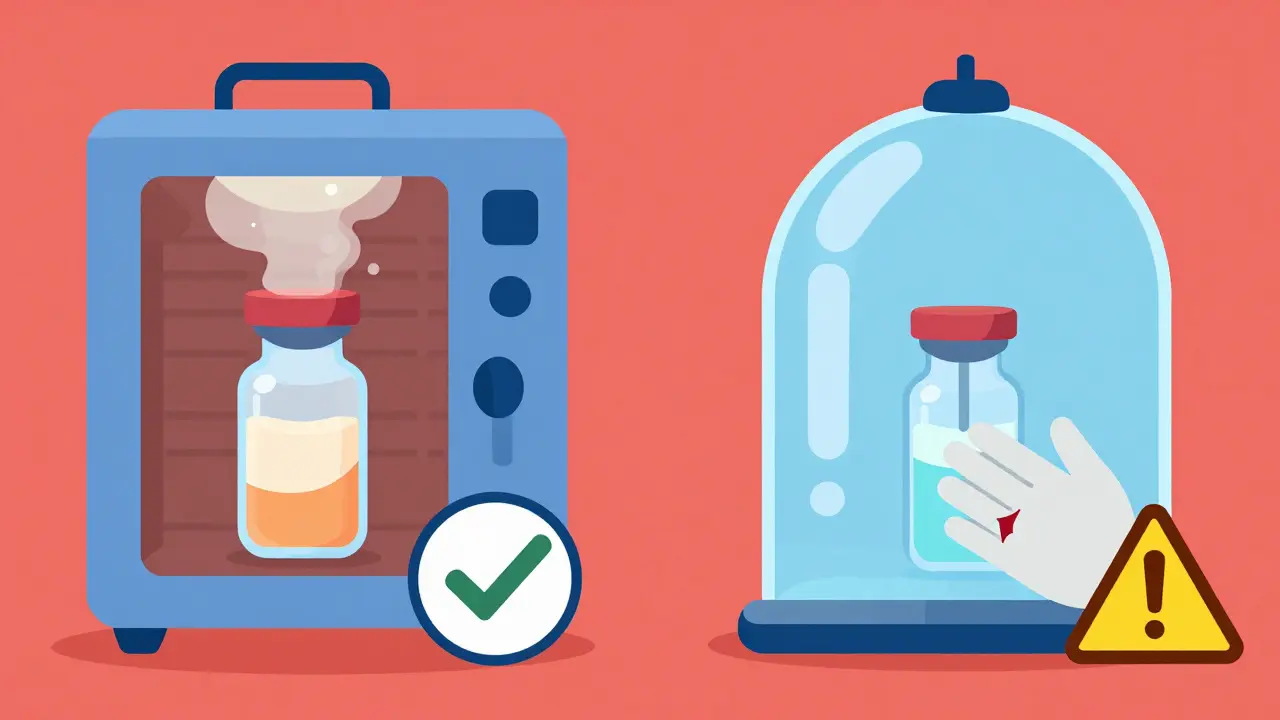
Media Fills: The Mock Test That Saves Lives
How do you know your aseptic process works? You don’t wait for contamination. You test it - constantly. Every six months, manufacturers run a media fill. Instead of the real drug, they fill vials with a nutrient broth - the kind bacteria love to grow in. Then they incubate them for 14 days. If even one vial grows bacteria, the whole process fails. The FDA requires at least 5,000 to 10,000 units per media fill. That’s not a formality. It’s a stress test. If you get a failure rate above 0.1%, regulators will shut you down. One company reported three media fill failures in one quarter because a glove in their RABS system had a microscopic tear. Each failure cost $450,000 in lost batches.Costs and Trade-offs
Sterile manufacturing isn’t cheap. A terminal sterilization line for a 1,000L batch? Around $50,000. An aseptic line? $120,000 to $150,000. Why? Because you need isolators, continuous air monitors, automated filling machines, and 80 hours of training per operator - plus semi-annual requalification. Setting up a new sterile facility? Minimum $50 million. Upgrading to meet EU GMP Annex 1 (2022)? Another $15-25 million. That’s why 55% of sterile injectables are now made by contract manufacturers - companies like Lonza, Catalent, and Thermo Fisher that specialize in this high-risk work. But the cost of failure is worse. A single sterility test failure averages $1.2 million in losses. And that’s before lawsuits, recalls, or reputational damage.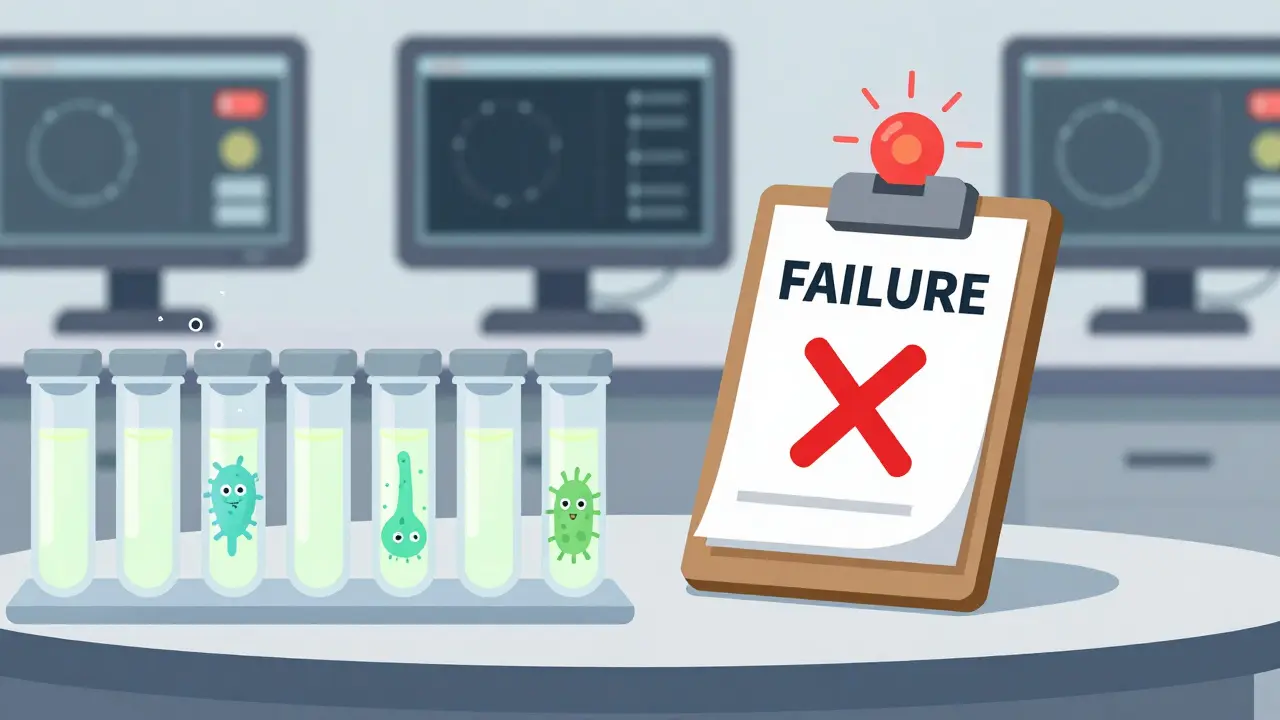
Randall Little
January 13, 2026 AT 13:53So let me get this straight: we’re spending $150K just to fill a vial, and the only thing keeping us alive is a 10^-6 statistical guarantee that some intern didn’t sneeze into the isolator? And we call this science? I’ve seen more sterile conditions in my bathroom after a deep clean.
But hey, at least the FDA’s got real-time dashboards now. Nothing says ‘patient safety’ like a spreadsheet that blinks red when a microbe dares to exist.
Meanwhile, my insulin costs $300 because ‘we can’t just sterilize it with steam.’ Funny how the same industry that can’t kill bacteria in a vial somehow makes billion-dollar profits off my diabetes.
Also, 64 dead from a steroid shot? That’s not a manufacturing failure - that’s a moral one. Someone should’ve been fired before the first batch shipped. Not after the autopsies started piling up.
And don’t get me started on media fills. Five thousand vials of broth? That’s not a test - it’s a buffet for every mold spore in Ohio. If one grows, you lose $450K? I’d rather lose the money than the patients.
Who’s really auditing the auditors? Because if the system’s this fragile, we’re not managing risk - we’re gambling with a loaded syringe.
And yet, somehow, we still trust this with our children’s vaccines. That’s not confidence. That’s Stockholm syndrome with aseptic technique.
Angel Tiestos lopez
January 14, 2026 AT 03:42bro. i just got my flu shot yesterday and now i’m sitting here thinking about how many people had to wear full space suits just to make sure i didn’t get a 10^-6 chance of dying from a speck of dust.
we’re basically trusting our lives to people who train for 80 hours to not sneeze.
also why is the water more regulated than my ex’s texts? WFI? Endotoxins? 250°C baking? someone’s got a microwave fetish.
but hey, at least we’re not using tap water. 🙏😂
Alan Lin
January 15, 2026 AT 07:21It is imperative to underscore the profound gravity of sterile manufacturing protocols - not as mere regulatory checkboxes, but as existential safeguards for human life. The 10^-6 Sterility Assurance Level is not an arbitrary metric; it is the mathematical embodiment of the ethical contract between the pharmaceutical industry and the vulnerable patient.
When we speak of aseptic processing failures, we are not discussing operational inefficiencies - we are confronting the direct causation of sepsis, organ failure, and preventable death. The 2012 outbreak was not an anomaly - it was a systemic collapse, and its victims were not statistics - they were mothers, fathers, children.
The investment in isolators, RABS, and continuous environmental monitoring is not an expense - it is an act of moral restitution. Every dollar spent on automation, every hour of operator training, every calibrated air flow - these are not costs. They are prayers whispered in sterile rooms.
Those who dismiss this as over-regulation are either profoundly ignorant or morally negligent. The cost of failure is not $1.2 million - it is a life. And no balance sheet can account for that.
Let us never forget: the person receiving that injection is not a ‘patient’ in a database - they are someone’s brother, someone’s friend, someone’s reason to wake up. We owe them more than compliance. We owe them reverence.
Pankaj Singh
January 16, 2026 AT 03:50Let’s be real - this entire system is a scam. You think $50 million for a sterile facility is about safety? Nah. It’s about profit margins disguised as purity. The real reason they don’t use terminal sterilization? Because biologics are expensive to make - so they charge you $10,000 per dose to justify the ‘high-risk’ process.
And media fills? 10,000 vials? That’s just a fancy way of saying ‘we’re too lazy to fix the real problem - human error.’
Meanwhile, in India, we make 70% of the world’s generics without half this infrastructure - and no one dies. Coincidence? I think not.
Stop pretending this is science. It’s a monopoly wrapped in cleanroom suits.
Robin Williams
January 16, 2026 AT 06:45ok but think about it - every time you get a shot, you’re basically getting injected with a miracle.
like… someone spent 1000s of hours in a room where the air is cleaner than your phone screen after you wipe it with a microfiber cloth.
and they’re moving so slow because if they move too fast, a single eyelash could kill you.
and yet we complain about the price? bro. if you think this is expensive - try being the 1 in a million.
we’re literally living in a sci-fi movie and we’re too busy scrolling to notice.
thank you, sterile warriors. 🙌🔥
Anny Kaettano
January 17, 2026 AT 04:33From a regulatory compliance standpoint, the EU Annex 1 updates represent a paradigm shift in environmental control - particularly the mandatory continuous monitoring of viable and non-viable particulates. The transition from discrete sampling to real-time data acquisition fundamentally alters the risk assessment model, reducing the stochastic uncertainty inherent in traditional microbiological testing.
Moreover, the integration of closed processing systems and digital twins enables predictive analytics at an unprecedented scale - moving from reactive compliance to proactive risk mitigation. This is not just innovation - it’s the evolution of quality culture.
That said, the human factor remains the most volatile variable. No algorithm can replace the discipline of gowning procedures or the vigilance of an operator who understands that a single lapse can cascade into catastrophe.
We must continue to invest in training, culture, and transparency - because sterile manufacturing is not a process. It’s a promise.
Kimberly Mitchell
January 17, 2026 AT 14:20So let me understand - we’re spending $50 million to make sure a single bacterium doesn’t get in, but we still can’t get insulin under $100? The math doesn’t add up. This isn’t about safety - it’s about corporate greed wrapped in a cleanroom.
And why do we still need humans to fill vials? Automation exists. We have robots that can assemble cars blindfolded. But we trust a $20/hour worker to not sneeze? That’s not science - that’s a liability waiting to happen.
Media fills? 14 days of incubation? In 2025? We have AI that can predict cancer from a CT scan in 3 seconds. Yet we’re still waiting for mold to grow in broth? Pathetic.
Someone’s making a fortune off this fear. And the patients are paying for it.
Angel Molano
January 19, 2026 AT 04:30Stop pretending this is hard. It’s not. It’s just expensive because no one wants to do it right. The 64 dead? Their fault for trusting a broken system. The regulators? Complicit. The companies? Greedy. The workers? Undertrained. Everyone failed.
Fix it. Or shut down.
Vinaypriy Wane
January 19, 2026 AT 15:17Let me say this with full respect - the level of precision required here is not just technical, it is spiritual. Every glove, every air particle, every drop of WFI - it’s all a covenant. We are not manufacturing drugs. We are preserving dignity.
And yet, we treat this like a cost center. We cut corners. We delay audits. We outsource to the lowest bidder. And then we wonder why people die.
I come from a country where people still die from dirty needles. So when I see this - I don’t see bureaucracy. I see salvation.
Please - don’t make it cheaper. Make it better.
And if you’re reading this - thank you. For showing up. For gowned. For breathing slow. For caring enough to be exact.
Diana Campos Ortiz
January 19, 2026 AT 16:26honestly… i never thought about how much goes into a shot until i read this.
like… i just get my flu jab and move on.
but now i’m imagining someone in a white suit, moving like a ghost in a silent room, just so i don’t get sick.
it’s quiet. it’s boring. it’s not glamorous.
but it’s everything.
thank you to the people who do this.
you’re the real heroes.
no cap.
Jesse Ibarra
January 21, 2026 AT 16:06Oh, so now we’re supposed to be impressed that a bunch of overpaid engineers in lab coats can keep a vial clean? Let’s be honest - this entire industry is a performance art piece for regulators and investors.
They spend $150K on a fill line, then charge $20,000 per dose - and call it ‘innovation.’
Meanwhile, in 2022, 68% of failures were due to human error - meaning someone forgot to change their gloves.
So we’re banking our lives on the fact that a tired, underpaid worker won’t scratch their nose?
And you call this ‘science’? This is a circus. With a $50 million price tag.
Someone please tell me why we’re not just using radiation on everything? Is it because the biologics market is too profitable to simplify?
Wake up. This isn’t safety. It’s spectacle.
laura Drever
January 22, 2026 AT 01:23so like… cleanrooms? media fills? wfi? honestly i dont care. just make the shot work and stop charging me $500 for it. also why does the water need to be baked? who thought of that?
jefferson fernandes
January 23, 2026 AT 11:30Let me be clear: the fact that this system works at all - despite human fallibility, aging infrastructure, and global supply chain chaos - is nothing short of miraculous.
Every single person who enters a cleanroom, who dons a gown, who checks a glove, who calibrates a sensor - they are not just employees. They are guardians of life.
And yet, we treat them like replaceable cogs. We underpay them. We overwork them. We ignore their training needs.
This isn’t just about compliance. It’s about justice. If you want sterile injectables - you must invest in the people who make them possible.
Not just the machines. Not just the audits. The hands. The minds. The hearts.
They are the real sterile barrier.
And they deserve better.
Alan Lin
January 25, 2026 AT 00:14Thank you for highlighting the human element - it is precisely this recognition that transforms sterile manufacturing from a technical endeavor into a moral imperative. The operators are not merely performing tasks; they are enacting a covenant with every patient who will receive their product.
When we speak of failures, we must not reduce them to statistical anomalies - we must see the faces behind the numbers. The child who will never walk again. The mother who will never hold her newborn. The elderly man who simply wanted to sleep without pain.
Training is not a cost. It is a sacred duty.
And if we continue to treat these workers as disposable, then no amount of isolators or real-time monitoring will save us from our own moral decay.