
Rifampin and Birth Control: What You Need to Know About Contraceptive Failure
 Mar, 8 2026
Rifampin Backup Contraception Calculator
Rifampin reduces birth control effectiveness by activating liver enzymes. Use backup contraception during rifampin treatment AND for 28 days after stopping. Calculate your safe return date here.
Recommended Contraception Timeline
Backup contraception must be used:
- During rifampin treatment (from 0000-00-00 to 0000-00-00)
- For 28 days after stopping (until 0000-00-00)
When you're taking rifampin for tuberculosis or a stubborn staph infection, the last thing you should worry about is your birth control failing. But here’s the hard truth: rifampin is one of the few antibiotics that can seriously reduce how well hormonal birth control works. It’s not a rumor. It’s not a myth. It’s science - and it’s been proven for over 50 years.
Let’s cut through the noise. Most antibiotics don’t touch your birth control. Penicillin? Azithromycin? Amoxicillin? They’re fine. You can take them without changing your routine. But rifampin? It’s different. It doesn’t just interfere - it actively breaks down the hormones in your pill, patch, or ring so fast that your body can’t use them properly. And that means you could get pregnant even if you take your pill every day at the same time.
How Rifampin Breaks Down Birth Control Hormones
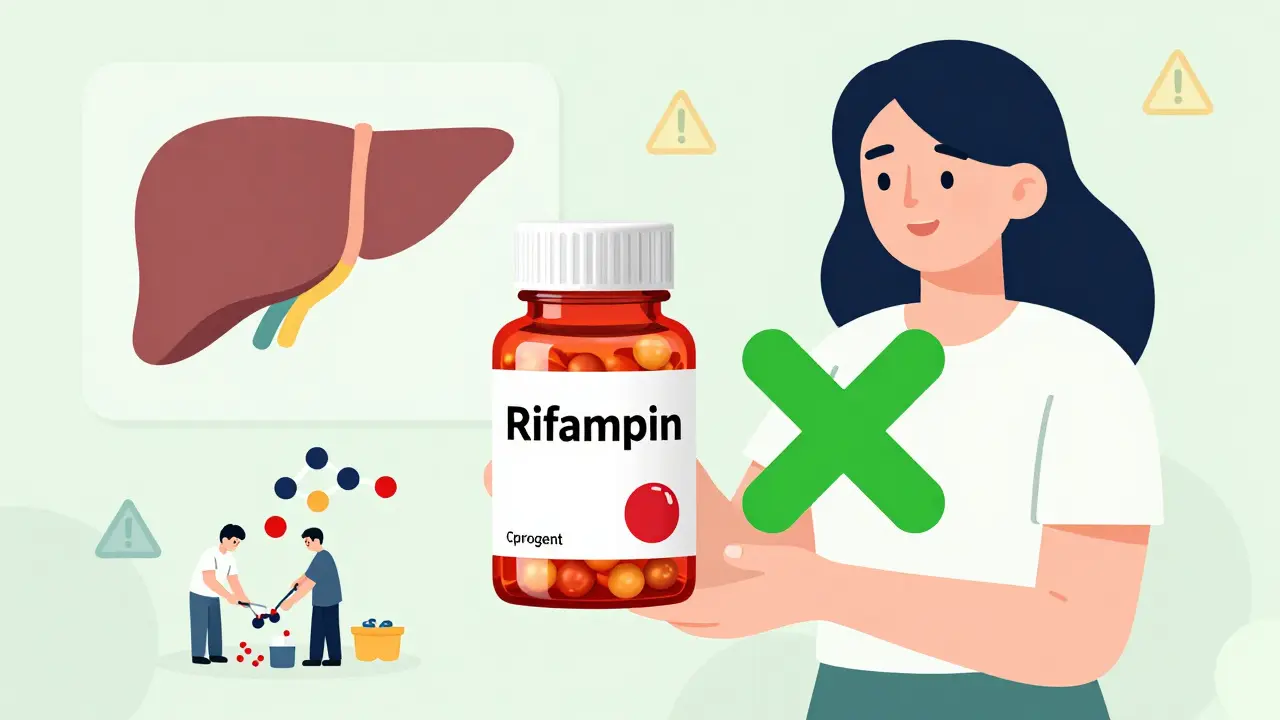
Rifampin doesn’t just pass through your body. It wakes up enzymes in your liver - specifically CYP3A4 - and tells them to go into overdrive. These enzymes are normally there to clean up toxins and old hormones. But when rifampin turns them on, they start chewing up your birth control hormones like they’re garbage.
Studies show that rifampin can slash estrogen levels by 37% to 67% and progestin levels by 27% to 52%. That’s not a small drop. That’s enough to stop your birth control from working. The result? Breakthrough bleeding, spotting, missed periods, or worse - ovulation when you thought you were protected.
This isn’t guesswork. In controlled studies, women taking rifampin along with oral contraceptives had hormone levels so low that their bodies started ovulating. One study found that up to half of participants ovulated during rifampin treatment. That’s not a coincidence. That’s a direct link.
Why Other Antibiotics Don’t Do This
For decades, doctors told women to use backup birth control with every antibiotic. That’s because back in the 1970s and 80s, there were reports of pregnancy after taking penicillin, tetracycline, or erythromycin. But here’s what we now know: those reports were mostly coincidence.
When researchers ran proper studies - not just case reports - they found no real drop in hormone levels with those antibiotics. No increase in ovulation. No rise in pregnancy rates. The UK’s Committee on Safety of Medicines collected 117 reports of contraceptive failure linked to non-rifamycin antibiotics between 1970 and 1999. But when they looked closer, they couldn’t prove the antibiotics caused the failures.
Rifampin is the only antibiotic with consistent, repeatable, and measurable proof of reducing contraceptive effectiveness. The Canadian Journal of Infectious Diseases reviewed every documented case and found that 100% of confirmed cases involved rifampin. No other antibiotic made the cut.
Rifabutin: A Weaker Cousin
If you’re on rifabutin instead of rifampin - often used for MAC (Mycobacterium avium complex) infections - you’re not off the hook, but you’re in a lower-risk zone. Rifabutin also induces liver enzymes, but not as strongly. Studies show it lowers hormone levels by about 20% to 30%. That’s still enough to be risky, especially if you’re on a low-dose pill.
One study found that while rifampin caused ovulation in half the women tested, rifabutin barely moved the needle. Still, experts recommend using backup contraception with rifabutin too - just to be safe. It’s not as dangerous as rifampin, but it’s not harmless either.
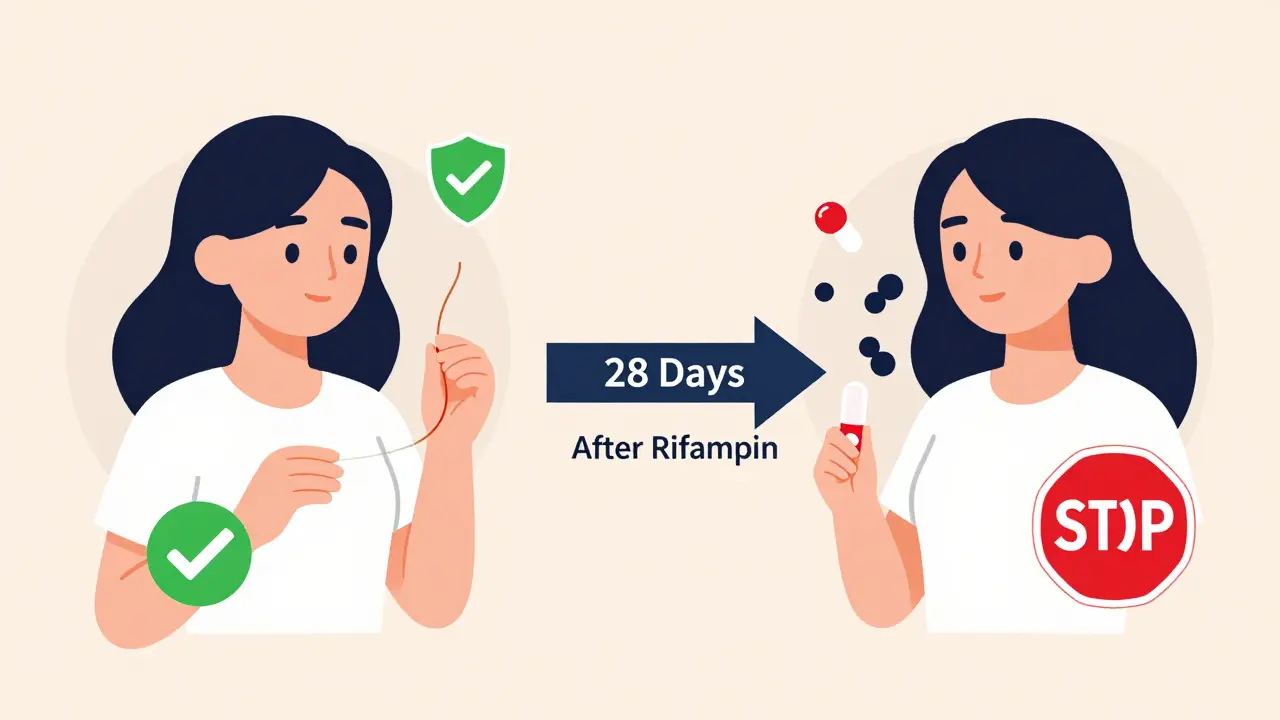
What You Must Do: The 28-Day Rule
If you’re taking rifampin, here’s what you need to do right now:
- Stop relying on your pill, patch, or ring for birth control.
- Use a non-hormonal method - like condoms or a copper IUD - for the entire time you’re on rifampin.
- Keep using that backup method for 28 days after you stop rifampin.
Why 28 days? Because rifampin doesn’t just disappear when you stop taking it. Its effect on liver enzymes lasts for weeks. Even after the drug is gone from your blood, your enzymes are still working overtime. If you go back to your birth control too soon, you’re still at risk.
The CDC says combined hormonal contraceptives are a Category 4 risk with rifampin - meaning they’re unsafe to use together. That’s the highest warning level. The American College of Obstetricians and Gynecologists says the same thing: non-rifamycin antibiotics? Fine. Rifampin? Not okay.
What About Other Birth Control Options?
Not all birth control is created equal when it comes to rifampin. Here’s what works:
- Copper IUD: This is the gold standard. It’s hormone-free, lasts up to 12 years, and isn’t affected by liver enzymes. Perfect for anyone on rifampin.
- Condoms: Reliable if used correctly. Combine with spermicide for extra safety.
- Hormonal IUDs (like Mirena): These release progestin directly into the uterus, so they’re less affected by liver metabolism. But even here, experts still recommend backup for the first few weeks of rifampin use.
- Implants (like Nexplanon): New data from 2023 suggests implants with higher progestin doses (etonogestrel) may still work during rifampin treatment. In a small study of 47 women, none got pregnant. But it’s not enough evidence to rely on alone yet.
- Birth control shots (Depo-Provera): These are injected, so they bypass the liver’s first-pass metabolism. Still, there’s no solid proof they’re safe with rifampin. Use backup.
Bottom line: if you’re on rifampin, go with the copper IUD or condoms. They’re the only methods with zero interaction risk.

Why This Still Isn’t Widely Understood
Even though we’ve known about this for decades, many doctors still don’t talk about it. A 2017 survey found that only 42% of primary care doctors consistently warn patients about rifampin’s effect on birth control. And 28% of them still tell patients to use backup for every antibiotic - which is wrong and causes unnecessary anxiety.
Women themselves are often in the dark. A 2022 study found that 63% of women prescribed rifampin received no proper counseling about contraception. That’s not just a gap - it’s a public health risk.
Part of the problem is that the risk feels small. The baseline failure rate of birth control pills is 1-3% per year. Adding rifampin might raise that to 5-10%, depending on the pill. But for someone who doesn’t want a pregnancy, even a 5% chance is too high.
The Bigger Picture: Global Impact
This isn’t just a problem in Australia or the U.S. It’s a global issue. Ten million people get tuberculosis every year. In places like sub-Saharan Africa, where access to contraception is already limited, rifampin’s interaction creates a dangerous double burden: treating a life-threatening disease while accidentally risking an unintended pregnancy.
The WHO now recommends copper IUDs or implants as first-line contraception for women needing rifampin-based TB treatment. Pharmaceutical companies now test every new birth control product against rifampin before approval. The FDA and EMA require specific interaction studies. That’s how serious this is.
What’s Next? New Treatments, New Hope
There’s good news on the horizon. New TB regimens are being tested that skip rifamycins entirely. One 4-month regimen using rifapentine and moxifloxacin showed promise in a 2022 trial. If approved, it could eliminate this interaction for future patients.
In the meantime, research continues. Scientists are looking at whether ultra-high-dose implants or new progestin compounds can resist rifampin’s effects. Early signs are encouraging, but we’re not there yet.
For now, the rule is simple: if you’re on rifampin, don’t trust your pill. Use a copper IUD or condoms. For 28 days after you stop. No exceptions.
Does rifampin affect all types of birth control?
No. Rifampin only affects hormonal birth control that relies on estrogen and progestin absorbed through the gut - like pills, patches, and rings. It does not affect non-hormonal methods like the copper IUD or condoms. Hormonal IUDs and implants may still work, but experts still recommend backup contraception during rifampin use because data isn’t conclusive.
Can I just take more birth control pills to make up for rifampin?
No. Doubling your pill dose won’t help. Rifampin doesn’t just reduce absorption - it speeds up how fast your liver breaks down the hormones. Taking more pills increases your risk of side effects like nausea, blood clots, or high blood pressure without improving protection. Always use a non-hormonal backup instead.
How long does rifampin’s effect last after I stop taking it?
The enzyme-inducing effects of rifampin can last up to 28 days after your last dose. Even though the drug leaves your system in a few hours, the liver enzymes it activated stay active for weeks. That’s why you need backup contraception for a full month after stopping rifampin.
Is there a birth control method that’s safe to use with rifampin?
Yes. The copper IUD is the safest option - it contains no hormones and isn’t affected by liver enzymes. Condoms are also fully safe. Hormonal IUDs and implants may be okay, but current guidelines still recommend using condoms alongside them during rifampin treatment until more data is available.
Why do some doctors say all antibiotics affect birth control?
This is an old myth that started in the 1970s when early case reports linked birth control failures to penicillin and tetracycline. Later studies proved those links were coincidental. Only rifampin (and possibly rifabutin) has been scientifically proven to interfere. Most doctors now know this, but some still follow outdated advice.