
Real-World Evidence Sources for Drug Safety: How Registries and Claims Data Keep Medications Safe
 Feb, 2 2026
Rare Side Effect Detection Calculator
How Many Patients to Detect a Rare Side Effect
This calculator shows how many patients you'd need to detect a specific side effect using either registries or claims data. Based on FDA guidance, claims data requires larger sample sizes than registries for the same detection confidence.
Results
Based on FDA guidelines: Registries require 50% fewer patients than claims data for the same detection confidence because they provide more complete clinical data (87% lab values vs 52% in claims).
When a new drug hits the market, we assume it’s safe. But clinical trials only involve a few thousand people over a few years. What happens when millions start taking it? That’s where real-world evidence comes in. Registries and claims data are two of the most powerful tools we have to catch rare side effects, track long-term outcomes, and make sure drugs stay safe after approval. These aren’t just backup systems-they’re now central to how regulators and drug makers monitor safety in the real world.
What Real-World Evidence Actually Means
Real-world evidence (RWE) isn’t lab data or controlled trial results. It’s what happens when drugs are used by real people in everyday life. Think of it as watching how a car performs on actual roads, not just a test track. The U.S. Food and Drug Administration (FDA) officially defined RWE in 2018 as clinical evidence drawn from real-world data (RWD)-information collected outside clinical trials. That includes hospital records, insurance claims, patient surveys, and registries tracking specific diseases or treatments. Before 2016, regulators mostly relied on clinical trials. But those trials leave gaps. They often exclude older patients, people with multiple conditions, or those taking other medications. Real-world data fills those gaps. And since the 21st Century Cures Act passed in 2016, the FDA has increasingly used RWE to support drug approvals and safety updates. Between 2017 and 2021, the agency approved 12 drugs or new uses where RWE played a key role. Five of those relied directly on claims or registry data.How Disease and Product Registries Work
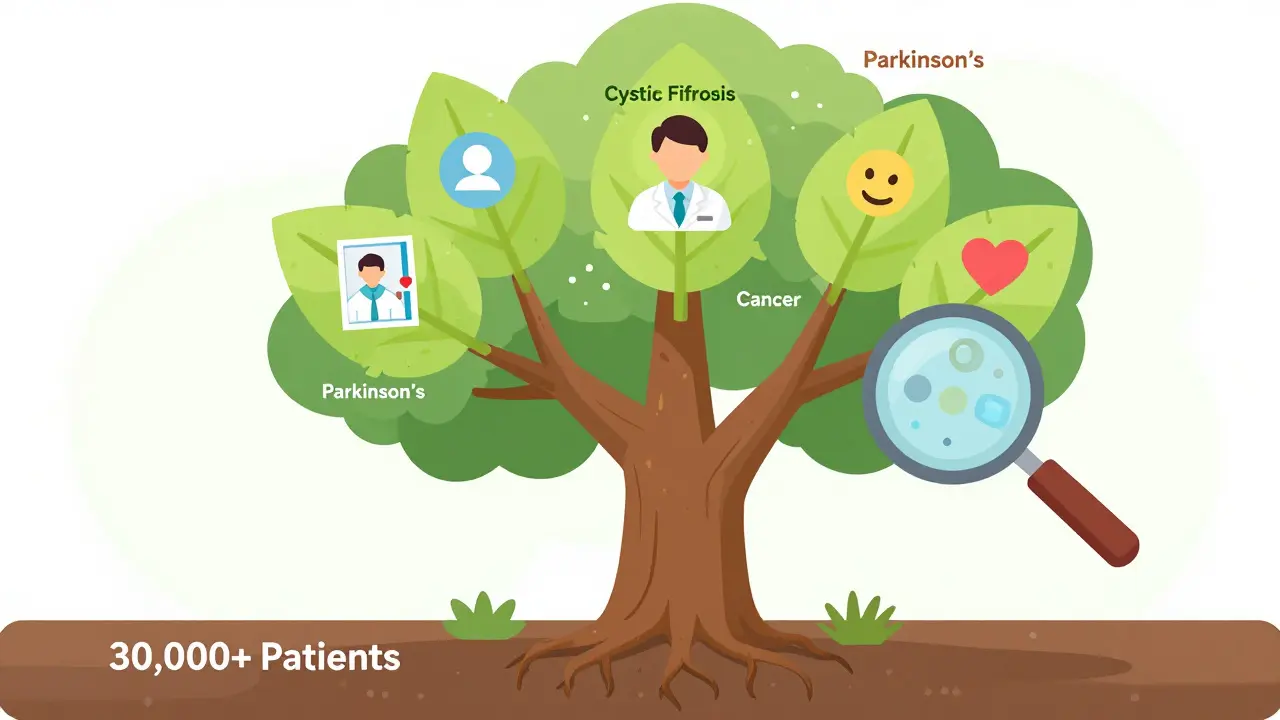
Registries are like living databases for specific patient groups. Some track people with a disease-like cystic fibrosis or Parkinson’s. Others track people using a specific drug, like a new cancer therapy. These aren’t random collections of records. They’re carefully designed systems that collect standardized information: diagnosis codes, lab results, treatment changes, side effects, and even how patients feel day to day. Take the Cystic Fibrosis Foundation Patient Registry. It tracks over 30,000 patients in the U.S. When the drug ivacaftor was approved, clinical trials showed it worked well. But the registry spotted something unexpected: patients with rare CFTR gene mutations had stronger responses than anyone predicted. That insight changed how doctors prescribed the drug. Disease registries vary in size. Some are small, run by a single hospital with a few hundred patients. Others, like the SEER cancer registry, cover nearly half the U.S. population. They’re rich in detail-87% of lab values and imaging results are recorded, compared to just 52% in claims data. But they’re expensive. Setting up a registry takes 18 to 24 months and costs between $1.2 million and $2.5 million. Annual upkeep runs $300,000 to $600,000. And because they rely on voluntary participation, only 60-80% of eligible patients join. That can introduce bias.Claims Data: The Power of Millions of Records
Claims data is what insurance companies collect when they pay for care. Every time someone visits a doctor, fills a prescription, or goes to the hospital, a claim is generated. These claims include diagnosis codes (ICD-10), procedure codes (CPT), and drug codes (NDC). They don’t have detailed lab results or patient stories-but they have scale. IBM MarketScan tracks 200 million lives. Optum covers 100 million. Truven Health has 150 million. Medicare claims alone cover over 60 million Americans. That’s enough data to find rare side effects that clinical trials would never catch. For example, in 2015, the FDA analyzed 1.2 million Medicare records over five years to check if the Parkinson’s drug entacapone increased heart risks. They found no link. Claims data is also long-lasting. Medicare records go back 15+ years. That’s crucial for spotting problems that take years to show up-like bone fractures from long-term osteoporosis drugs or liver damage from chronic pain meds. But claims data has blind spots. Only 45-60% of lab values are recorded. Patient-reported symptoms like fatigue or brain fog? Almost never captured. And coding errors happen. The Agency for Healthcare Research and Quality estimates 15-20% of diagnosis codes are wrong.
Registries vs. Claims Data: When to Use Which
Here’s the simple breakdown:- Use registries when you need deep clinical detail-like tracking how a drug affects patients with rare mutations, or measuring quality of life over time.
- Use claims data when you need big numbers-like detecting a side effect that occurs in 1 in 10,000 patients, or monitoring safety across an entire population.
Regulators Are Taking Notice
The FDA doesn’t just accept RWE-it’s building systems around it. The Sentinel Initiative, launched in 2008, connects 11 major healthcare systems and 3 claims processors to monitor 300 million patient records. In 2022, the FDA reviewed 107 RWE submissions. In 2018, that number was 29. The European Medicines Agency (EMA) launched Darwin EU in 2021 to do the same across Europe. By late 2023, it connected 32 databases across 15 countries, covering 120 million people. These aren’t pilot projects. They’re infrastructure. Dr. Amy Abernethy, former FDA deputy commissioner, said registry studies can provide evidence nearly as strong as randomized trials for safety questions. Dr. Janet Woodcock, former head of FDA’s drug evaluation unit, called claims databases “indispensable” for spotting rare risks. But it’s not all smooth sailing. Dr. Joseph Ross from Yale warns that claims data alone can’t prove cause-and-effect. He found that 22% of safety signals from claims data turned out to be false positives once doctors reviewed actual medical records. That’s why regulators now require statistical methods to fix common biases-like “immortal time bias,” where patients are incorrectly counted as being at risk before they even started the drug. Proper methods reduce that bias by 35-50%.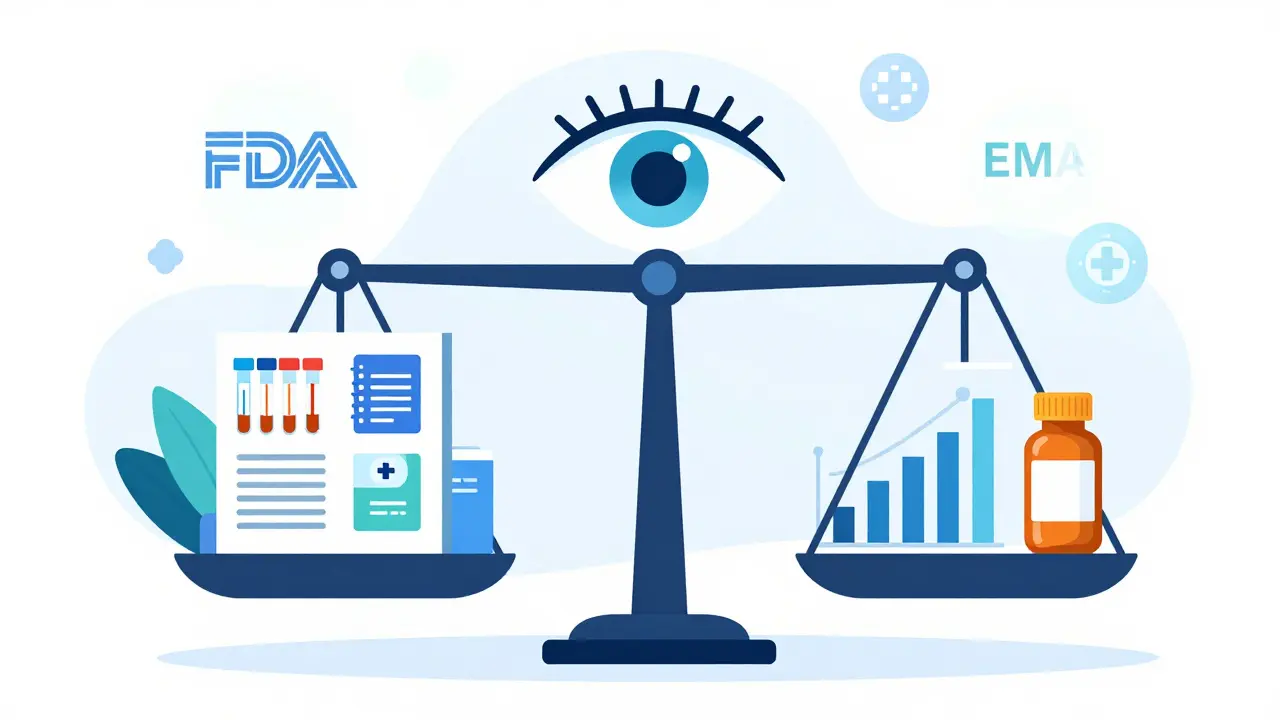
What’s Changing in 2024 and Beyond
The field is moving fast. In January 2024, the FDA released new draft guidance requiring registries to maintain at least 80% data completeness on key variables. That’s a big step toward standardization. New tech is helping too. AI tools now scan millions of records to flag unusual patterns. A 2024 study in JAMA Network Open showed AI cut false safety signals by 28%. Novartis is even combining claims data with wearable device readings-like heart rate and activity levels-to monitor heart failure patients on Entresto. The FDA’s REAL program, launched in 2023, aims to standardize registry data collection for 20 priority diseases by 2026. The first focus? Rare diseases. Why? Because traditional trials can’t recruit enough patients. Registries are the only way to understand safety in these groups.Why This Matters to Patients and Doctors
You might think this is all behind-the-scenes stuff. But it’s not. Every time your doctor prescribes a new medication, they’re relying on data collected from people just like you. If a drug causes a rare liver problem in 1 in 50,000 users, it’s likely that a registry or claims database caught it before the warning went out. For patients with chronic conditions-diabetes, cancer, autoimmune diseases-this means better, safer treatments. For doctors, it means more confidence in prescribing. And for everyone, it means drugs are being watched longer and more closely than ever before. The old model-approve a drug, then wait for complaints-is gone. Today’s system is proactive, data-driven, and built on the real experiences of millions of patients. Registries and claims data aren’t perfect. But together, they’re the most powerful safety net we’ve ever had for medications.What’s the difference between claims data and registry data?
Claims data comes from insurance billing records and includes diagnosis codes, drug prescriptions, and hospital visits. It covers huge populations but lacks detailed clinical info like lab results or patient symptoms. Registry data is collected directly from patients and doctors in structured systems. It’s richer in detail-tracking symptoms, lab values, and outcomes-but covers smaller groups, usually thousands rather than millions of people.
Can claims data detect rare side effects?
Yes, but it needs a large sample size. To reliably detect a side effect that affects 1 in 10,000 people, claims data typically requires at least 1 million patient records. Registries can detect the same signal with half that number because their data is more complete and accurate. That’s why claims data is best for broad, population-level safety checks, while registries are better for targeted, detailed monitoring.
Why do regulators trust claims data if it has coding errors?
Regulators don’t trust it blindly. They use statistical methods to correct for common errors like misclassified diagnoses or missing data. For example, they adjust for “immortal time bias,” where patients are wrongly counted as being at risk before they even started the drug. These corrections can reduce false signals by 35-50%. They also cross-check claims data with other sources like registries or electronic health records to validate findings.
Are registries more reliable than claims data?
It depends on the question. Registries are more reliable for detailed clinical outcomes-like how a drug affects kidney function or patient-reported quality of life. Claims data is more reliable for tracking how many people use a drug, how often they’re hospitalized, or whether deaths increase after a drug launch. Neither is “better”-they answer different questions. The strongest evidence comes from using both together.
How do drug companies use these data sources?
Pharmaceutical companies use registries and claims data for post-market safety monitoring, to support new drug label updates, and to meet regulatory requirements. For example, if a drug is approved for a new group of patients (like older adults or those with kidney disease), companies often submit RWE to prove it’s safe in that population. They now spend 8-12% of their pharmacovigilance budgets on RWE-up from just 3-5% in 2017.
Is real-world evidence replacing clinical trials?
No. Clinical trials are still the gold standard for proving a drug works and is safe before approval. RWE doesn’t replace them-it complements them. Trials answer: “Does this drug work under ideal conditions?” RWE answers: “How does it perform in real life, over time, in diverse populations?” Both are needed. Regulators now use RWE to expand approvals, monitor long-term safety, and update warnings-not to replace initial approval.
Real-world evidence is no longer a side note in drug safety. It’s the backbone of modern pharmacovigilance. Registries and claims data-despite their flaws-are giving us a clearer, more complete picture of how medications affect real people. And as technology improves and global systems like Darwin EU expand, we’ll get even better at catching risks before they become crises.
Hannah Gliane
February 2, 2026 AT 18:47Murarikar Satishwar
February 4, 2026 AT 04:03Akhona Myeki
February 4, 2026 AT 16:10Brett MacDonald
February 5, 2026 AT 02:31phara don
February 5, 2026 AT 10:55Dan Pearson
February 6, 2026 AT 21:56Bob Hynes
February 7, 2026 AT 15:56Eli Kiseop
February 8, 2026 AT 08:51Ellie Norris
February 9, 2026 AT 07:44Marc Durocher
February 10, 2026 AT 19:11Brittany Marioni
February 11, 2026 AT 06:49jay patel
February 13, 2026 AT 06:33Ansley Mayson
February 14, 2026 AT 00:23