
Metformin and Contrast Dye: What You Need to Know About Lactic Acidosis and Kidney Function
 Dec, 10 2025
Metformin Risk Calculator
Check Your Metformin Risk Before Imaging
This tool helps determine if you need to stop metformin before receiving contrast dye for an imaging scan based on your kidney function and scan type.
Why Metformin and Contrast Dye Are a Concern
If you take metformin for type 2 diabetes and need an imaging scan like a CT or angiogram, you’ve probably heard you might need to stop your medication. But here’s the truth: metformin doesn’t automatically put you at risk just because you’re getting contrast dye. The real issue isn’t the dye itself-it’s what happens when your kidneys can’t clear metformin properly.
Metformin is cleared almost entirely by your kidneys. If your kidney function drops-especially after receiving iodinated contrast dye-metformin can build up in your blood. That’s when things get dangerous. Too much metformin can push your body into lactic acidosis, a rare but life-threatening condition where lactic acid floods your bloodstream and your blood becomes too acidic.
It sounds scary. And yes, lactic acidosis has a 40% mortality rate in severe cases. But here’s what most people don’t know: fewer than 10 cases happen per 100,000 people taking metformin each year. That’s rarer than being struck by lightning. The real risk isn’t the contrast dye-it’s having pre-existing kidney problems, heart failure, liver disease, or being over 65.
How Metformin Causes Lactic Acidosis
Metformin works by lowering blood sugar, but it also affects how your cells produce energy. It blocks a key part of the mitochondria-the powerhouse of your cells-called complex I. This forces your body to switch from using oxygen to make energy (aerobic metabolism) to burning sugar without oxygen (anaerobic metabolism). That process produces lactic acid as a byproduct.
Normally, your liver and kidneys clear that acid. But if your kidneys aren’t working well, lactic acid builds up. Combine that with metformin stuck in your system, and you get a double hit: more acid made, less acid removed.
It’s not just metformin alone. The biggest risk comes when you have other problems: heart failure, sepsis, dehydration, or chronic hypoxia. These conditions already stress your body’s ability to handle lactic acid. Add metformin and contrast dye into the mix, and the risk climbs.
Who’s Actually at Risk?
Not everyone needs to stop metformin before a scan. The guidelines changed in 2016 because new evidence showed most people were being over-treated.
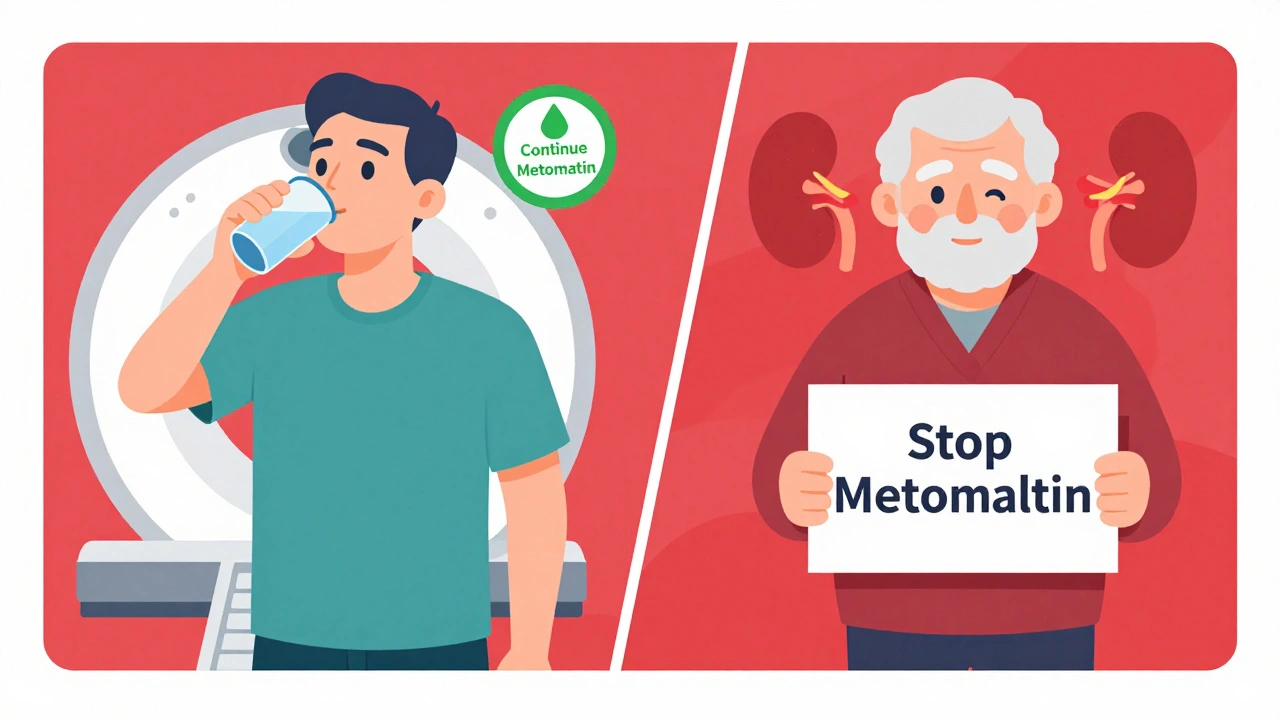
- If your eGFR (kidney function test) is above 60 mL/min/1.73 m²: You can keep taking metformin. No need to stop. No extra tests needed.
- If your eGFR is between 30 and 60: Stop metformin at the time of the scan. Restart only after 48 hours, once your kidney function is checked again and stable.
- If your eGFR is below 30: Metformin is already not recommended. You shouldn’t be on it at all.
There are also other red flags that mean you should stop metformin, even if your kidneys are fine:
- Receiving contrast dye through an artery (like during a heart catheterization)
- Severe heart failure
- Liver disease
- Alcohol use disorder
- Being over 65 with other health issues
For most healthy people under 65 with normal kidney function, the risk of lactic acidosis from contrast dye is so low it’s practically zero. Stopping metformin unnecessarily can cause your blood sugar to spike, leading to hospital visits, dehydration, and worse outcomes than the contrast ever could.
What’s Different Now vs. 10 Years Ago
Before 2016, the rule was simple: stop metformin before any scan using contrast dye, and don’t restart for 48 hours. No exceptions. That meant millions of people with healthy kidneys were taken off a safe, effective drug for no reason.
The American College of Radiology and the National Kidney Foundation reviewed the data and said: enough. Studies showed no spike in lactic acidosis cases in patients with normal kidney function who got IV contrast while staying on metformin. The FDA updated its label. Guidelines changed. Hospitals slowly followed.
Today, about 65% of U.S. hospitals use the updated protocols. But many still stick to the old way-out of habit, fear, or lack of training. That’s why it’s still important to ask your doctor or radiologist: “Do I need to stop metformin based on my kidney function and the type of scan I’m having?”
What Happens During and After the Scan
If you’re in the group that needs to stop metformin:
- Stop taking it at the time of the contrast injection.
- Stay well-hydrated before and after the scan. Water helps your kidneys flush out the dye faster.
- Get a blood test for kidney function (eGFR) 48 hours after the scan.
- If your kidneys are working normally, restart metformin.
- If your kidney function dropped, hold off and talk to your doctor. You may need more time or further testing.
For patients with eGFR above 60, no action is needed. Keep taking your metformin. Drink water. Go about your day.
For high-risk patients-like those with heart failure or severe kidney disease-doctors may consider using a different type of contrast dye (low-osmolar or iso-osmolar) or even skipping contrast altogether if another imaging option exists.
What If Lactic Acidosis Happens?
It’s rare, but it can happen. Symptoms are vague at first: nausea, vomiting, stomach pain, fatigue, rapid breathing, dizziness. By the time someone feels really sick, it’s already serious.
Diagnosis is confirmed with blood tests: high lactate levels, low blood pH, and a high anion gap. Metformin levels can be measured, but they’re not always helpful-by the time you test, treatment has already started.
Treatment is aggressive:
- Stop metformin immediately
- IV fluids to support blood pressure and kidney function
- Correcting acidosis with bicarbonate if needed
- Renal replacement therapy (dialysis) to remove metformin and lactate from the blood
Studies show that patients who get dialysis early have much better survival rates. The faster you remove metformin and fix the acid imbalance, the better your chances.
Most ICU admissions for this condition are in people over 65 with multiple health problems. Young, healthy people on metformin with normal kidneys almost never develop it.
What About Other Diabetes Medications?
Metformin is the only common diabetes drug that carries this specific risk with contrast dye. Other medications like sulfonylureas, GLP-1 agonists, SGLT2 inhibitors, or insulin don’t increase lactic acidosis risk in this context.
If you’re worried about stopping metformin, talk to your doctor about alternatives during the 48-hour window. Insulin is often used temporarily to keep blood sugar stable while metformin is paused.
But remember: don’t switch medications without medical advice. Metformin is still the best first-line treatment for type 2 diabetes worldwide, with decades of safety data and proven heart benefits.
The Bigger Picture: Why This Matters
Over 150 million metformin prescriptions are filled each year in the U.S. alone. That’s millions of people who need imaging scans for cancer, heart disease, or trauma. If every single one stopped their medication unnecessarily, we’d see more cases of high blood sugar, diabetic ketoacidosis, and hospitalizations than we would from lactic acidosis.
The shift in guidelines isn’t just about saving time or convenience. It’s about evidence-based medicine. It’s about not treating every patient like they’re at high risk when most aren’t.
Doctors are learning to think in terms of risk stratification-not blanket rules. Your kidney function, your age, your other conditions, the type of scan-all of it matters. One-size-fits-all is outdated.
And the future? More personalized care. Researchers are now looking at genetic factors that might make some people more prone to lactic acidosis. Soon, we might be able to test for those risks before even giving contrast.
Bottom Line: What You Should Do
Don’t panic. Don’t assume you need to stop metformin. Do this:
- Know your eGFR. Ask your doctor for your latest kidney function number.
- If it’s above 60: Keep taking metformin. No changes needed.
- If it’s between 30 and 60: Stop metformin the day of your scan. Restart only after 48 hours and a follow-up kidney test.
- If you’re having an arterial contrast study (like a heart cath): Stop metformin, regardless of kidney function.
- Stay hydrated before and after the scan.
- Report any unusual symptoms like nausea, rapid breathing, or extreme fatigue after the scan.
Metformin saved millions of lives. Contrast dye saves millions more. Together, they’re not a threat-they’re tools. The key is using them wisely, based on real data, not fear.
Jean Claude de La Ronde
December 11, 2025 AT 22:56also who wrote this? the guy who thinks ‘lactic acidosis’ is a new energy drink?
Courtney Blake
December 12, 2025 AT 13:16Kristi Pope
December 12, 2025 AT 14:17Doris Lee
December 13, 2025 AT 19:03Raj Rsvpraj
December 14, 2025 AT 01:52Jack Appleby
December 15, 2025 AT 01:31Frank Nouwens
December 15, 2025 AT 23:52Kaitlynn nail
December 16, 2025 AT 09:00Aileen Ferris
December 16, 2025 AT 21:46