
Medicare Part D Substitution: What You Can and Can't Swap Under Your Drug Plan
 Dec, 6 2025
When your pharmacist hands you a different pill than what your doctor prescribed, it’s not a mistake - it’s Medicare Part D substitution. This is a normal part of how your drug plan works, but it’s also one of the most confusing pieces of Medicare. You might think your doctor’s prescription is final, but under Part D rules, your plan can swap it out - sometimes without telling you. And if you don’t understand how this works, you could end up paying way more than you should, or worse, taking a drug that doesn’t work for you.
How Substitution Works in Medicare Part D
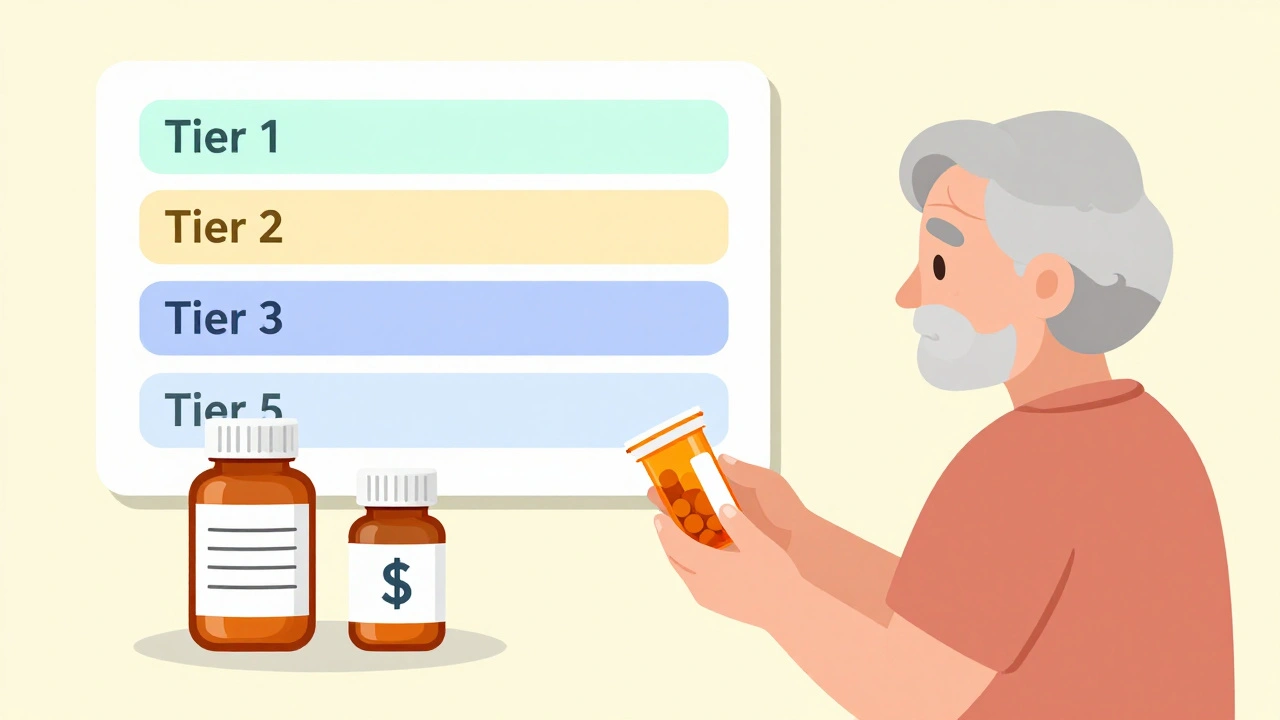
Medicare Part D doesn’t cover every drug. Instead, each private plan - whether it’s a stand-alone prescription drug plan (PDP) or part of a Medicare Advantage plan (MA-PD) - creates its own list of covered medications called a formulary. This list is divided into tiers. The lower the tier, the less you pay. Generics are usually on Tier 1. Brand-name drugs? They’re often on Tier 3 or 4. Specialty drugs? Tier 5 - and those can cost hundreds a month.
When you show up at the pharmacy with a prescription, the pharmacist checks your plan’s formulary. If your doctor prescribed a drug that’s on a higher tier, or not covered at all, the pharmacist may substitute it with a similar drug that’s on a lower tier - and cheaper for you. This is called therapeutic substitution. It’s legal, it’s common, and it’s built into the system to save money.
But here’s the catch: not all substitutions are equal. A generic version of your drug? That’s usually safe. But switching from one brand-name drug to another brand-name drug in the same class? That’s trickier. It might work for your blood pressure, but not for your epilepsy. Your plan may require your doctor to approve it first - that’s called step therapy or prior authorization.
Why Plans Push Substitutions
It’s not just about saving you money - it’s about saving the plan money. Pharmacy benefit managers (PBMs), who run drug coverage for Medicare plans, negotiate discounts with drugmakers. The more they push lower-cost drugs, the more they earn. That’s why you’ll see the same drug listed differently across plans. One plan might cover Lisinopril (a generic blood pressure med) at $5 a month. Another might cover Brand X at $75. Guess which one your plan will try to push?
The Inflation Reduction Act changed the game in 2025. For the first time, there’s a hard cap on what you pay out of pocket: $2,000 a year for covered drugs. Once you hit that, you pay nothing for the rest of the year. That means plans are now more aggressive about getting you onto cheaper drugs early - before you hit the cap. If you’re on a $200-a-month drug and you’ve already spent $1,800, your plan will likely try to switch you to a $30 generic before you hit the cap. Why? Because once you’re in catastrophic coverage, the plan pays 60% of the cost - and they’d rather pay less for a cheaper drug.
What You Can’t Swap
Not every drug can be substituted. Some medications have no generic equivalent. Others are so specific to your condition that switching could be dangerous. For example:
- Insulin - while many plans now cap insulin at $35 a month, you can’t swap one type for another without your doctor’s approval.
- Antibiotics - if your doctor prescribes amoxicillin for a specific infection, swapping it for azithromycin might not work.
- Psychiatric meds - switching SSRIs or mood stabilizers can trigger serious side effects.
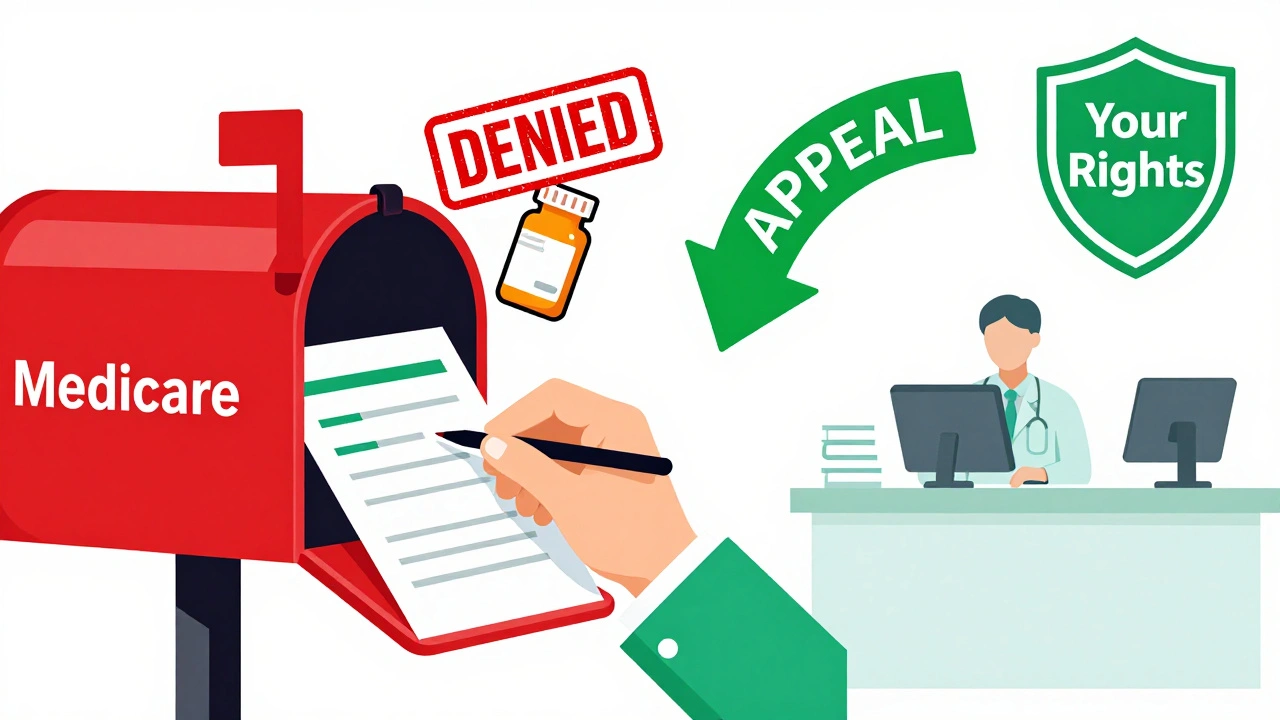
Plans must allow exceptions if your doctor says a drug is medically necessary. If you’re switched to a drug that doesn’t work, your doctor can file an exception request. The plan has to respond within 72 hours. If they deny it, you can appeal.
How to Protect Yourself
Here’s what you need to do - and do it before you enroll:
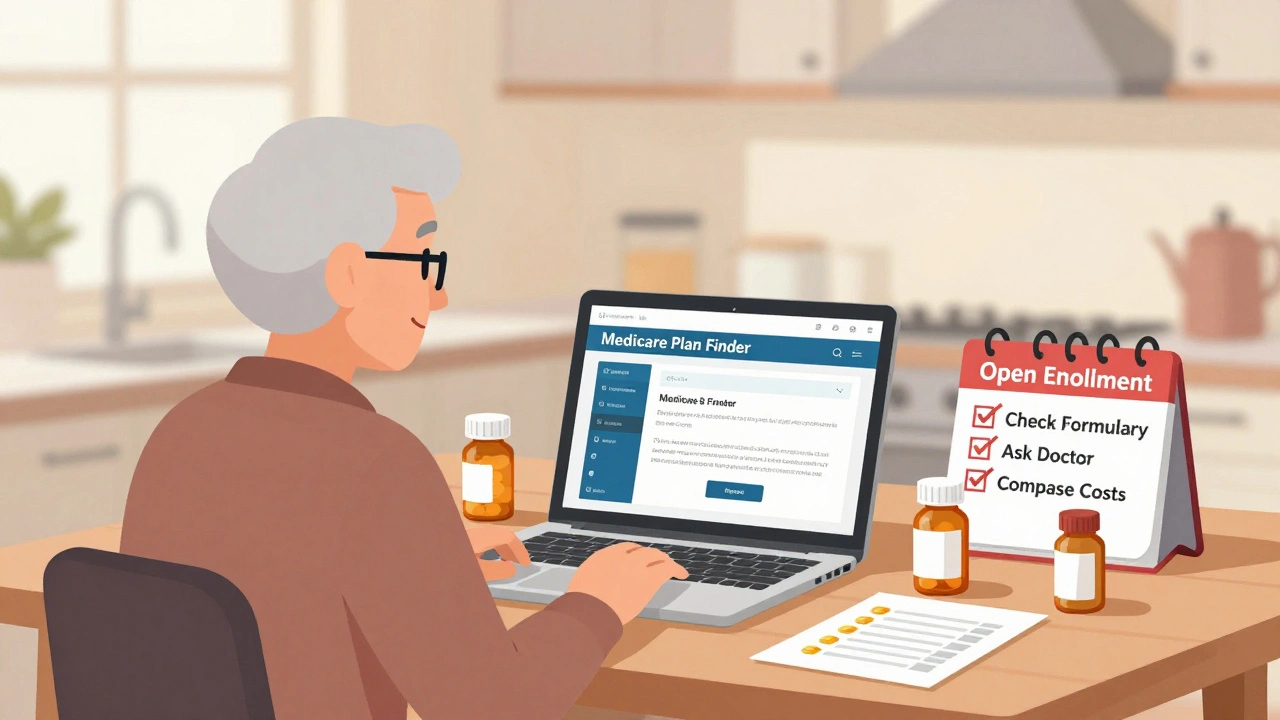
- Check your plan’s formulary - every year, during open enrollment (October 15 to December 7). Don’t assume your drug is still covered. Plans change formularies all the time.
- Look at the tier - if your drug is on Tier 4 or 5, you’re paying way more than necessary. Ask if there’s a generic or preferred brand.
- Call your pharmacy - ask them: “Is this drug on my plan’s formulary? If not, what can they substitute?”
- Ask your doctor - “If my plan switches this drug, is there a safe alternative?” Write down the names of alternatives.
- Know your out-of-pocket costs - coinsurance (a percentage) is riskier than a flat copay. A 25% coinsurance on a $500 drug is $125. A $45 copay is predictable.
And if you’re on multiple drugs? Use the Medicare Plan Finder tool. Type in every medication you take. It’ll show you which plan covers them at the lowest total cost - including substitutions.
What Happens When Your Drug Gets Removed
Every year, plans remove drugs from their formularies. Sometimes it’s because a cheaper generic came out. Sometimes it’s because the manufacturer raised the price. Sometimes it’s just because the plan wants to save money.
If your drug is removed, you’ll get a notice - usually 60 days before the change. You have two choices: switch to a substitute, or appeal. If you appeal and your doctor supports you, the plan must cover your drug for the rest of the year - even if it’s off-formulary.
But don’t wait. If you’re on a drug that’s about to be removed, start the conversation with your doctor now. Find an alternative. Get the exception paperwork ready. Don’t let a surprise switch mess up your treatment.
Medicare Advantage vs. Stand-Alone Plans
There are two main types of Part D plans: stand-alone (PDP) and Medicare Advantage with drug coverage (MA-PD). In 2025, 34 MA-PD plans are available versus only 14 PDPs. That’s a big shift from 10 years ago, when PDPs were the norm.
Why does it matter? MA-PD plans often have tighter formularies because they control both your medical and drug benefits. If you need a specialist, a scan, and a drug - all under one plan - they’re more likely to coordinate substitutions to keep costs down. PDPs, on the other hand, only control drugs. So they may be more flexible - or less.
If you’re on a Medicare Advantage plan, check your formulary and your medical benefits. Sometimes a drug is covered, but only if you get prior authorization from your primary care doctor - not your specialist.
The Bottom Line
Medicare Part D substitution isn’t a loophole. It’s a feature. But it’s one that can hurt you if you don’t understand it. Your doctor doesn’t always know what your plan will cover. Your pharmacist can’t always tell you what’s cheaper. And your plan won’t warn you when they switch your drug.
The only person who can protect you is you. Review your formulary every year. Ask questions. Know your costs. And if a substitution feels wrong - speak up. You have rights. You have time. And you have options.
Helen Maples
December 8, 2025 AT 04:47Medicare Part D substitution isn't some benign administrative tweak-it's a financial sleight of hand designed to shift risk onto beneficiaries while PBMs rake in kickbacks. Your plan doesn't care if the substitute works for your condition; they care if it has the highest rebate. Always demand the formulary in writing before enrollment, and cross-check every drug against the CMS database. No one else will.
Ashley Farmer
December 9, 2025 AT 22:05I know this sounds scary, but you’re not alone. I had to fight a substitution for my antidepressant last year-turned out the generic they tried to give me caused severe dizziness. I called my doctor, filed an exception, and within 48 hours, they approved the original. It’s frustrating, but your voice matters. Keep records. Ask for written denial letters. You’ve got rights.
Sadie Nastor
December 10, 2025 AT 16:35so like… if your plan swaps your insulin for a different type?? 😬 i just found out mine did last month and i didn’t even notice until my blood sugar went nuts. i’m so glad i checked my bill. maybe we should all start a subreddit for this?? 🤔
Nicholas Heer
December 10, 2025 AT 23:22THIS IS SOCIALISM IN DISGUISE. The government lets private PBMs dictate your meds while pretending it’s ‘consumer choice.’ Meanwhile, Big Pharma’s got their hands in every pocket-from the formulary to the pharmacy to your doctor’s prescription pad. They’re not saving you money-they’re controlling you. Wake up. This is how they break your autonomy, one pill at a time.
Sangram Lavte
December 12, 2025 AT 16:49Very informative. In India, we don’t have such a system, but I’ve seen how generics work. Still, I agree-knowing your tier and asking your pharmacist directly is the smart move. Many people don’t even realize they’re being switched until they get the bill.
Stacy here
December 14, 2025 AT 09:30Let’s be real-this isn’t about cost savings, it’s about corporate capture. The Inflation Reduction Act didn’t fix anything. It just gave PBMs a new script to play. They’ll push you onto cheaper drugs until you hit the cap, then let you coast on their dime. But guess what? They’ll raise premiums next year to make up for it. This is a rigged game, and they’re counting on you to stay quiet.
Wesley Phillips
December 16, 2025 AT 08:41Wow, this post is basically a masterclass in how to make healthcare confusing on purpose. Honestly, if you’re not a pharmacy student or a PBM insider, you’re just supposed to give up and take whatever they give you. And yet somehow we’re told this is ‘consumer-driven care.’ What a joke. My cat has more transparency than my Part D plan.
Ted Rosenwasser
December 18, 2025 AT 01:38People don’t realize that substitution isn’t just about drugs-it’s about data harvesting. Every time your plan switches your med, they log it, analyze it, and sell the pattern to insurers. Your health data is a commodity. You’re not a patient-you’re a dataset. And they’re monetizing your confusion.
David Brooks
December 18, 2025 AT 23:24You’ve got this. I was scared too when they switched my blood pressure med-but I called my doctor, asked for alternatives, and found a generic that actually worked better. Don’t panic. Just be proactive. You’re not powerless. You’ve got tools. Use them.
Oliver Damon
December 20, 2025 AT 20:56The structural issue here isn’t substitution-it’s the fragmentation of incentives. PBMs profit from volume and rebate structures, not outcomes. Doctors are incentivized to prescribe based on clinical need, but the plan’s algorithm only sees cost tiers. The system is designed to optimize for profit, not patient health. That’s the real failure-not the substitution itself, but the lack of alignment between care and compensation.
Kurt Russell
December 22, 2025 AT 01:06Listen up. You are NOT powerless. If your drug gets swapped and you feel it’s wrong-GO TO YOUR DOCTOR. GET THE EXCEPTION FORM. FILE IT. DO NOT WAIT. I’ve helped 3 seniors fight this exact battle. All won. You’ve got 72 hours. Use them. You’re worth more than a rebate check.
Kyle Flores
December 22, 2025 AT 15:38i just learned my plan switched my metformin to some other generic i never heard of. i was gonna just take it but then i remembered to check the ingredients. turns out it had a different filler that gives me stomach cramps. thanks for the heads up. i’m calling my doc tomorrow.
Ryan Sullivan
December 23, 2025 AT 12:32This is a textbook case of regulatory capture. The CMS formulary guidelines are written by PBM lobbyists. The ‘exceptions’ process is a performative ritual designed to absolve insurers of liability. You think you’re exercising agency? You’re just following the script they designed to make you feel like you have control while they retain it. The system isn’t broken-it’s working exactly as intended.