
How to Use Patient Assistance Programs When No Generic Medication Exists
 Jan, 3 2026
When a life-saving medication has no generic version, the price can feel impossible. Some drugs cost more than $10,000 a month. If you’re paying out of pocket, that’s not just expensive-it’s devastating. But there’s a way forward: patient assistance programs (PAPs). These aren’t charity handouts. They’re structured, legal programs run by drugmakers, nonprofits, and sometimes states to help people get the medicines they need when there’s no cheaper alternative.
Why PAPs Matter When No Generic Exists
Generic drugs cut costs by 80% or more. But when a drug has no generic-like Soliris for rare blood disorders, Tasigna for leukemia, or certain HIV and cancer treatments-you’re stuck with the brand-name price tag. These drugs often cost $500,000 a year or more. Without help, many patients skip doses, split pills, or stop treatment entirely. That’s not just risky-it’s deadly. PAPs exist because pharmaceutical companies know this. In 2022 alone, these programs gave out $4.7 billion in free or discounted drugs. Most of that went to patients needing brand-name medications with no alternatives. For people without insurance, PAPs often mean the difference between getting the medicine and losing everything.How PAPs Actually Work
Not all PAPs are the same. There are three main types:- Manufacturer-sponsored (65% of programs): Run by drug companies like Novartis, Gilead, or Eli Lilly. These usually cover 100% of the drug cost if you qualify.
- Foundation-sponsored (25%): Nonprofits like the Patient Access Network Foundation or Chronic Disease Fund. They help people with insurance who still can’t afford copays.
- State programs (10%): Like Pennsylvania’s PACE for seniors. These have lower income limits but also lower assistance amounts.
- Have no insurance or be underinsured
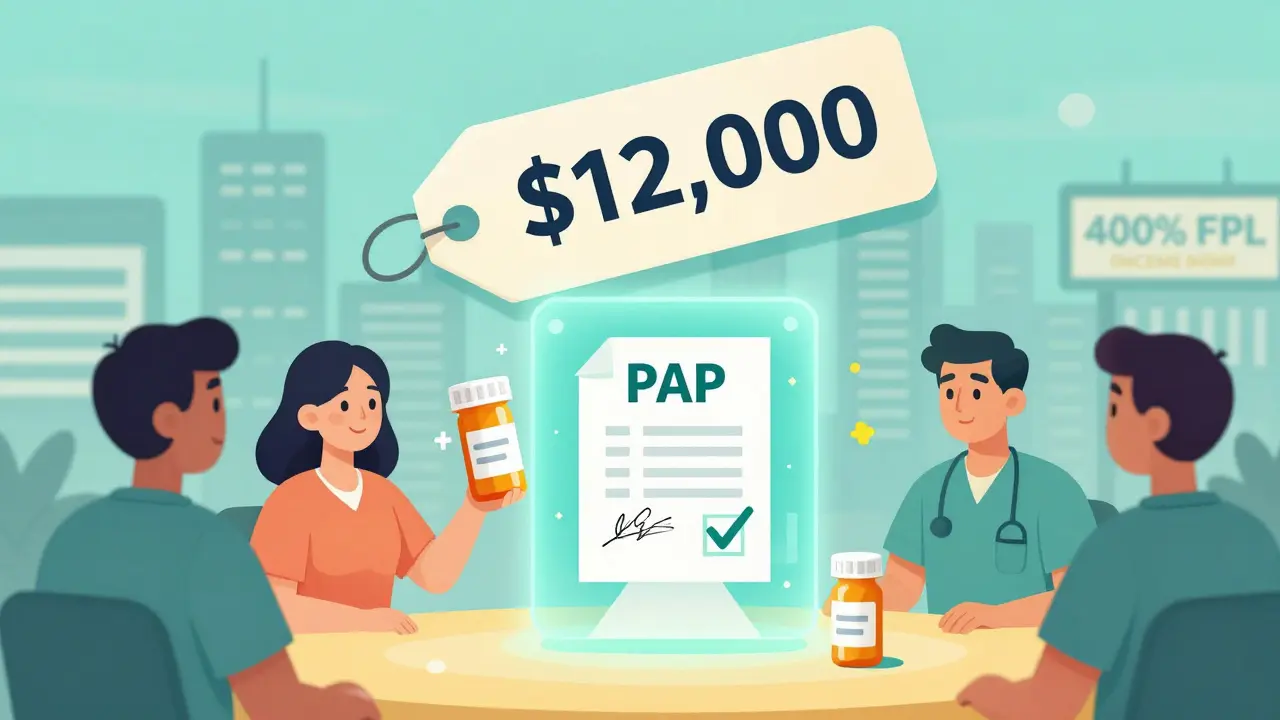
- Make less than 400% of the Federal Poverty Level ($60,000/year for one person in 2023)
- Have a valid prescription
- Get your doctor to sign paperwork
Who Can Use PAPs? The Real Eligibility Rules
Many people assume PAPs are only for the uninsured. That’s partly true-but not the whole story.- Uninsured patients: These are the primary beneficiaries. About 89% of PAP users have no insurance. For them, PAPs often mean $0 monthly costs.
- Insured patients: If your insurance doesn’t cover the drug, or your copay is still too high, you might qualify. But here’s the catch: most insurance plans now use accumulator adjustment policies. That means even if a PAP pays your drug cost, it doesn’t count toward your deductible or out-of-pocket maximum. So you could get free medicine but still owe thousands in other medical bills.
- Medicare patients: Since January 2020, Medicare Part D beneficiaries can’t use manufacturer copay assistance. That’s federal law. But you can still apply for foundation-sponsored PAPs, which aren’t blocked by this rule.
The Big Problem: Accumulator Programs
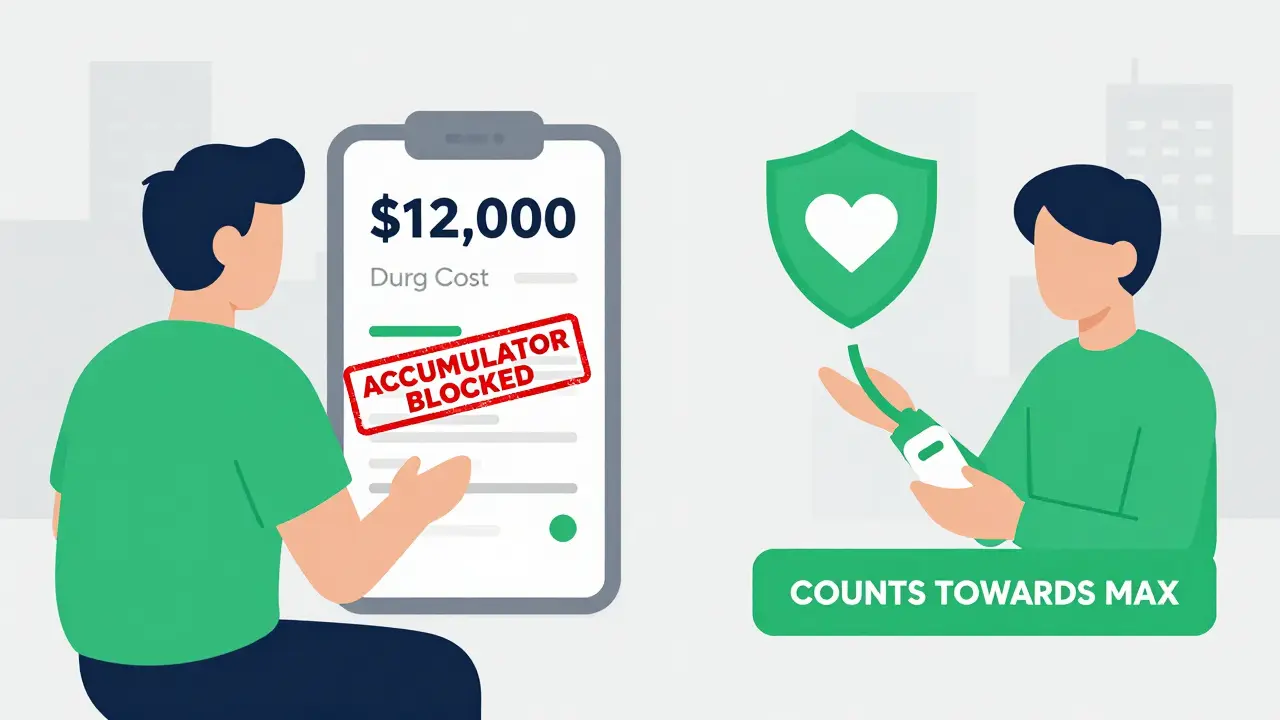
This is the hidden trap most patients don’t know about until it’s too late. Big pharmacy benefit managers (PBMs)-like Express Scripts and Optum-run the insurance networks for most employers and insurers. Since 2020, 78% of them have implemented accumulator adjustment policies. Here’s what that means:- You get approved for a PAP that covers your $12,000/month cancer drug.
- The drug company sends $12,000 to your pharmacy.
- Your insurance says: “Thanks, but we’re not counting that toward your deductible.”
- You still owe $12,000 out-of-pocket to meet your plan’s annual max.
How to Apply: A Step-by-Step Guide
Applying for a PAP isn’t like signing up for a coupon. It’s a process. But it’s doable if you take it one step at a time.- Find the right program. Go to RxHope.org or NeedyMeds.org. These sites let you search by drug name and instantly show which PAPs cover it. They cover 92% of all manufacturer programs.
- Check eligibility. Use their free online screener. It takes 5 minutes. It’ll tell you if you qualify based on income, insurance, and drug.
- Gather documents. You’ll need: your most recent tax return or W-2, a copy of your prescription (on doctor’s letterhead), proof of income (pay stubs or unemployment letter), and a signed physician attestation form. Your doctor’s office can help with this.
- Submit the application. Most programs accept online applications. Some still require fax or mail. Keep a copy of everything.
- Follow up. Manufacturer PAPs usually respond in 7-10 days. Foundation programs take 2-3 weeks. If you don’t hear back, call. Don’t wait.
What If You’re on Medicare?
If you’re on Medicare Part D, you can’t use drugmaker copay cards. But you’re not out of options.- Apply for a foundation PAP. They don’t follow the same rules.
- Check if your state has a Pharmaceutical Assistance Program (SPAP). Some states help seniors with high drug costs.
- Ask your doctor about alternative drugs. Sometimes, a different brand-name drug in the same class has a PAP.
- Apply for Extra Help (Low-Income Subsidy) through Medicare. If you qualify, you’ll get lower premiums and copays.
Real Stories: What It’s Like to Use a PAP
One patient in Ohio had chronic myeloid leukemia. Her drug, Tasigna, cost $14,000 a month. She had insurance, but her copay was $1,400. She couldn’t afford it. After three months of skipping doses, she applied for Novartis’s PAP. She spent 11 hours over three weeks gathering documents and talking to her doctor. When approved, her cost dropped to $0. She stayed on treatment. Her cancer stayed in remission. Another patient in Texas had HIV. His medication cost $15,000 a month. He had no insurance. He was about to lose his apartment. He applied for Gilead’s Advancing Access program. He got approved in 12 days. His rent stayed paid. His viral load dropped to undetectable. But not everyone wins. One woman in Florida applied for a PAP for her $12,000/month cancer drug. She got approved. Then her insurance told her the PAP payment didn’t count toward her deductible. She ended up paying $20,700 out-of-pocket that year. She didn’t know about accumulator rules until it was too late.What to Do If You Can’t Get Help
If you’ve tried everything and still can’t get into a PAP, here’s what else you can try:- Ask your doctor for samples. Many clinics still have free drug samples. It won’t last forever, but it can buy you time.
- Use GoodRx. It won’t help much with brand-name drugs without generics-it only saves about 8% on average. But if you’re paying cash, it’s better than nothing.
- Call the drugmaker directly. Sometimes, their patient support line can bypass the formal PAP and offer emergency help.
- Reach out to nonprofits. Organizations like the Patient Advocate Foundation and CancerCare offer case managers who can help you navigate PAPs, insurance appeals, and financial aid.
What’s Changing in 2026
The rules are shifting. The Inflation Reduction Act banned manufacturer copay assistance for Medicare Part D patients starting January 2025. That means more pressure on nonprofit PAPs. Drugmakers are responding by making applications simpler. Eli Lilly’s “Simple Bridge” program for insulin cuts the application from 17 steps to just 5-and approves in 48 hours. More hospitals are hiring patient navigators-specialists whose only job is to help people get into PAPs. By 2023, 98% of U.S. hospitals had these roles. If your doctor’s office doesn’t have one, ask them to connect you with a local nonprofit. The future of PAPs isn’t perfect. They’re a band-aid on a broken system. But right now, for people who need a drug with no generic, they’re the only thing standing between them and giving up.Can I use a patient assistance program if I have insurance?
Yes, but only under certain conditions. If your insurance doesn’t cover the drug at all, or your copay is still too high, you may qualify. However, most insurance plans now use accumulator adjustment policies, which means the PAP payment won’t count toward your deductible or out-of-pocket maximum. In these cases, foundation-sponsored PAPs (not drugmaker ones) are your best option because they’re not affected by accumulator rules.
Do I need to be unemployed to qualify for a PAP?
No. You don’t need to be unemployed. Most programs use income as the main factor, not employment status. You can work full-time and still qualify if your income is below 400% of the Federal Poverty Level. For example, a single person making $55,000 a year may still be eligible. What matters is your total household income, not whether you have a job.
How long does it take to get approved for a PAP?
Manufacturer-sponsored PAPs usually approve applications in 7-10 business days. Foundation-sponsored programs take longer-typically 14-21 days-because they review more paperwork and have limited funding. If you’re in a medical emergency, call the program directly. Many can fast-track approvals with a doctor’s note.
Can I apply for PAPs for multiple drugs at once?
Yes. Many patients need more than one expensive medication. You can and should apply for PAPs for each drug separately. Each program has its own application, but tools like RxHope.org let you apply for multiple drugs at once using the same portal. Just make sure each application has the correct prescription and income documents.
What if my PAP application gets denied?
Don’t give up. About 41% of initial applications are denied-but many are approved on appeal. Common reasons for denial include missing documents, income documentation that’s outdated, or incomplete physician forms. Call the program to find out why you were denied. Fix the issue, resubmit, and ask for a review. Some programs have a formal appeals process. The Patient Advocate Foundation offers free help with appeals.
Are PAPs only for U.S. citizens?
No. Most PAPs require proof of U.S. residency, not citizenship. Legal permanent residents, refugees, and people with valid visas can qualify. You’ll need to show a U.S. address and proof of income. Some programs may ask for a Social Security number, but if you don’t have one, you can often provide an Individual Taxpayer Identification Number (ITIN) instead.
Can I switch PAPs if my situation changes?
Yes. If you get insurance, lose income, or your current PAP ends, you can apply for a different one. Some patients start with a manufacturer PAP, then switch to a foundation PAP if they get insurance with an accumulator policy. Others move from a foundation PAP to a manufacturer program if their income drops. PAPs are designed to adapt to your changing needs.
Jay Tejada
January 5, 2026 AT 05:10So you're telling me the system literally rewards insurance companies for letting people die slowly? Cool. I'll just keep my $12k/month cancer drug and my $20k deductible. Thanks, capitalism.
Stephen Craig
January 7, 2026 AT 04:54Documentation is the real drug. 17 forms, 3 letters, 2 pay stubs, and still no guarantee. The system is designed to exhaust you before it helps you.
Connor Hale
January 7, 2026 AT 16:18I’ve seen this play out in my hospital. Patients cry in the parking lot after getting approved-because they finally won the lottery of bureaucracy. It shouldn’t be this hard to stay alive.
Cassie Tynan
January 8, 2026 AT 05:08Let me get this straight: the same companies that price-gouge you are now your saviors? I’m not buying the ‘charity’ angle. This is PR with a side of guilt.
Michael Rudge
January 8, 2026 AT 11:13Oh look, another sob story about how rich people can’t afford $10k/month pills. Maybe don’t pick a career that requires $500k/year meds? Just a thought.
Vikram Sujay
January 10, 2026 AT 10:13The moral architecture of this system reveals a deeper truth: when life-saving medicine becomes a commodity, human dignity becomes a negotiable variable. The PAPs are not solutions-they are ethical bandages on a systemic hemorrhage.
One cannot speak of charity when the very structure of the market necessitates it. The pharmaceutical industry does not merely profit from illness-it institutionalizes dependency.
That a patient must navigate seventeen forms to remain alive is not inefficiency-it is design. The state, the insurer, the manufacturer-all conspire in the architecture of exclusion.
And yet, we praise the nonprofits who fill the gaps. We call them heroes. But heroes should not be required to patch holes in a sinking ship while the crew laughs from the deck.
What if we stopped asking how to survive the system, and began asking how to dismantle it?
There is no dignity in being saved by a corporate goodwill program. There is only shame in being forced to beg for the right to breathe.
Let us not confuse compassion with justice. One is a favor. The other is a right.
Chris Cantey
January 11, 2026 AT 21:32Every time I see one of these posts, I wonder: how many people died while waiting for a fax to go through? How many families lost their homes because the PAP took 18 days? We’re not talking about convenience here. We’re talking about death by paperwork.
bob bob
January 12, 2026 AT 10:49My cousin got approved for a PAP after 6 months and 3 appeals. She’s alive now. But she’s also in debt up to her eyeballs. The system doesn’t care if you live-it just wants you to jump through the right hoops.
Rory Corrigan
January 13, 2026 AT 11:13Life is a glitch in the system, man. 😔 But hey, at least the PAPs are kinda like a secret cheat code? If you know the right websites, you can unlock free drugs. Just don’t ask how the game was designed to make you need it in the first place…
Jack Wernet
January 14, 2026 AT 02:01As someone who has worked with refugee communities in the U.S., I can confirm: many non-citizens are eligible for PAPs, yet fear applying due to immigration concerns. The lack of clear, multilingual guidance is a silent killer.
Catherine HARDY
January 15, 2026 AT 13:21Did you know the same companies running PAPs also lobby against drug price caps? And that the accumulator rules were created by PBMs who own half the insurance companies? This isn’t a loophole-it’s a trapdoor.
Peyton Feuer
January 16, 2026 AT 20:04just applied for a pap for my dad’s meds… took 3 weeks and i still dont know if it went through. my doc’s office said ‘we do this every day’ but they never called back. i’m so tired.
Justin Lowans
January 17, 2026 AT 08:42The elegance of this system lies in its cruel paradox: it provides salvation only to those who survive the gauntlet. The real innovation here isn’t the drug-it’s the psychological endurance required to access it.
Let us not mistake compassion for structural reform. We applaud the nonprofit that delivers the medicine, while ignoring the architect who built the prison.
There is no moral victory in being granted a reprieve by the very entity that created your suffering.
Uzoamaka Nwankpa
January 17, 2026 AT 22:38My sister died waiting for a PAP approval. They said she didn’t have ‘enough documentation.’ She was 32. I still have the fax confirmation page. It’s framed. I look at it every night.
Roshan Aryal
January 19, 2026 AT 16:49Why do Americans act like this is normal? In India, we have a national health program that covers 80% of cancer drugs. You people built the most advanced medical system on Earth… and still can’t give your own citizens insulin without a PhD in bureaucracy?
It’s not a crisis. It’s a choice. And you chose profit.