
How to Store Inhalers and Nebulizer Medications Safely: Temperature, Humidity, and Common Mistakes
 Feb, 9 2026
When your inhaler or nebulizer stops working during an asthma attack, it’s rarely because the medication ran out. More often, it’s because it was stored wrong. Heat, moisture, or even a car dashboard can ruin your rescue medication before you even need it. And if you’re relying on it to breathe, that’s not just inconvenient - it’s dangerous.
Why Storage Matters More Than You Think
Inhalers and nebulizer solutions aren’t like pills you can toss in a drawer. They’re precision devices with liquid or powder formulations that break down under the wrong conditions. The American Lung Association found that improperly stored inhalers contribute to about 12% of treatment failures during acute asthma episodes. That means one in eight times someone can’t get relief, it’s because their inhaler was left in a hot car, a humid bathroom, or a gym bag in the sun. The science behind this is clear. Pharmaceutical manufacturers test their products under strict conditions set by the International Council for Harmonisation (ICH). These guidelines, adopted by the FDA and EMA, define how stable a medication remains over time. If you store your inhaler outside those limits, you’re not just reducing its effectiveness - you might be getting zero relief.Temperature Rules: What’s Safe and What’s Not
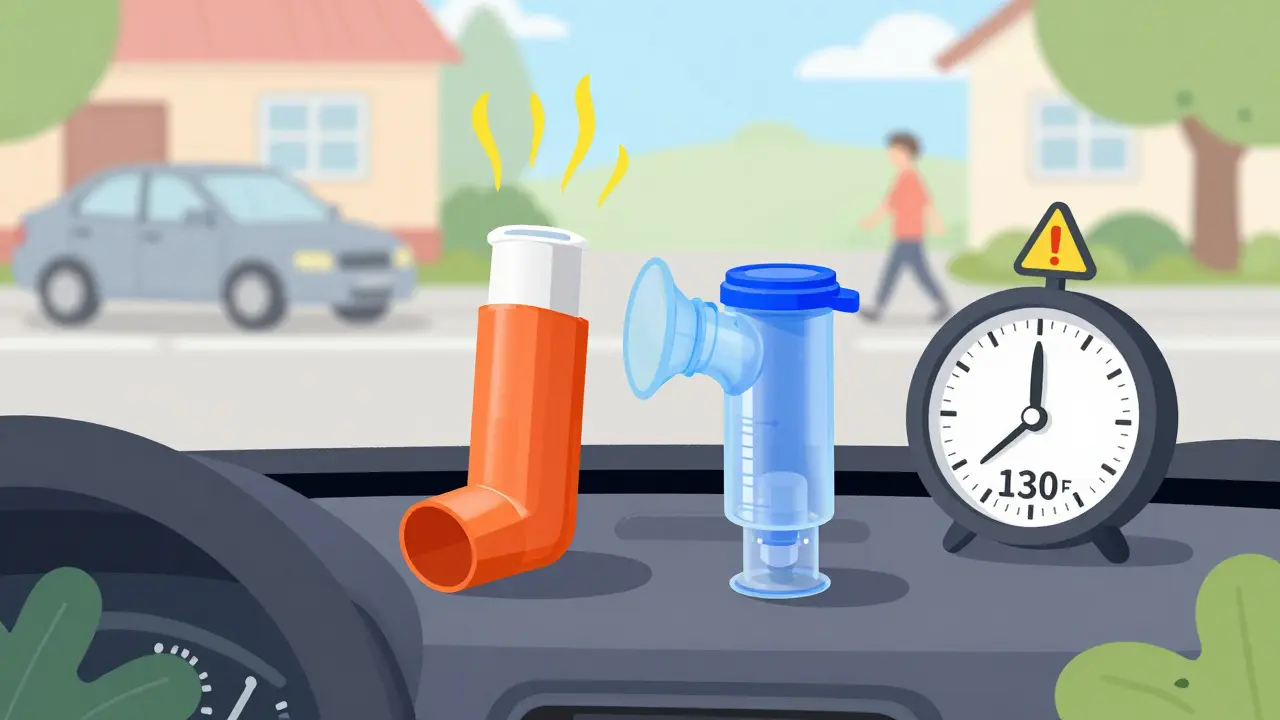
Most inhalers need to be kept between 59°F and 77°F (15°C to 25°C). That’s room temperature - not too cold, not too hot. But here’s the catch: different types have different needs.- Pressurized metered-dose inhalers (pMDIs) like ProAir HFA or Ventolin HFA: Keep them between 68°F and 77°F (20°C to 25°C). Don’t freeze them. Don’t leave them in a car. A car parked in 80°F weather can hit 130°F inside in under 30 minutes. At that temperature, the propellant breaks down, and the medication becomes useless.
- Dry powder inhalers (DPIs) like Spiriva HandiHaler or Advair Diskus: These are even more sensitive. Moisture is their enemy, but so is extreme heat. Above 86°F (30°C), the powder can clump, and the capsules become brittle. One study showed that after 24 hours in a 95°F car, DPIs delivered only 62% of their labeled dose.
- Breath-actuated inhalers (BAIs) like Proventil RespiClick: These are designed to release medication when you inhale. They need the same temperature range as pMDIs - 68°F to 77°F. Cold or hot environments can interfere with the mechanism.
- Nebulizer solutions like albuterol ampules or Pulmicort Respules: These are liquid. Until opened, they often need refrigeration (36°F to 46°F / 2°C to 8°C). Once opened, they’re stable at room temperature - but only for 7 days. After that, they degrade fast. A 2022 study in the Journal of Aerosol Medicine found that exposure to 104°F (40°C) for just 30 minutes caused irreversible damage.
Humidity: The Silent Killer
You wouldn’t think a little moisture would matter - until your inhaler stops working. Dry powder inhalers are especially vulnerable. Humidity above 60% causes the capsules to become brittle. Above 65%, they can crack during use, spilling the dose before you even inhale. Bathrooms are the worst place to store inhalers. Showers, sinks, and steam raise humidity levels to 70-90%. A 2023 study from St. Jude Children’s Research Hospital found that storing an albuterol inhaler in a bathroom for 14 days reduced its concentration by 35%. That’s not a small drop - that’s enough to leave you without relief during an attack.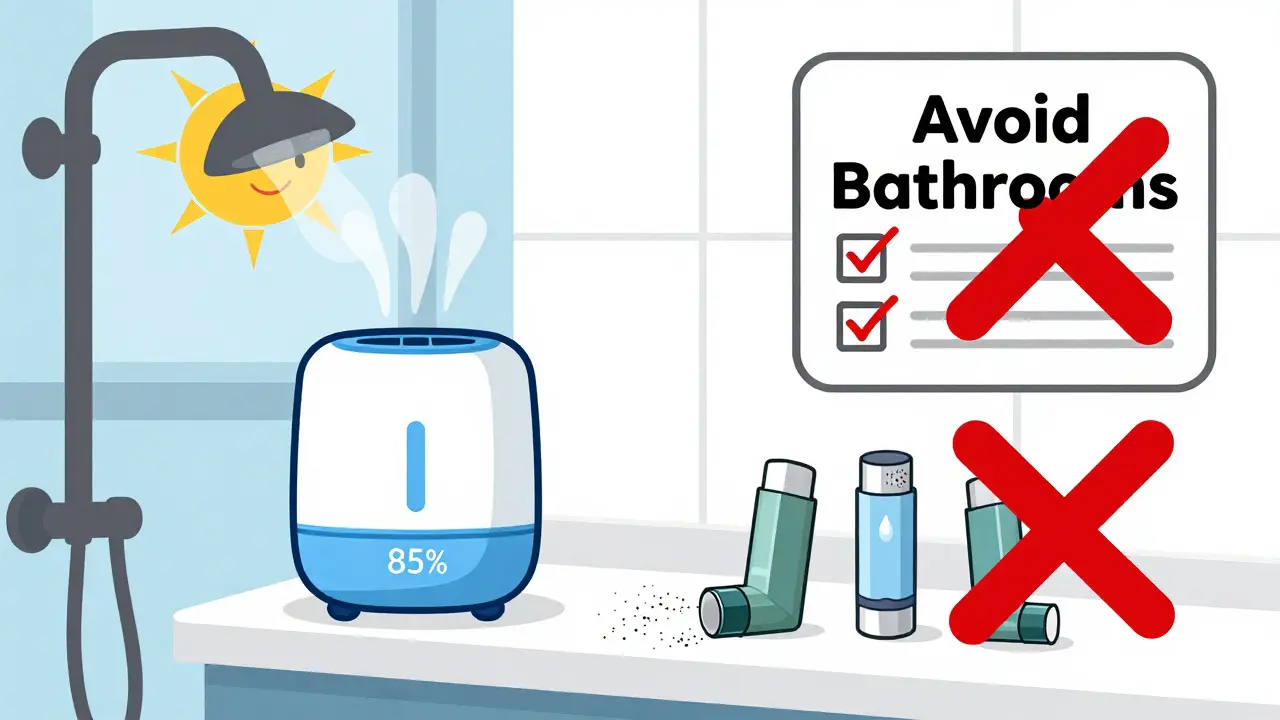
Light, Shock, and Other Hidden Risks
Inhalers are not just temperature-sensitive - they’re also light-sensitive. The plastic canisters can degrade under direct sunlight. That’s why keeping them in their original carton matters. The carton isn’t just for labeling - it blocks UV rays. Physical damage matters too. Never puncture an inhaler canister. Even if it feels empty, it still contains pressurized gas. Throwing it in the trash or leaving it near a heat source can cause it to explode. Always dispose of them properly through pharmacy take-back programs. Nebulizer compressors are electronic devices. Keep them at least 12 inches away from Wi-Fi routers, microwaves, or other strong electromagnetic sources. Philips Respironics’ 2021 manual warns that interference can disrupt airflow, leading to inconsistent dosing.Travel, Schools, and Work: Real-World Challenges
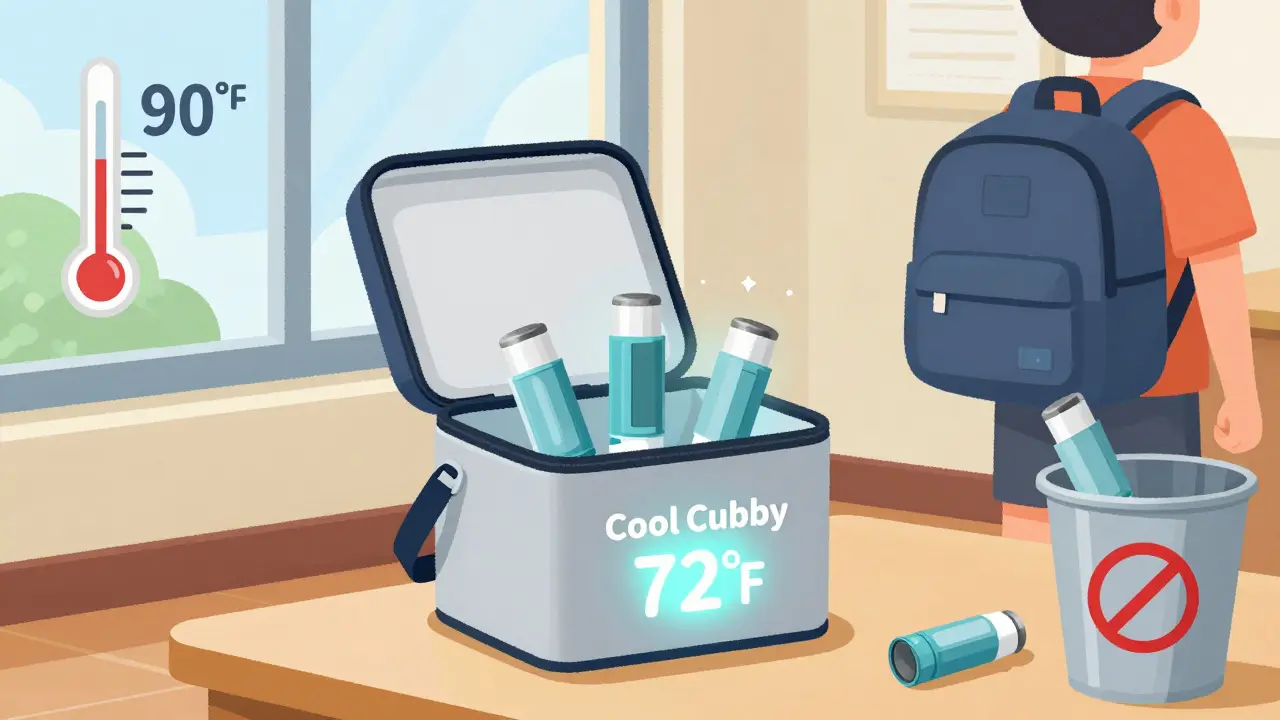
Traveling with inhalers? The American College of Physicians recommends the “Rule of 15”: no more than 15 minutes outside a temperature-controlled environment. Use an insulated case. The MediSafe case, for example, kept Xopenex at perfect temperature during Florida summers for 18 months - no issues. Schools are a major problem. The CDC reports that 63% of school-related asthma emergencies in 2022 involved inhalers stored in nurse’s offices that hit 80°F or higher. That’s because many offices are near windows or heating vents. One solution? St. Jude Children’s Research Hospital’s “Cool Cubby” - a temperature-monitored storage box in classrooms that maintains 72°F ± 2°F. Their pilot program cut medication failures by 89%. At work, keep your inhaler in a desk drawer, not on a windowsill. If you’re in a hot climate, consider a small cooler or insulated pouch. It’s not overkill - it’s survival.What About Refrigeration?
This is where confusion sets in. Some people think refrigerating inhalers makes them last longer. It doesn’t - and it can hurt.- Refrigerate only if instructed: Pulmicort Respules and some other nebulizer solutions need refrigeration until first use. Once opened, they go to room temperature.
- Don’t refrigerate pMDIs or DPIs: Cold temperatures can cause condensation inside the device, leading to clogs. The American Thoracic Society strictly prohibits refrigeration for all multi-dose inhalers.
- Exception? Maybe: The European Respiratory Society allows brief refrigeration during extreme heat (above 95°F), but the U.S. guidelines don’t support this. Stick to room temperature unless your doctor or packaging says otherwise.
How to Check If Your Inhaler Is Still Good
You can’t see if the medication has degraded. But you can spot warning signs:- Your inhaler feels lighter than usual - but the dose counter still shows doses left.
- The spray feels different - weaker, spotty, or not as forceful.
- You’ve had to use it more often than usual - not because your asthma is worse, but because the dose isn’t delivering.
- The expiration date is still valid, but you know it was left in a hot car last summer.
Storage Checklist: Simple Rules to Follow
- Keep it at room temperature: 68°F to 77°F (20°C to 25°C).
- Avoid bathrooms: Too humid. Too hot. Too risky.
- Never leave it in a car: Even on a 70°F day, the inside can hit 120°F.
- Store in original packaging: Protects from light and keeps instructions handy.
- Check humidity: Use a digital hygrometer. Aim for 40-50%.
- Don’t mix inhalers: DPIs can get damp from pMDIs if stored together.
- Use an insulated case for travel: Especially in summer or when flying.
- Dispose properly: Don’t throw in trash. Return to pharmacy for safe disposal.
The Bigger Picture: Why This Isn’t Just About You
Only 38% of asthma patients store their inhalers correctly - even though 92% think they do. That gap is dangerous. It’s not just about your health. It’s about emergency response. Paramedics and ER staff rely on your inhaler working. If it doesn’t, they have to use backup treatments - which cost more, take longer, and carry more risk. New tech is coming. In 2023, GlaxoSmithKline rolled out humidity-indicating packaging for Ellipta inhalers. The SmartInhale case - with Bluetooth temperature tracking - got FDA clearance. By 2026, the FDA may require all rescue inhalers to have built-in environmental sensors. But until then, the responsibility is yours. Your inhaler is your lifeline. Treat it like one.Can I store my inhaler in the fridge to make it last longer?
No, unless specifically instructed. Refrigerating pressurized inhalers (like albuterol MDIs) can cause condensation inside the device, leading to clogs or malfunction. Dry powder inhalers can also become brittle. Only nebulizer solutions like Pulmicort Respules need refrigeration before first use - and even then, they go to room temperature after opening. Always follow the manufacturer’s instructions.
What happens if I leave my inhaler in a hot car?
Leaving an inhaler in a hot car can permanently damage it. Temperatures inside a parked car can exceed 158°F in under 30 minutes. At that heat, the propellant breaks down, the medication degrades, and the device may stop working entirely. Studies show delivery efficiency can drop from 95% to 62% after just one day in a 95°F car. You could be left without relief during an asthma attack.
Is it okay to keep my inhaler in my purse or gym bag?
Only if it’s protected. A gym bag left in a hot car or in direct sunlight can expose your inhaler to unsafe temperatures. If you must carry it in a bag, use an insulated case or keep it in its original carton. Avoid leaving it unattended in places where temperature swings are extreme - like a car trunk or a locker.
Why do some inhalers have expiration dates if they still work after?
Expiration dates are based on stability testing under ideal storage conditions. If your inhaler was stored properly, it may still be effective past its date. But if it was exposed to heat, moisture, or sunlight, it could degrade long before the expiration date. The FDA doesn’t guarantee effectiveness after expiration - and neither should you. When in doubt, replace it.
How do I know if my nebulizer solution is still good after opening?
Most liquid nebulizer solutions (like albuterol or Pulmicort) are only stable for 7 days after opening - even if refrigerated. Check the packaging for specific instructions. If the liquid looks cloudy, discolored, or has particles, throw it out. Never use a solution past its 7-day window. Using degraded medication can worsen symptoms or cause infections.
PAUL MCQUEEN
February 9, 2026 AT 14:08Look, I get it - storage matters. But honestly? Most people just don’t care until they’re gasping for air and their inhaler clicks like a dead battery. I’ve seen it. My buddy left his Ventolin in his glovebox for a week after a road trip. Didn’t think twice. Then he had a panic attack at the gym - and nothing happened. Not even a puff. He had to call 911. Turns out, the propellant had turned to soup. Yeah, science is cool. But people? They’re lazy. And now he’s got a new inhaler and a lecture from his nurse. Classic.
Don’t even get me started on the ‘I keep it in the bathroom’ crowd. That’s not storage. That’s a science experiment in condensation.
Also, why do we still have expiration dates printed in tiny font? Like, if you’re gonna die because you didn’t replace your inhaler, at least make the warning louder than a smoke alarm.
glenn mendoza
February 11, 2026 AT 03:34Thank you for this meticulously researched and deeply necessary guide. As a healthcare professional who has witnessed countless preventable asthma crises, I cannot overstate the importance of proper medication storage. The statistics cited - particularly the 12% treatment failure rate due to environmental degradation - are not merely numbers; they represent lives on the brink.
I have personally counseled patients who stored their inhalers in direct sunlight, believing the warmth would ‘activate’ the medication. The tragic irony is that heat does not enhance efficacy - it destroys it. Similarly, the misconception that refrigeration extends shelf life is both widespread and perilous.
I urge all caregivers, educators, and patients to treat inhalers with the same reverence as insulin or epinephrine: temperature-controlled, humidity-protected, and never left to chance. Your life may depend on it - and so may someone else’s.
Kathryn Lenn
February 11, 2026 AT 23:18Oh wow, another government-approved pharmaceutical pamphlet. Let me guess - you’re also gonna tell me the FDA ‘tested’ these things under perfect conditions while ignoring that 90% of people live in places where ‘room temperature’ is a myth.
Ever been to Texas in July? Or Arizona? Or even a damn apartment in Chicago with no AC? Your ‘68°F–77°F’ rule is a joke. My inhaler lives in my purse. And my purse lives in a car that hits 120°F. And guess what? It still works. Maybe because my body’s not made of lab rats.
And don’t even get me started on the ‘SmartInhale case’ with Bluetooth tracking. Yeah, sure. Next they’ll charge us $200 for a case that texts us when we’re about to die. Meanwhile, the real problem? The price of the damn thing. But hey, keep buying the hype. The pharma companies love you for it.
Also - why does the article mention ‘FDA clearance’ like it’s a holy seal? Last I checked, the FDA approved OxyContin. So thanks, but I’ll trust my own experience over a 2023 study funded by GlaxoSmithKline.
Monica Warnick
February 12, 2026 AT 20:09I just… I can’t. I’ve been living with asthma since I was 5. I’ve had 3 ER visits because my inhaler didn’t work. Not because I forgot it. Not because I was panicked. Because I stored it in my gym bag - and that bag sat in my car for 3 hours after a workout. The day it failed? I was alone. No one knew I was in trouble. I could’ve died. And it wasn’t because I didn’t try. It was because I didn’t know.
I didn’t know about humidity. I didn’t know about UV light. I didn’t know that the carton wasn’t just packaging - it was armor.
Now I keep mine in a little insulated pouch. I have a hygrometer on my nightstand. I label every inhaler with the date I opened it. I’m obsessive now. And I’m terrified every time I leave the house.
This article? It’s not just informative. It’s the reason I’m still alive.
Ashlyn Ellison
February 13, 2026 AT 21:47My inhaler lives in my desk drawer. Always has. Never left the house. Never near a window. No bathroom. No car. Just… there. Quiet. Cool. Dry.
And yeah, I know I’m weird about it. My roommate thinks I’m a hoarder because I have 4 spares. But I’ve seen what happens when it fails. You don’t get a second chance to breathe. So I don’t gamble.
Also - if you’re using a nebulizer and it’s been open for 8 days? Toss it. No, really. Just toss it. You think you’re saving money? You’re risking your lungs. It’s not worth it.
Brandon Osborne
February 14, 2026 AT 05:54STOP. JUST STOP. How many people are gonna die because they didn’t read this? How many kids are gonna have seizures because their parents thought ‘room temperature’ meant ‘anywhere in the house’? This isn’t just advice - it’s a moral obligation.
I had a cousin. 12 years old. Asthma. Left her inhaler in the glovebox. Mom said, ‘It’s fine, it’s just a little heat.’ She had a seizure in the school bathroom. They had to use a nebulizer from the nurse’s closet - and it was expired. She was in the ICU for 72 hours.
Now? I carry 3 inhalers. One in my pocket. One in my backpack. One in my car. I have a mini cooler in my trunk. I check humidity levels every morning like it’s the weather.
If you’re not doing this - you’re not just careless. You’re dangerous. And if you’re reading this and still leaving it in the car? You’re one bad day away from a funeral.
Lyle Whyatt
February 16, 2026 AT 03:00As someone who’s lived in both Australia and the U.S., I’ve seen how wildly storage norms vary - and honestly, it’s terrifying. In Sydney, we’re taught to keep inhalers in a cool, dark cupboard - no exceptions. In the U.S., I’ve seen people store them in sunlit windowsills like decorative items.
One thing I’ve learned: the more extreme the climate, the more you need to over-engineer your storage. In Perth, where summer temps hit 42°C, I used a thermally insulated lunchbox with a cold pack. It worked. My inhaler never missed a beat.
And yes - I carry a spare. Always. Because if you’re relying on one device to keep you alive, you’re playing Russian roulette with a loaded chamber.
Also, I’ve started putting a small note on my inhaler: ‘Opened: 04/12/2024’. It’s dumb. But it’s saved me twice.
Ken Cooper
February 16, 2026 AT 07:14ok so i just read this whole thing and i’m like… wow. i had no idea. like, i thought if the inhaler still had liquid in it, it was fine. turns out i was wrong. like, really wrong.
i’ve been leaving mine in my gym bag since high school. no joke. and i’ve been using it for like 3 years. i just thought it was ‘just working’
so now i’m gonna go buy one of those insulated cases. and i’m gonna get a hygrometer. and i’m gonna write the date on the box. i’m gonna be the guy who’s ready.
also - i didn’t know about the carton. that’s wild. i thought it was just for looks. turns out it’s like armor. cool.
thank you. seriously. this might’ve saved my life. or at least my next asthma attack.