
How Clinician Communication Shapes Patient Trust in Generic Medications
 Jan, 1 2026
When your doctor hands you a prescription for a generic drug, what’s the first thing you think? If you’ve ever wondered whether it’s really the same as the brand-name version, you’re not alone. Generic medications make up 90% of all prescriptions filled in the U.S., yet nearly half of patients still doubt their effectiveness. The real difference isn’t in the pill-it’s in the conversation.
Why Patients Don’t Trust Generics (Even When They Should)
Most people don’t realize that the FDA requires generic drugs to meet the same strict standards as brand-name drugs. The active ingredient must be identical, and the drug must deliver the same amount of medicine into the bloodstream within a narrow range-80% to 125% of the brand. That’s not a guess. It’s science. But patients aren’t hearing this from their doctors.
A 2015 study found that 29.9% of patients believed brand-name drugs worked better. Another 53.7% said their doctor never talked to them about generics. That silence speaks louder than any marketing ad. When patients get a different-looking pill without explanation, they assume something’s changed. They worry it’s weaker. Or cheaper because it’s inferior. That’s not logic-it’s psychology.
And it’s not just about cost. Even when generics save 80-85% of the price, patients still hesitate. Why? Because trust isn’t built on price tags. It’s built on clarity, confidence, and consistency in communication.
The One Thing That Changes Everything: How Doctors Talk About Generics
Research shows that the single biggest factor influencing whether a patient accepts a generic is what their clinician says-or doesn’t say. A 2011 study of nearly 2,000 patients found that those who received clear communication from their provider were 37% more likely to stick with the generic. Not because they liked the price. Not because they were forced. Because they understood.
It’s not enough to say, “We’re switching you to the generic.” That’s like handing someone a new phone and saying, “It’s the same as your old one.” Without context, people feel confused, even threatened.
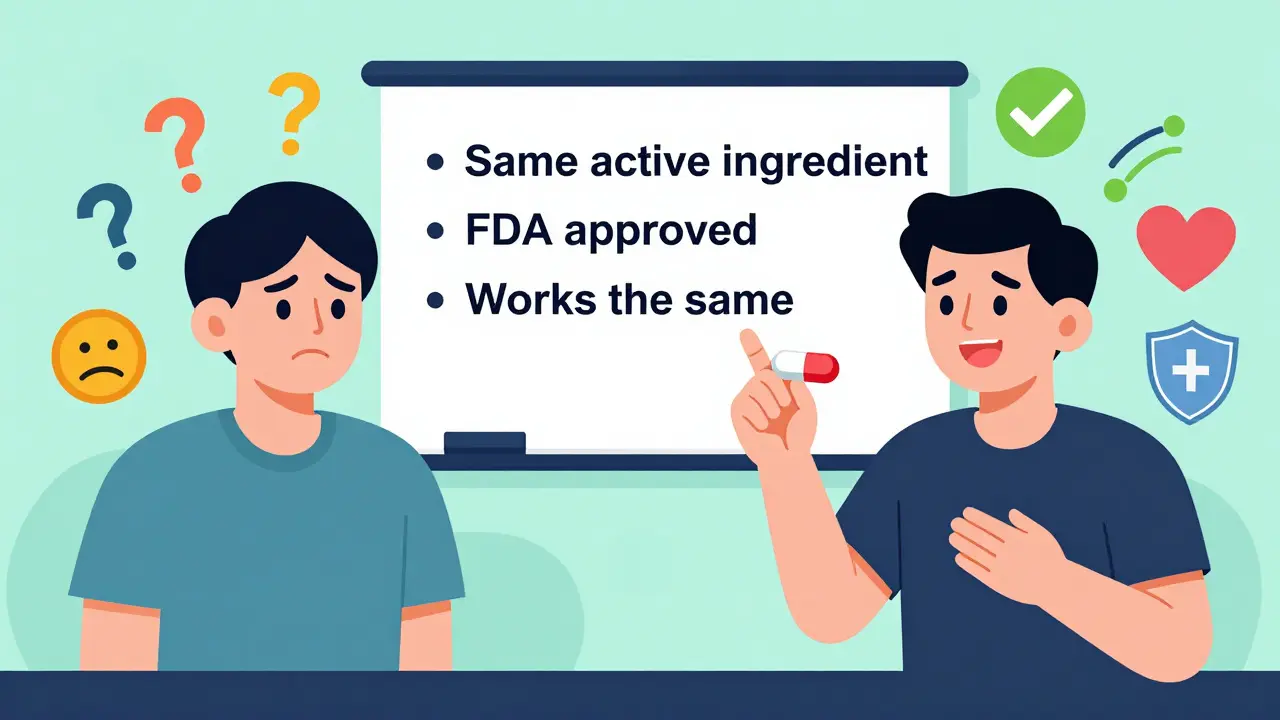
Effective communication includes four key points:
- Identical active ingredient. The medicine inside is the same. No exceptions.
- FDA bioequivalence. The drug must deliver the same amount of medicine into the body within a scientifically proven range-80-125%.
- Cost savings. Generics typically cost 80-85% less. That’s real money saved without losing effectiveness.
- Nocebo effect. Some people feel side effects simply because they expect them. Good communication prevents this.
One cardiologist in Minnesota told his patient: “I take the same generic amlodipine as you. I’ve been on it for five years. My blood pressure is better than when I was on the brand. Here’s the FDA data.” The patient stayed on the generic for two years with no issues. That’s not luck. That’s communication.
What Happens When Communication Fails
Bad communication doesn’t just lead to non-adherence-it leads to real health consequences.
A 2019 JAMA study followed 412 patients with chronic conditions after switching to generics. Those who got a simple substitution notice reported more headaches, dizziness, and fatigue. Those who received a detailed explanation-emphasizing FDA approval and bioequivalence-reported 28% fewer symptoms. Why? Because their brains stopped expecting harm.
This is called the nocebo effect: when negative expectations create real physical symptoms. It’s the opposite of the placebo effect. And it’s triggered by vague language like, “Some people react to generics,” or “Let’s try this and see how it goes.”
One patient on Healthgrades wrote: “My pharmacist just handed me a different pill. When I got headaches, he said, ‘Some people react to generics.’ I stopped taking it for three weeks.” That’s not just poor service-it’s clinical negligence.
Analysis of over 4,200 patient reviews found that 89% of negative experiences cited poor or absent communication. Meanwhile, 78% of positive experiences mentioned the doctor’s explanation as the turning point.

Who’s Most at Risk-and Why
Not all patients react the same way. Communication needs to be tailored.
NIH data from 2016 shows non-Caucasian patients were 1.7 times more likely to distrust generics than Caucasian patients. Patients earning under $30,000 a year were 2.3 times more likely to prefer brand-name drugs. These aren’t random differences. They’re shaped by history, access, and messaging.
People who’ve been overcharged for medications, or who’ve seen ads pushing “premium” brands, are more skeptical. Cultural beliefs about medicine matter too. A 2021 study found that culturally competent communication-using familiar language, trusted examples, and community-relevant analogies-reduced skepticism by 41% in minority populations.
It’s not about dumbing things down. It’s about connecting. Saying, “This is like buying store-brand cereal instead of the name brand-it’s the same ingredients, just cheaper,” works better than quoting FDA guidelines to someone who’s never heard of bioequivalence.
What Works in Real Clinics
Kaiser Permanente didn’t just hope patients would accept generics. They built a system around it. Their “Generic First” initiative included mandatory training for all providers, standardized scripts, and electronic health record prompts that reminded clinicians to explain the switch. Result? 94% generic utilization rate. $1.2 billion saved annually.
Pharmacists aren’t left out. The American Pharmacists Association created a 15-minute training toolkit that increased patient understanding from 42% to 87% in just a few months. The secret? Short, clear, confident language. No jargon. No hesitation.
Now, Epic Systems-the biggest EHR vendor in the U.S.-has launched the “Generic Confidence Score.” It’s a pop-up in the electronic chart that asks clinicians: “Did you explain the FDA bioequivalence? Did you address concerns about effectiveness?” If not, the system prompts them to do so before finalizing the prescription.
This isn’t bureaucracy. It’s clinical best practice.
The Bigger Picture: Why This Matters
Generics save the U.S. healthcare system $37 billion a year. That’s money that goes back into care, research, and access. But the biggest barrier isn’t cost-it’s perception.
Even though 90% of prescriptions are generics, brand-name preference requests have climbed from 12% in 2010 to 23% in 2022. Why? Because drug companies spend billions on ads that imply generics are second-rate. And too many clinicians don’t push back.
The FDA, AMA, and APhA all agree: clinician communication is a clinical intervention. Not an add-on. Not optional. It’s part of treatment.
By 2025, Medicare Part D will start tying reimbursement to how well doctors and pharmacists explain generics. The CDC plans to make this part of national health literacy standards. This isn’t coming. It’s already here.
What You Can Do-Whether You’re a Patient or Provider
If you’re a patient and you’re handed a generic:
- Ask: “Is this the same medicine as the brand?”
- Ask: “Has the FDA approved it as equally effective?”
- Ask: “Have you taken this yourself?”
If you’re a provider:
- Don’t assume patients know the basics.
- Use plain language. Avoid “bioequivalence.” Say, “It works the same way.”
- Be confident. Say, “This is just as safe and effective.” Not, “It might work.”
- Use visual aids. Show the FDA’s patient guide. It’s free, clear, and available in 12 languages.
The gap between science and belief isn’t closing on its own. It’s closing because someone took the time to explain it.
Are generic medications really as effective as brand-name drugs?
Yes. The FDA requires generic drugs to contain the same active ingredient, in the same strength, and deliver the same amount of medicine into the bloodstream as the brand-name version. They must meet a strict bioequivalence range of 80% to 125%. Thousands of studies confirm they work the same way. The only differences are in inactive ingredients-like color or filler-which don’t affect how the drug works.
Why do some people feel worse after switching to a generic?
It’s usually not the drug-it’s the expectation. This is called the nocebo effect. If a patient believes a generic is inferior, their brain can trigger real symptoms like headaches or nausea, even when the medicine is identical. Studies show that when patients are clearly told about FDA standards and bioequivalence, these symptoms drop by nearly 30%. Poor communication creates real side effects.
Can pharmacists explain generics better than doctors?
Both matter-but together, they’re strongest. Patients who hear about generics from both their doctor and pharmacist have a 92% acceptance rate. When only one speaks up, it drops to 76%. When neither does, it’s just 61%. Doctors set the tone. Pharmacists reinforce it. Consistency builds trust.
Why do some doctors avoid talking about generics?
Three main reasons: time, knowledge, and confidence. On average, doctors have just 1.2 minutes per patient to explain a switch. Many don’t know the exact FDA bioequivalence range-only 54% of physicians got it right in a 2019 survey. And 39% feel unsure about generics for conditions like epilepsy. Training and simple scripts fix this. It’s not about being an expert-it’s about being clear.
Is there evidence that communication actually saves money?
Yes. Every 1% increase in generic use saves the system about $1 billion annually. If communication can boost acceptance by just 12-15 percentage points-something proven possible-it could save $180 billion over the next decade. But more than that, it reduces hospital visits and complications from patients stopping meds because they didn’t trust the generic.
Bobby Collins
January 2, 2026 AT 08:02lol so now the FDA is our benevolent overlord? they approved the same pills that gave my cousin seizures last year. they just changed the color and called it 'bioequivalent' like that means anything. i bet they're in cahoots with big pharma to push generics so they can cut costs on medicare. you think your 'science' is foolproof? i've seen pills that look identical but one makes you feel like you're dying and the other doesn't. it's not psychology-it's cover-up.
Kristen Russell
January 2, 2026 AT 15:00Stop panicking and start listening. The science is rock solid. If your doctor says it's the same, trust them. Your health isn't a conspiracy-it's a partnership.
Bill Medley
January 3, 2026 AT 18:50It is axiomatic that the integrity of clinical communication directly influences therapeutic adherence. The empirical data presented herein are both statistically significant and clinically actionable. One would be remiss to dismiss the role of linguistic clarity in pharmacological compliance.
Richard Thomas
January 5, 2026 AT 14:32It's fascinating how we've turned medicine into a transactional exchange of information rather than a relational healing practice. We've got all these studies proving that words matter, yet we still treat patients like data points. The real issue isn't the pill-it's the silence between the doctor and the person who has to swallow it. We've forgotten that trust isn't built by citing FDA guidelines-it's built by someone looking you in the eye and saying, 'I believe in this, and I'd take it myself.' That's not protocol. That's humanity. And when we reduce that to a checkbox on an EHR screen, we're not saving money-we're losing something far more valuable.
Paul Ong
January 7, 2026 AT 08:55Doctors need to just say it plain. Same medicine cheaper. No drama. No jargon. Just say it like you mean it. People get it. Stop overthinking it. Just talk.
Andy Heinlein
January 9, 2026 AT 07:09so i switched to generic lisinopril last year and my bp is better than ever. no headaches no dizziness. my doc just said 'this is the same stuff' and handed it to me. i was skeptical but it worked. now i tell everyone. why make it complicated? simple works.
Phoebe McKenzie
January 10, 2026 AT 18:39Of course you're all drinking the kool-aid. The FDA is a puppet of Big Pharma. They let tainted generics into the market while locking out foreign manufacturers who actually make better pills. You think your '80-125% bioequivalence' means anything? That's a loophole designed to let junk through. I've seen generics that crumble in your hand. Your 'trust' is just blind obedience to a broken system. And you call yourselves healthcare professionals?
gerard najera
January 11, 2026 AT 11:51Trust is earned through consistency, not coercion.
Stephen Gikuma
January 12, 2026 AT 14:10Generic drugs are fine if you're okay with Chinese and Indian factories making your medicine. We used to make pills here. Now we import them and pray they work. This isn't science-it's outsourcing our health to countries with weaker regulations. And you wonder why people are scared? The government lets this happen and then tells us to trust the system. No thanks. I'll pay extra for American-made.