
Fulminant Hepatic Failure from Medications: How to Recognize It in an Emergency
 Dec, 30 2025
What Is Fulminant Hepatic Failure?
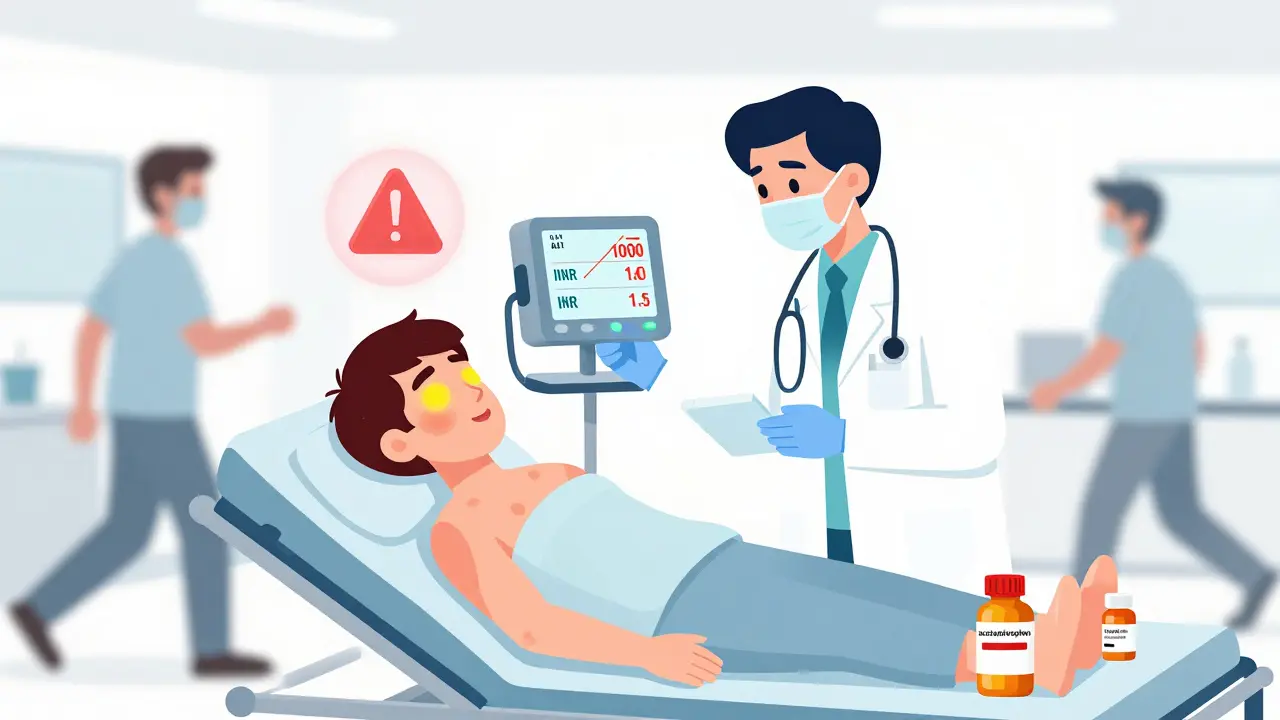
Fulminant hepatic failure (FHF) doesn’t creep up-it strikes. It’s when a healthy liver collapses in days, sometimes hours, because of a medication reaction. No prior liver disease. No warning. Just jaundice, confusion, and a blood clotting problem that says: your liver is dying.
This isn’t a slow decline. It’s a medical emergency. The term ‘fulminant’ comes from Latin for ‘lightning strike,’ and that’s exactly how it feels. In the U.S., about 2,000 cases happen every year. Nearly half are caused by medications. And the difference between life and death often comes down to whether someone recognizes it in time.
Acetaminophen: The Silent Killer in Your Medicine Cabinet
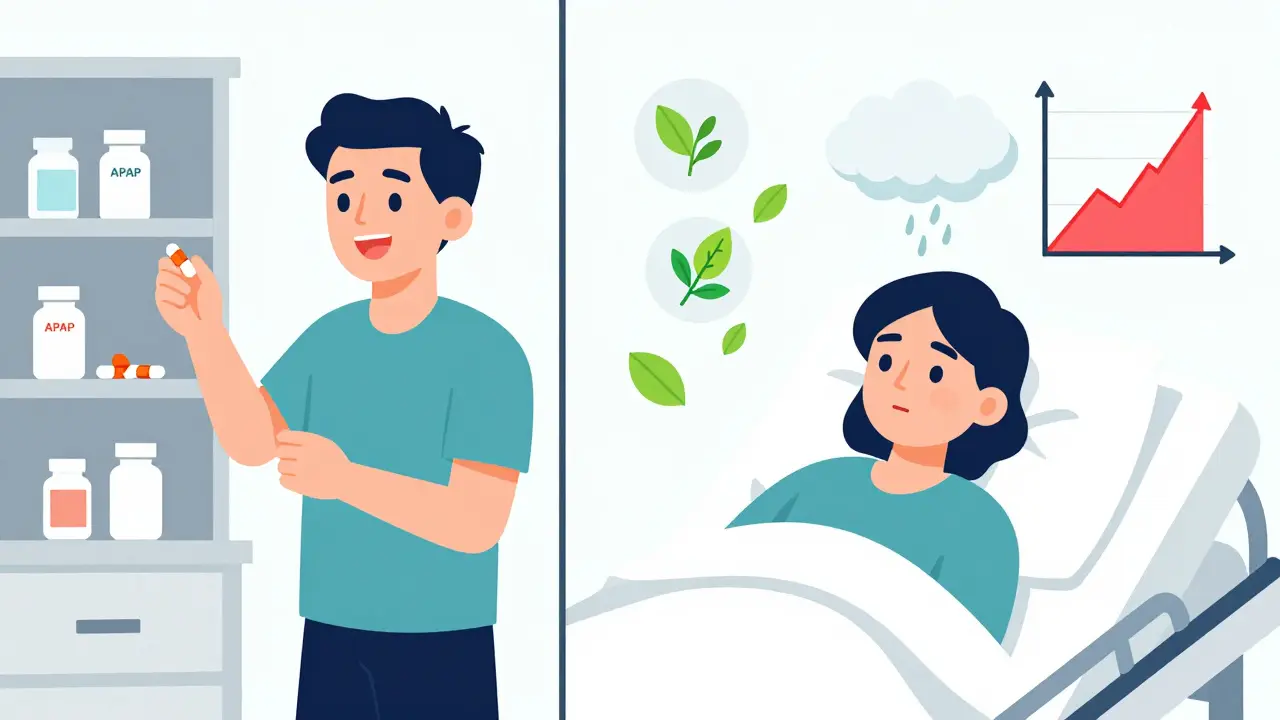
Acetaminophen is the most common cause of FHF in the United States. It’s in more than 600 over-the-counter and prescription products-pain relievers, cold medicines, sleep aids. People think it’s safe because it’s everywhere. But take too much-even if you’re following the label-and your liver can’t handle it.
Here’s what matters: More than 7.5 grams in a single day for an adult, or over 150 mg per kilogram of body weight, can trigger toxicity. That’s just 15 extra-strength pills. And here’s the catch: many people don’t realize they’re overdosing. They take one pill for a headache, another for back pain, then a cold medicine that also has acetaminophen. Total? 5 grams. They think they’re fine. Then they wake up confused. Or their family notices they’re acting weird.
The lab clues are clear: ALT levels over 1,000 IU/L, often with an ALT-to-AST ratio greater than 2:1. That’s a red flag no ER should miss. And if the INR (a blood clotting test) is above 1.5? That’s not just liver trouble. That’s failure.
When It’s Not Acetaminophen: The Hidden Culprits
Not every case of drug-induced liver failure comes from acetaminophen. In fact, the trickier cases are the ones you don’t expect.
Antibiotics like amoxicillin-clavulanate can cause liver damage-but not right away. It takes weeks. People think they have the flu. Their skin turns yellow. Their doctor orders a viral hepatitis panel. Everything comes back negative. Meanwhile, their alkaline phosphatase is sky-high, and their bilirubin is climbing. This is Hy’s Law: ALT or AST more than three times the upper limit of normal, with bilirubin more than twice the normal level. That’s a hospital admission, not a follow-up in a week.
Antiseizure drugs like valproic acid? They cause a different kind of damage-microvesicular steatosis. Ammonia levels rise before the brain gets affected. If you see someone with unexplained vomiting, drowsiness, and high ammonia? Think valproate. Especially if they’re on it for migraines or bipolar disorder and haven’t had their levels checked in months.
Herbal supplements are growing fast as a cause. Green tea extract-yes, the ‘healthy’ one-has caused liver failure in people taking more than 800 mg per day of epigallocatechin-3-gallate. Kava, used for anxiety, has killed people after months of daily use. And here’s the problem: most patients won’t tell you they’re taking them. They don’t think it’s a ‘drug.’
What Doctors Must Do in the ER
Emergency teams don’t have time to guess. They need a system. The Acute Liver Failure Study Group recommends a 30-minute triage protocol for anyone with nausea, vomiting, and yellow eyes:
- Check ALT, INR, and acetaminophen level-right away.
- Assess mental status hourly using the West Haven Criteria. Is the patient slurring words? Confused? Sleeping too much? That’s encephalopathy.
- If INR is above 1.5, repeat it every 6 hours. Rising INR = worsening liver.
And here’s the rule no one should ignore: If ALT is above 500 IU/L, test for acetaminophen-even if the patient denies taking it. One in four cases of acetaminophen-induced liver failure comes from people who swear they didn’t overdose. They took their prescription painkiller, didn’t count the acetaminophen in it, and hit 5 grams without realizing.
The King’s College Criteria tell you when to call a transplant center: INR over 6.5 with grade III or IV encephalopathy. Or if pH is below 7.3 and creatinine is above 3.4 mg/dL at 96 hours. Those numbers mean 90% chance of death without a transplant.
Why Timing Is Everything
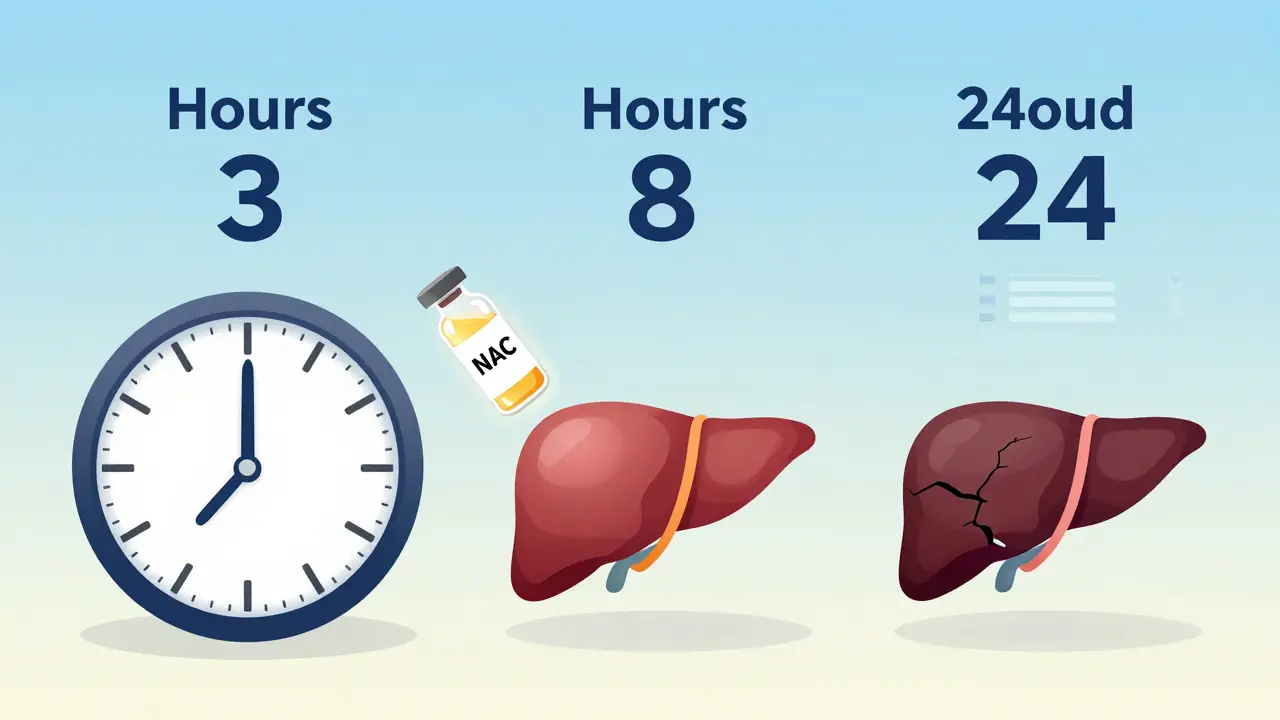
N-acetylcysteine (NAC) is the antidote for acetaminophen overdose. It works best if given within 8 hours. After 24 hours? It still helps-but survival drops from 67% to 29%.
One case from Cleveland Clinic: a 28-year-old woman took 12 pills for a migraine. Her husband brought her in 3 hours later. They ran the Rumack-Matthew nomogram. Acetaminophen level was 180 μg/mL at 4 hours-well above the toxicity line. NAC started at hour 5. She walked out in 5 days.
Another case: a 52-year-old man took 4 grams a day of acetaminophen for back pain for six months. He didn’t think it was too much. He came in confused. INR was 8.2. NAC was given-but too late. He needed a transplant. He survived. But he’s on lifelong medication now.
The difference? Hours.
What Patients and Families Should Watch For
You don’t need to be a doctor to spot the warning signs. Here’s what to look for:
- Persistent nausea or vomiting-especially if it lasts more than two days and you haven’t been sick with the flu.
- Yellow eyes or skin-not just a little yellow, but noticeable.
- Confusion, forgetfulness, or personality changes. Someone who’s usually sharp becomes slow, drowsy, or irritable.
- Swelling in the belly or legs.
- Bleeding easily-nosebleeds, bruising without injury, or dark, tarry stools.
Family members often notice these changes before the patient does. If you see any of these in someone taking medications-including herbs or supplements-don’t wait. Go to the ER. Say: ‘I think it might be liver failure.’
What’s Changing in Emergency Care
There’s new hope. In 2023, the FDA cleared HepaPredict AI-a system that analyzes 17 clinical factors to predict liver failure progression with 89% accuracy within 24 hours. Emergency rooms are starting to use it.
By mid-2024, a national FHF Alert System will go live. When an ER suspects fulminant liver failure, they’ll notify transplant centers within one hour. In California, this cut time-to-transplant by more than a day. That’s life saved.
And research is moving fast. A blood marker called miR-122 can detect acetaminophen damage as early as six hours after overdose-before ALT even rises. It’s not widely available yet, but it’s coming.
Don’t Assume It’s Just the Flu
Too many people die because their symptoms are mistaken for something else. A stomach bug. The flu. A migraine. A panic attack. One Johns Hopkins study found 17 cases where NSAID-induced liver injury was called gastroenteritis. The patients waited five days on average before getting the right diagnosis.
And herbal supplements? They’re the fastest-growing cause. The FDA is now requiring bold warnings on prescription acetaminophen products. But OTC ones? Still no warning. People don’t know. And they’re not asking.
What You Can Do Today
- Know what’s in your medicine cabinet. Check every pill for acetaminophen. It’s listed as APAP or paracetamol.
- Never take more than 3,000 mg a day unless your doctor says so. The old 4,000 mg limit is too high for many people.
- Tell your doctor about every supplement you take-even ‘natural’ ones.
- If you’re on long-term pain meds, ask your doctor to check your liver enzymes every 3-6 months.
- If you or someone you know has sudden nausea, jaundice, or confusion-go to the ER. Don’t wait. Don’t call your primary care. Go now.
Fulminant hepatic failure doesn’t care if you’re careful. It doesn’t care if you thought you were safe. It only cares if someone recognizes it fast enough. The tools are here. The knowledge is here. What’s missing is the urgency.
Nadia Spira
January 1, 2026 AT 07:59Let me just say this: acetaminophen isn't a drug-it's a Trojan horse disguised as relief. We've normalized polypharmacy like it's yoga. People think 'natural' means safe, but your liver doesn't give a damn about your yoga mat. The FDA's toothless warnings? Pathetic. This isn't about personal responsibility-it's about systemic negligence. We let corporations profit off silent organ death while we scroll TikTok with our kidneys in standby mode.
Kunal Karakoti
January 2, 2026 AT 08:25Interesting how the body has this quiet way of screaming when we ignore its language. The liver doesn't complain-it just stops. Like a candle blown out by wind you didn't feel coming. Maybe we need to stop seeing medicine as a fix and start seeing it as a conversation. What are we asking our bodies to endure, really? And at what cost to our stillness?
Glendon Cone
January 3, 2026 AT 06:37Big shoutout to the ER docs who catch this before it's too late 🙌 I had a cousin who took 'just a few extra' Tylenol for back pain after a car accident-ended up in ICU for 10 days. NAC saved her. Also, green tea extract? Yeah, I stopped that shit after reading this. Who knew 'healthy' could kill? 🤯
Henry Ward
January 4, 2026 AT 06:37Of course people die from this. They're lazy. They don't read labels. They take 'natural' supplements like they're vitamins. You think your kombucha is healing you? It's probably frying your liver. This isn't a medical crisis-it's a moral one. If you can't manage your own damn pills, why should society save you?
Aayush Khandelwal
January 5, 2026 AT 02:25Acetaminophen is the silent symphony of modern self-destruction-every pill a note, every combo a crescendo. But let’s not forget the herbal dark horses: kava’s whisper, green tea’s siren song. The body doesn’t discriminate between ‘pharmaceutical’ and ‘Ayurvedic’-it only knows dose, duration, and dereliction. We weaponize wellness while ignoring the calculus of toxicity.
Sandeep Mishra
January 6, 2026 AT 12:41Hey, I'm a nurse in Delhi, and I've seen this too many times. People come in with jaundice, say 'I only took turmeric and ashwagandha,' and we find ALT over 2000. I tell everyone: if it's in a bottle, it can hurt you. Don't be ashamed to say what you take. Your liver doesn't care if it's 'natural'-it just wants to live. Talk to your doctor. No judgment here. ❤️
Joseph Corry
January 7, 2026 AT 08:05While the article is technically sound, it fundamentally misunderstands the epistemological vacuum of contemporary pharmacological literacy. The patient is not a passive recipient of biomedical knowledge but an agent of epistemic disobedience-choosing folk wisdom over peer-reviewed science. The real tragedy isn't the liver failure-it's the collapse of epistemic authority in the age of Instagram healers.
srishti Jain
January 8, 2026 AT 04:30People are stupid. They take 15 pills. They die. End of story.
Cheyenne Sims
January 9, 2026 AT 11:13It is imperative to note that the United States Department of Health and Human Services has repeatedly emphasized the necessity of accurate pharmaceutical labeling. The failure to adhere to established dosage guidelines constitutes a gross disregard for public health infrastructure. This is not an isolated incident-it is a systemic failure of civic responsibility.
Shae Chapman
January 10, 2026 AT 03:39I cried reading this. My mom almost died from this exact thing. She took cold medicine + Tylenol + a 'liver cleanse' supplement. We didn’t know. She was just tired. Then she couldn’t stand up. I’m so glad you wrote this. I’m printing it out and handing it to every family member. 🤍🫂
henry mateo
January 11, 2026 AT 05:01damn i never knew green tea extract could do this… i drink like 3 bags a day… i’m gonna cut back for real this time. thanks for the wake up call
Kelly Gerrard
January 12, 2026 AT 11:22Emergency protocols must be standardized nationwide. Delayed recognition is not an acceptable outcome in 21st-century medicine. This is preventable. This is avoidable. This is a failure of education, regulation, and accountability. We owe it to every patient to do better.
Colin L
January 13, 2026 AT 16:57You know what’s really scary? I used to work in a pharmacy in Manchester. People would come in with 12 different bottles-every single one had acetaminophen. One guy had 17 meds. He didn’t even know what half of them were for. He said, ‘Doc said take it.’ I’d ask, ‘Which doc?’ He’d say, ‘The one on YouTube.’ I swear to god, I’ve seen it. The algorithm doesn’t care if you live or die. It just wants you to click. And now your liver is a pile of ash. I’ve watched people die from this. It’s not dramatic. It’s quiet. And it’s everywhere.