
Drug-Disease Interactions: How Your Health Conditions Can Change How Medicines Work
 Dec, 1 2025
Think your medicine is safe just because your doctor prescribed it? Think again. Many people don’t realize that drug-disease interactions can turn a life-saving drug into a dangerous one - not because of other pills you’re taking, but because of the health conditions you already have. This isn’t about mixing drugs. It’s about how your body, already struggling with one illness, reacts badly when you add a medication meant for something else.
What Exactly Is a Drug-Disease Interaction?
A drug-disease interaction happens when a medicine prescribed to treat one condition makes another condition worse - or hides its symptoms so you don’t notice it getting worse. For example, a beta-blocker for high blood pressure might mask the shaky hands and fast heartbeat that warn you your blood sugar is dropping. If you have diabetes, that’s not just inconvenient - it’s life-threatening.
These aren’t rare edge cases. They’re common, serious, and often missed. The Agency for Healthcare Research and Quality estimates that 5-10% of hospital admissions are caused by medication problems, and a big chunk of those come from undiagnosed drug-disease interactions. The problem is growing. The average American over 65 takes 4.7 chronic medications and has 4.7 chronic conditions. When you stack those together, the risk isn’t just possible - it’s likely.
How Do These Interactions Actually Happen?
It’s not magic. It’s biology. Here’s how it works in real life:
- Pharmacodynamic interference: The drug’s effect directly fights your disease. Beta-blockers like propranolol help heart patients by slowing the heart rate - but they also tighten airways. For someone with asthma or COPD, that can trigger a severe attack.
- Pharmacokinetic changes: Your disease changes how your body handles the drug. If you have liver disease, your body can’t break down warfarin (a blood thinner) the way it should. That means the drug builds up, and you bleed easily - even at normal doses.
- Masking symptoms: Some drugs hide warning signs. Diabetics on beta-blockers might not feel their blood sugar crash. Someone with heart failure on NSAIDs might not realize their swelling is getting worse because the pain relief makes them feel fine.
- Exacerbating complications: NSAIDs like ibuprofen cause your body to hold onto salt and water. That’s fine for a healthy person. For someone with heart failure, it means more fluid in the lungs, more strain on the heart, and a higher chance of hospitalization.
- Direct organ damage: Metformin, a common diabetes drug, can cause lactic acidosis - a deadly buildup of acid in the blood - if your kidneys aren’t working well. That’s why kidney function is checked before and during treatment.
These aren’t theoretical risks. A 2015 study found that 84% of dangerous drug-disease interactions in diabetes patients involved chronic kidney disease. In heart failure, 35% of serious events were bleeding episodes tied to blood thinners. In depression, 42% of the big risks were bleeding from SSRIs when combined with other conditions like ulcers or clotting disorders.
Top Four Conditions That Trigger Dangerous Interactions
Not all diseases are equal when it comes to drug interactions. Four stand out as major risk factors:
- Chronic kidney disease: Your kidneys filter drugs out of your blood. If they’re failing, drugs build up. Metformin, lithium, NSAIDs, and certain antibiotics become toxic at normal doses. Even mild kidney impairment can turn a safe drug dangerous.
- Heart failure: Fluid retention is already a problem. NSAIDs, some calcium channel blockers, and even certain diabetes drugs like thiazolidinediones can make it worse. Beta-blockers help - but only if chosen carefully. Some, like carvedilol, are safe. Others, like propranolol, can trigger arrhythmias.
- Liver disease: The liver metabolizes most drugs. If it’s damaged, drugs stick around longer. Warfarin, benzodiazepines, statins, and many antidepressants can reach toxic levels. Doses must be lowered - often by half or more.
- Psychiatric conditions: Depression, bipolar disorder, and anxiety often require multiple drugs. SSRIs can cause bleeding if you also have ulcers or take aspirin. Lithium becomes toxic if you’re dehydrated or have kidney issues. And don’t forget St. John’s wort - a popular supplement - which can trigger serotonin syndrome when mixed with SSRIs.
These four conditions account for 78% of all clinically significant drug-disease interactions, according to the American Society of Health-System Pharmacists. That’s not a coincidence. It’s a pattern.

Why Doctors Miss These Interactions
You’d think guidelines would warn doctors. But they don’t. A 2015 study found that only 16% of clinical guidelines for diabetes, depression, and heart failure even mentioned drug-disease interactions. Most focus on the main disease - not the others you might have.
Electronic health records try to help. Epic’s system flags 87% of high-risk interactions - but also throws up 42% false alarms. Doctors get so many useless alerts that they start ignoring them all. It’s called alert fatigue. And it’s deadly.
Community pharmacists know this better than anyone. They spend nearly 13 minutes per patient just checking for these interactions during medication reviews. But most dispensing appointments last 3-5 minutes. There’s no time. No training. No support.
Patients? Most don’t know what to ask. A 2022 survey found only 22% of people with high blood pressure understood why decongestants like pseudoephedrine could spike their pressure. Yet nearly 9 out of 10 had been prescribed them.
What You Can Do Right Now
You don’t need to be a doctor to protect yourself. Here’s what works:
- Keep a living list: Write down every medication - pills, patches, inhalers, supplements, even over-the-counter stuff. Include doses and why you take them. Update it every time something changes.
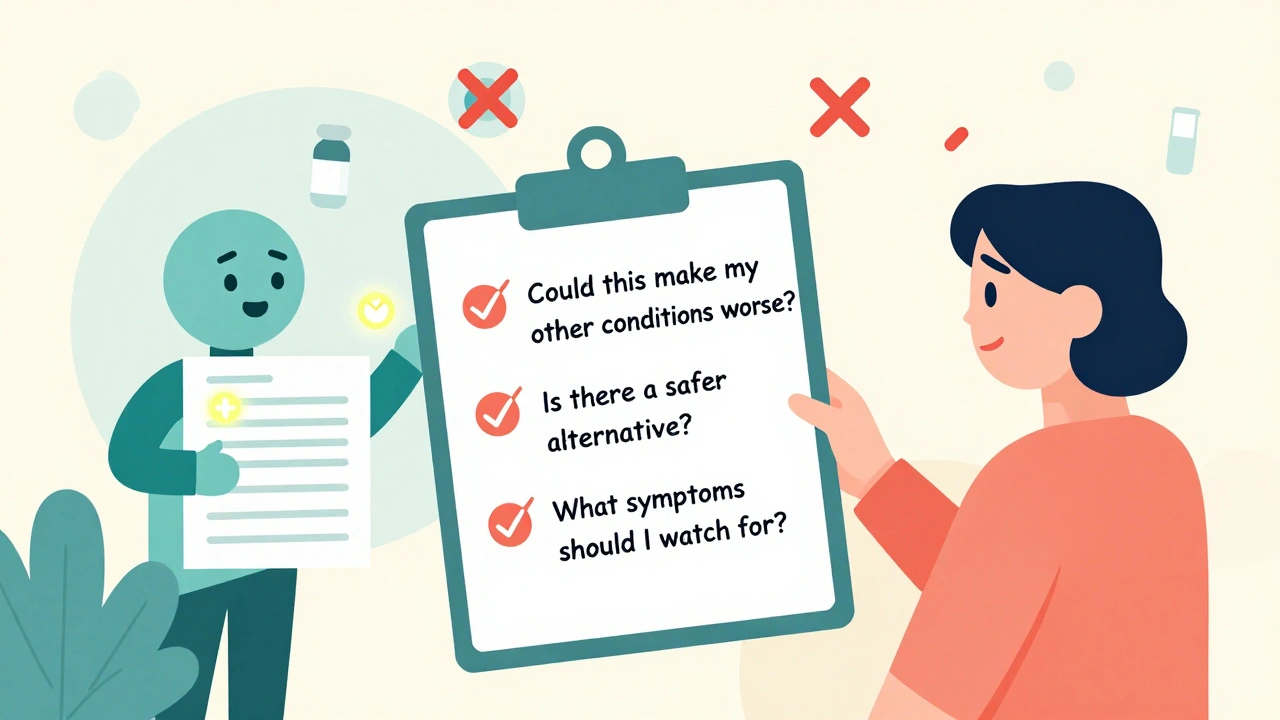
- Ask the three questions: Every time you get a new prescription, ask:
- “Could this make any of my other conditions worse?”
- “Is there a safer alternative for someone with my health history?”
- “What symptoms should I watch for that mean this drug is hurting me?”
- Know your kidney and liver numbers: If you have any chronic condition, ask for your eGFR (kidney function) and liver enzyme tests. If you don’t know your numbers, you can’t know your risk.
- Use the Beers Criteria: This is the gold standard for older adults. It lists drugs that are risky for people with certain conditions. You can look it up online. If your doctor prescribes something on that list, ask why.
- Review meds every 6 months: Don’t wait for a crisis. Schedule a “medication check-up” with your pharmacist or doctor. Bring your list. Ask if anything can be stopped, switched, or lowered.
One woman in Sydney, 72, had diabetes, heart failure, and depression. She was on metformin, lisinopril, and sertraline. Her doctor didn’t know she was also taking ibuprofen for arthritis. Within weeks, her kidneys dropped, her heart failure worsened, and her blood pressure spiked. A simple medication review caught it. She switched to acetaminophen, lowered her sertraline dose, and got a kidney specialist involved. She’s been stable for over a year.
The Bigger Picture: Why This Matters Now
This isn’t just about individual patients. It’s about the whole system.
The global market for drug interaction software is growing at 14% a year - because hospitals are getting fined for preventable errors. Medicare now penalizes hospitals with too many adverse drug events. The FDA now requires drug makers to test new medications in patients with common comorbidities - not just healthy volunteers. The NIH’s All of Us program is using AI to predict individual risks based on genetics and health history. Early results show a 38% improvement in prediction accuracy.
But here’s the catch: medical schools spend an average of 4.2 hours teaching drug-disease interactions. Four hours. For a problem that causes 1 in 10 hospital admissions. That’s not training. That’s negligence.
Meanwhile, marginalized communities face 23% higher rates of harm from these interactions - because they get fragmented care, fewer follow-ups, and less time with providers. This isn’t just a medical issue. It’s a justice issue.
What’s Next?
Technology will help. AI tools can now predict dangerous interactions with 89% accuracy by analyzing 157 different clinical factors. But tools don’t replace conversations. They just make them better.
The future of safe medicine isn’t just about better drugs. It’s about better thinking. About seeing the whole person - not just the diagnosis on the chart. About asking: “What else is going on?”
If you’re taking more than one medication - especially if you have two or more chronic conditions - don’t assume everything’s fine. Ask. Check. Review. Your life might depend on it.
Can a drug-disease interaction happen even if I’m only taking one medication?
Yes. A drug-disease interaction doesn’t require multiple medications. It happens when a single drug prescribed for one condition worsens another condition you already have. For example, taking metformin for type 2 diabetes can cause lactic acidosis if you have undiagnosed kidney disease - even if you’re not taking any other pills.
Are over-the-counter drugs and supplements safe if I have chronic conditions?
No. Many OTC drugs and supplements are risky. NSAIDs like ibuprofen can worsen heart failure and kidney disease. Decongestants like pseudoephedrine can spike blood pressure. St. John’s wort can cause serotonin syndrome when mixed with antidepressants. Always check with your pharmacist before taking anything new, even if it’s sold without a prescription.
How do I know if my kidney or liver function is affecting my meds?
Your doctor can check with simple blood tests: eGFR for kidney function and liver enzymes (ALT, AST) for liver health. If you have heart failure, diabetes, or high blood pressure, ask for these tests at least once a year. If your eGFR is below 60, or your liver enzymes are elevated, your medication doses may need adjustment.
Why don’t my doctors talk about drug-disease interactions more?
Many clinical guidelines don’t include them. Medical training spends less than 5 hours on the topic. Electronic systems flood doctors with false alerts, making them ignore warnings. And most appointments are too short to cover everything. It’s not that they don’t care - it’s that the system isn’t built to catch these risks.
What should I do if I think a medication is making one of my conditions worse?
Don’t stop the medication on your own. Write down exactly what changed - symptoms, timing, dosage. Bring your full medication list to your doctor or pharmacist. Ask: “Could this drug be making my [condition] worse?” If they dismiss you, ask for a referral to a clinical pharmacist or medication therapy management service. Your safety matters more than convenience.
Jim Schultz
December 3, 2025 AT 16:55Wow. Just... wow. This is the kind of thing that keeps me up at night-like, seriously, how is this not front-page news? Beta-blockers masking hypoglycemia? That’s not a side effect-that’s a death sentence waiting to happen. And don’t even get me started on NSAIDs for heart failure patients-doctors are prescribing these like they’re candy! I’ve seen it myself: 78-year-old guy on ibuprofen for ‘arthritis,’ ends up in ICU with pulmonary edema. And no one connects the dots?!!?!
Albert Essel
December 4, 2025 AT 02:10The structural failure of medical education to address polypharmacy and drug-disease interactions is not merely an oversight-it is a systemic abandonment of patient safety. The data presented here is not anecdotal; it is epidemiologically robust. Yet, clinical guidelines remain siloed by disease entity, ignoring the biological reality of multimorbidity. This is not negligence-it is institutionalized reductionism.
Kidar Saleh
December 5, 2025 AT 04:39I’ve worked in NHS pharmacies for 22 years. I’ve seen the same pattern over and over. A man comes in for his statin, his blood pressure med, his antidepressant, and his ‘little aspirin’ for his heart. He doesn’t mention the turmeric capsules, the glucosamine, or the OTC cold syrup he took last week. We ask. They say, ‘Oh, that’s just natural.’ Natural doesn’t mean safe. It means unregulated. And it means deadly when stacked with kidney disease. We need more time. We need more funding. We need more respect.
Chloe Madison
December 5, 2025 AT 17:16PLEASE-every single person reading this: make a medication list. Right now. On your phone. On paper. In your wallet. Write down EVERYTHING-even the gummy vitamins. Then take it to your pharmacist. Not your doctor. Your pharmacist. They’re the unsung heroes who actually know what’s in your body. I’ve helped 3 people avoid hospitalization just by asking, ‘What else are you taking?’ You don’t need to be a genius. You just need to be organized.
Vincent Soldja
December 6, 2025 AT 04:50Makenzie Keely
December 7, 2025 AT 20:01Let me tell you about my mom. She had diabetes, hypertension, and depression. Took metformin, lisinopril, sertraline-and a daily ibuprofen for her knees. She didn’t think it mattered. She was fine! Until her creatinine spiked, her ankles swelled like balloons, and she passed out in the grocery store. Turns out? The ibuprofen was hiding her worsening kidney function AND worsening her heart failure. We switched to acetaminophen. She’s walking again. No ER visits in 18 months. It’s not complicated. It’s just ignored. Ask the three questions. Every time. No excuses.
Francine Phillips
December 8, 2025 AT 13:39Katherine Gianelli
December 9, 2025 AT 22:49Hey. I see you. I see the person reading this and thinking, ‘I’m too busy.’ I see the person who’s scared to ask their doctor because they don’t want to seem ‘difficult.’ I see the person who’s been told, ‘It’s fine, just keep taking it.’ You’re not being dramatic. You’re not overreacting. You’re surviving in a system that doesn’t care enough to protect you. But you can still protect yourself. Write down your meds. Ask the three questions. Bring your list. Say, ‘I want to be safe.’ That’s not being difficult. That’s being human.
Joykrishna Banerjee
December 10, 2025 AT 01:14Let’s be honest: this is a Western medical failure rooted in Cartesian reductionism. You treat hypertension as a discrete entity, ignoring the systemic metabolic dysregulation that underlies it. Meanwhile, in Ayurveda, we’ve known for millennia that a patient’s prakriti determines drug response. But no-Western medicine insists on one-size-fits-all dosing, then wonders why 10% of hospitalizations are iatrogenic. The answer? You’re treating symptoms, not the organism. And St. John’s wort? That’s not ‘supplement’-that’s a monoamine oxidase inhibitor. You’re playing with fire.
Myson Jones
December 10, 2025 AT 09:05Thank you for writing this. I’m a nurse, and I’ve watched patients get hurt because the system doesn’t allow time to connect the dots. I’ve had to spend my lunch break reviewing med lists with elderly patients who didn’t know their own prescriptions. This isn’t just about drugs-it’s about dignity. We need to stop treating people like collections of diagnoses and start treating them like people. And yes, that means more time, more training, and more humility.
parth pandya
December 11, 2025 AT 18:03hi i read this and its so true! i have diabetis and kidney problem and i was takin metformin and i didnt know it was bad for my kidnyes until my doc told me. now i take less dose and check my eGFR every 3 months. its scary but its better to know than not know. also dont forget to drink water! :)