
De Facto Combinations: Why Some Patients Take Separate Generics Instead of Fixed-Dose Combos
 Dec, 24 2025
Every day, millions of people around the world take more than one pill to manage chronic conditions like high blood pressure, diabetes, or HIV. But here’s the thing: they’re not taking a single pill that combines everything. They’re taking two, three, or even four separate generic pills-each one sold individually. This isn’t an accident. It’s a common practice called de facto combinations.
What Exactly Is a De Facto Combination?
A de facto combination happens when a doctor prescribes two or more separate generic drugs instead of a single fixed-dose combination (FDC) pill that contains the same ingredients. For example, instead of prescribing a single tablet with amlodipine and valsartan (a common FDC for high blood pressure), the patient gets two pills: one with just amlodipine, another with just valsartan. This isn’t new. It’s been happening for years, especially as brand-name FDCs lost patent protection and cheaper generics flooded the market. But while it sounds simple-just buy the individual pieces-it’s not always safer or smarter. In fact, it can create hidden risks that most patients don’t even know about.Why Do Doctors Choose Separate Generics?
There are three main reasons why a doctor might pick separate generics over an FDC:- Dosing flexibility: FDCs come in fixed ratios. If you need 5 mg of drug A and 100 mg of drug B, but the only FDC available is 10 mg/150 mg, you’re stuck. With separate generics, you can fine-tune each dose. This matters a lot for people with kidney disease, older adults, or those who need slow adjustments.
- Cost savings: In some places, buying two separate generics is cheaper than the branded FDC. Especially in countries like India or the U.S. with strong generic markets, the price difference can be $10-$20 a month. For patients paying out-of-pocket, that adds up.
- Availability: Sometimes the FDC just isn’t stocked at the pharmacy. Or the insurance plan doesn’t cover it, but the individual generics do.
What You’re Missing With Separate Pills
FDCs aren’t just convenient. They go through years of testing before they’re approved. Regulators like the FDA and EMA require manufacturers to prove:- That both drugs work well together
- That they don’t interfere with each other’s absorption
- That the combination is safer or more effective than taking them separately

The Big Problem: Adherence
This is where de facto combinations hurt the most. Taking multiple pills means more chances to forget. A study published in PubMed showed that every extra pill in your daily routine cuts your chance of sticking to the regimen by about 16%. FDCs, by contrast, improve adherence by up to 22% compared to separate pills. Real stories back this up. One patient on Reddit said: “My doctor switched me from a single Amlodipine/Benazepril pill to two separate generics to save $15 a month. Now I forget which blue pill is which. I’ve missed doses twice.” On PatientsLikeMe, 63% of people on separate generics said they struggled to remember their schedule. Only 31% of those on FDCs said the same. It’s not just about forgetting. It’s about confusion. Two blue pills. One white. One yellow. No labels. No packaging. If you’re elderly, stressed, or juggling multiple conditions, this becomes a minefield.When Separate Generics Actually Make Sense
This isn’t all bad. There are real cases where de facto combinations are the better choice. For example, a diabetic patient with kidney problems might need Metformin at 500 mg and Sitagliptin at 25 mg. But the only FDC available is 1000 mg/50 mg. That’s too much Metformin for their kidneys. Taking separate generics lets the doctor adjust safely. In HIV treatment, dose changes are common due to drug interactions or side effects. Many clinicians prefer separate pills so they can tweak one component without replacing the whole combo. The key is intentionality. If your doctor knows why they’re choosing separate pills-and they’ve considered the risks-it’s a valid strategy. But too often, it’s just the path of least resistance.What Pharmacists See Every Day
A 2022 survey of over 1,500 U.S. pharmacists found that 72% were worried about medication errors from de facto combinations. Why? Because patients don’t understand why they’re taking so many pills. They assume they’re interchangeable. They skip one because they think it’s “the same as the other.” Pharmacists have to step in. They spend extra time counseling. They create color-coded charts. They use blister packs. Some pharmacies, like PillPack (now part of Amazon), offer pre-sorted, labeled pouches for patients on complex regimens. That’s not a luxury-it’s a necessity. But not everyone has access to that kind of support. And not every pharmacy has the staff to do it.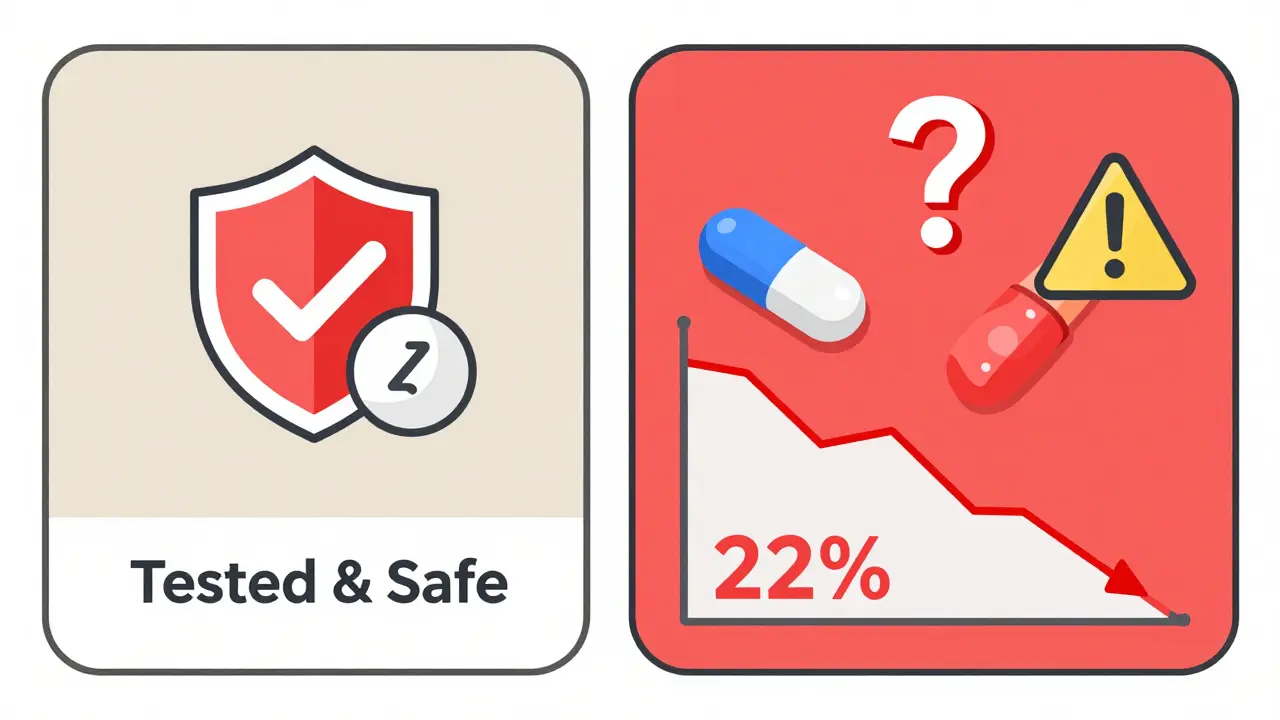
Regulators Are Watching
The FDA and EMA are starting to take notice. In January 2023, the FDA issued a safety alert after 147 adverse events were linked to untested combinations of separate generics. They didn’t name specific drugs-but they made it clear: unmonitored combinations are a growing concern. The EMA launched a 2023-2025 project to study the real-world impact of off-label combinations. Early findings suggest that up to 30% of de facto combinations in Europe lack clear clinical justification. Meanwhile, pharmaceutical companies are innovating. AstraZeneca filed a patent in 2022 for a modular FDC system that lets patients adjust doses within a single pill. It’s not mainstream yet-but it’s a sign of where things are headed.What You Should Do
If you’re on separate generics instead of an FDC, ask yourself these questions:- Why am I taking multiple pills? Is it because the FDC dose doesn’t fit my needs? Or just because it’s cheaper?
- Do I have a clear schedule? Are you using a pill organizer? A phone reminder? A printed chart?
- Has my doctor checked for interactions? Are these generics from the same manufacturer? Have they been tested together?
- Is my adherence slipping? Have you missed doses? Felt overwhelmed?
The Future of Combination Therapy
The goal isn’t to ban de facto combinations. It’s to make them safer. In the next five years, electronic prescribing systems will start flagging inappropriate combinations. Insurance companies may start requiring prior authorization for multiple generics when an FDC exists. Some states are already piloting programs that bundle combination therapy support into primary care. But until then, the burden falls on you. Don’t assume separate pills are automatically better. Don’t assume they’re cheaper. Don’t assume they’re safer. Sometimes, one pill really is better than two.Are de facto combinations illegal?
No, de facto combinations are not illegal. Doctors can legally prescribe separate generic drugs even when an FDC exists. But while it’s legal, it’s not always safe or supported by evidence. Regulators don’t approve these combinations-they just don’t stop doctors from prescribing them.
Can I just switch from an FDC to separate generics myself?
No. Never switch your medication without talking to your doctor or pharmacist. The dosages in FDCs are carefully balanced. Taking separate pills without adjusting the amounts could lead to underdosing or overdosing. Even if the ingredients are the same, the way they’re absorbed can differ between brands.
Why aren’t FDCs always the best option?
FDCs work well when the fixed ratio matches your needs. But if you need different doses of each drug-say, a lower dose of one component due to kidney issues-an FDC might force you to take too much of one drug or not enough of another. That’s why separate generics can be necessary in specific cases.
Do separate generics cost less than FDCs?
It depends. In some markets, especially where multiple generic manufacturers compete, separate pills can be cheaper. But in others, FDCs are priced lower because manufacturers save on packaging and distribution. Always check with your pharmacy. Sometimes the FDC is actually the better deal.
What can I do to stay safe if I’m on separate generics?
Use a pill organizer with labeled compartments. Set phone reminders for each pill. Ask your pharmacist for a printed schedule with colors or icons. Never mix pills from different manufacturers unless approved. And if you miss a dose, don’t double up-call your doctor.
sagar patel
December 26, 2025 AT 11:23Doctors in India prescribe separate generics because FDCs are often overpriced even as generics. I’ve seen patients pay 300 rupees for a combo pill that costs 80 rupees as two separate tablets. No one tests interactions here either. We just hope for the best.
Christopher King
December 26, 2025 AT 13:31Let me guess-Big Pharma pushed FDCs so they could charge more. They don’t care if you live or die. They care if you buy their branded combo. The FDA? Totally bought off. You think they’d warn about mixing generics? Nah. They’re too busy protecting profits. This is why people get sick. It’s not medicine-it’s a corporate racket.
Terry Free
December 27, 2025 AT 17:14So you’re telling me the system is broken because doctors are lazy? No. It’s because FDCs are often priced like luxury goods while generics are dirt cheap. If you can’t afford the combo, you take the pills. That’s not negligence. That’s capitalism.
Sophie Stallkind
December 28, 2025 AT 13:03Thank you for this comprehensive and clinically grounded analysis. The adherence data presented is particularly compelling. I would strongly encourage all patients on multiple generics to engage in structured medication reconciliation with their pharmacist, as recommended.
Linda B.
December 29, 2025 AT 13:25Did you know the FDA has a secret database of all the generic manufacturers that fail bioequivalence tests? They don’t tell you. They just let pharmacies stock them. Your blue pill? Could be from a plant in China that got flagged in 2019. But hey-it’s cheap. That’s the American way.
Michael Dillon
December 29, 2025 AT 14:38Actually, I’ve been on separate generics for 8 years. Never missed a dose. I use a pillbox. I set alarms. I read the labels. People who say they forget are just bad at organizing their lives. Don’t blame the pills.
Gary Hartung
December 29, 2025 AT 15:42It’s not just about adherence-it’s about epistemological instability. When you mix generics from three different manufacturers, you’re essentially constructing a polypharmaceutical chimera. No one has mapped the pharmacokinetic interplay. We are all unwitting participants in an uncontrolled, decentralized clinical trial. And the placebo effect? It’s the only thing holding us together.
Ben Harris
December 30, 2025 AT 13:43I had a neighbor take four separate generics for hypertension and ended up in the ER because one batch was contaminated with lead. The pharmacy didn’t even know they were from different suppliers. They just grabbed whatever was on the shelf. This isn’t healthcare. It’s Russian roulette with a prescription pad.
Oluwatosin Ayodele
January 1, 2026 AT 08:58In Nigeria, FDCs are rare. We use separate generics because the supply chain doesn’t support combo pills. Pharmacies don’t stock them. Doctors don’t prescribe them. We manage because we have no choice. The problem isn’t the practice-it’s the lack of infrastructure. Stop pretending this is a Western problem.
Jason Jasper
January 1, 2026 AT 16:47I’ve seen both sides. My dad took the combo. I took the separate pills. He never missed a dose. I forgot sometimes. But I could adjust my dose when my kidney numbers changed. There’s no one-size-fits-all. The key is communication-with your doctor, your pharmacist, yourself.
Mussin Machhour
January 3, 2026 AT 06:05My grandma uses a pill organizer with colors and pictures. She calls them ‘the happy pills’-blue for blood pressure, red for sugar. She never misses. Simple tools make all the difference. You don’t need fancy tech. You just need to care enough to set it up.
Carlos Narvaez
January 4, 2026 AT 00:25Adherence stats are misleading. They assume all patients are equal. But what about the 40-year-old working two jobs? Or the veteran with PTSD? They don’t need more pills. They need support. The system fails them. Not the pills.
Harbans Singh
January 5, 2026 AT 10:48I’m a pharmacist in Delhi. We see this every day. A patient comes in with three separate generics. I ask why. They say, ‘My doctor said it’s cheaper.’ I check the prices. The FDC is actually 15% cheaper. But the doctor didn’t know. That’s the real problem-lack of awareness. We need better training. Not more pills.
Justin James
January 5, 2026 AT 15:01Here’s what they won’t tell you: the reason FDCs are so rare in the U.S. isn’t cost-it’s patent evergreening. Big Pharma delays generic combos by filing frivolous patents on packaging or delivery methods. They know if you can’t combine the drugs in one pill, you’ll keep buying two separate ones. And guess what? That’s where the real profit is. This isn’t about safety. It’s about corporate monopolies masquerading as public health policy. The FDA’s ‘safety alert’? A distraction. They’ve been asleep at the wheel for 15 years.
Zabihullah Saleh
January 7, 2026 AT 06:06It’s funny. In my village in Afghanistan, people take herbs and pills together. No one checks interactions. They just know what works. Maybe the answer isn’t more regulation. Maybe it’s more trust-in patients, in tradition, in the quiet wisdom of people who’ve survived longer than any pill ever will.