
Carbamazepine Generics: Enzyme Induction and Drug Interactions Explained
 Feb, 24 2026
When you're taking carbamazepine for epilepsy or nerve pain, you might not realize that switching from one generic version to another could change how well it works-or even make you sicker. This isn't just a pharmacy mix-up. It's a real, documented risk tied to how carbamazepine behaves in your body. And it's why doctors and pharmacists are increasingly cautious about switching brands, even when the label says "bioequivalent."
Why Carbamazepine Is Different
Carbamazepine isn't like most other seizure meds. Most drugs in your system stay pretty stable once you take them. Carbamazepine? It changes the way your body processes itself-and everything else you take. It’s a powerful enzyme inducer. That means it speeds up the activity of liver enzymes, especially CYP3A4, which handles about half of all prescription drugs. This isn't a minor effect. It starts within 48 to 72 hours of starting the drug, peaks in 2 to 3 weeks, and can linger for weeks after you stop.This enzyme surge doesn't just affect carbamazepine itself-it drops the levels of many other medications. Warfarin, birth control pills, statins, certain antidepressants, HIV drugs, and even immunosuppressants like cyclosporine can become less effective. In one case, a woman on carbamazepine and birth control got pregnant because the pill's hormone levels dropped below the threshold needed to prevent ovulation. That’s not rare. It’s predictable. And it’s why the FDA lists over 20 drugs with clear warnings about carbamazepine interactions.
The Narrow Window Between Help and Harm
Carbamazepine has a very narrow therapeutic range: 4 to 12 micrograms per milliliter in the blood. Go below 4, and seizures might return. Go above 12, and you risk dizziness, double vision, nausea, or even life-threatening toxicity. That’s a tight margin. For comparison, many other drugs have ranges that are twice as wide.And here’s the kicker: people absorb and process carbamazepine differently. One person might need 600 mg a day to stay in range, while another needs 1,200 mg. That variability is why about 70% of people on carbamazepine need regular blood tests to monitor levels. It’s not optional-it’s essential.

Generic Switches Aren’t Always Safe
All generic carbamazepine tablets must meet FDA standards: they must deliver 80% to 125% of the brand-name drug’s absorption. Sounds fair, right? But for a drug with a narrow window and autoinduction properties, that 45% range is too wide. Two generics can both be "bioequivalent" to the brand, but not to each other.A 2018 study of 327 epilepsy patients found that 12.4% had seizures or side effects after switching between generic brands-even though all met regulatory standards. Over 7% ended up in the ER. One patient reported her carbamazepine level dropped from 7.2 to 4.8 mcg/mL after switching from Tegretol XR to a generic. Her seizure frequency jumped from once a month to four or five times a week.
Why? Because different manufacturers use different fillers, coatings, and release mechanisms. For extended-release versions, the tiny beads inside the capsule that control how slowly the drug is released can vary in size or composition. A patient with gastroparesis (delayed stomach emptying) might absorb one generic’s beads perfectly, but another’s might pass through too fast-causing a spike in levels and toxicity.
Gender, Genetics, and Other Hidden Factors
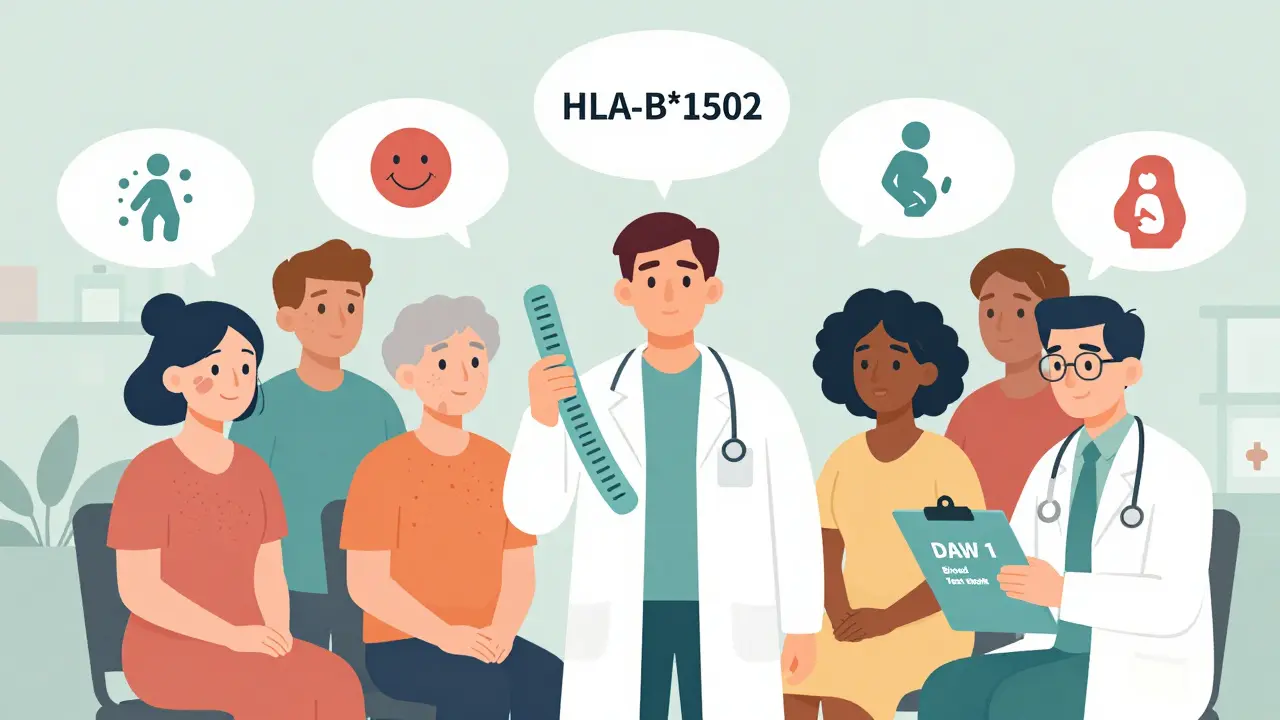
Your biology plays a big role. Women, especially those of childbearing age, metabolize carbamazepine faster than men. Hormones like estrogen boost CYP3A4 activity. A 2021 study in JAMA Neurology showed women on carbamazepine had 22% more breakthrough seizures after switching generics-likely because their bodies were processing the new version differently.Genetics matter too. People with the HLA-B*1502 gene variant-common in Asian populations-are at 10 times higher risk of developing Stevens-Johnson Syndrome, a deadly skin reaction. The FDA recommends genetic testing before starting carbamazepine for anyone with Asian ancestry. If you carry this gene, carbamazepine shouldn’t be your first choice.
Other gene variants like CYP3A4*22 can make you a slow metabolizer. These patients need lower doses, but without testing, they’re often prescribed the same dose as everyone else. A 2023 study in Scotland identified 17 genetic markers affecting carbamazepine metabolism. We’re moving toward precision dosing-but we’re not there yet.
What You Should Do
If you’re on carbamazepine, here’s what matters:- Don’t switch brands without talking to your doctor. Even if your pharmacy says it’s the same, ask which manufacturer you’re getting. Keep using the same one.
- Ask for "dispense as written" (DAW 1) on your prescription. This stops automatic substitution. About 68% of U.S. neurologists already do this for carbamazepine patients.
- Get blood levels checked before and after any switch. Monitor at 7-10 days and again at 4 weeks. If levels change by more than 15%, your dose may need adjusting.
- Watch for warning signs. New dizziness, confusion, rash, or more seizures? Call your neurologist. Don’t wait.
- Know your meds. If you take birth control, blood thinners, or antidepressants, talk to your doctor about potential interactions.
Pharmacists can help too. When filling a carbamazepine script, they should check the manufacturer against your previous fill. The FDA’s Orange Book lists 12 different manufacturers for just the 200 mg tablet. That’s not a typo-it’s a risk.
The Bigger Picture
Carbamazepine generics make up over 90% of prescriptions in the U.S., but they cost less than $9 for a 30-day supply. That low price comes with trade-offs. Regulatory standards were designed for drugs with wide therapeutic windows. Carbamazepine doesn’t fit. The FDA and EMA now classify it as a narrow therapeutic index (NTI) drug, and they’re updating testing rules. By 2025, the FDA plans to require steady-state studies-not just single-dose tests-for carbamazepine generics.Meanwhile, patient stories keep piling up. On epilepsy forums, people describe sudden seizures, rashes, and hospitalizations after a pharmacy switch. One user wrote: "I thought generics were interchangeable. I was wrong. I almost died."
Experts agree: carbamazepine is one of the riskiest AEDs for generic substitution. The American Academy of Neurology advises against switching in patients with poorly controlled seizures. The American Epilepsy Society says: "If it ain’t broke, don’t fix it."
Carbamazepine saves lives. But it demands respect. It’s not a simple pill. It’s a powerful, unpredictable tool. And when you’re on it, your safety depends on consistency, monitoring, and clear communication-with your doctor, your pharmacist, and yourself.
Can I switch between different generic versions of carbamazepine safely?
Switching between generic versions of carbamazepine carries real risk. Even though all generics must meet FDA bioequivalence standards, studies show that 12% of patients experience breakthrough seizures or side effects after a switch. This is because carbamazepine has a narrow therapeutic range (4-12 mcg/mL) and its own metabolism is affected by the drug itself (autoinduction). Small differences in how the drug is released-due to fillers, coatings, or bead size-can lead to dangerous drops or spikes in blood levels. Never switch without consulting your neurologist and checking your blood levels before and after.
Why do I need blood tests if I’m taking carbamazepine?
Carbamazepine’s effectiveness and safety depend on staying within a very narrow blood concentration range: 4 to 12 mcg/mL. Below 4, seizures may return. Above 12, you risk toxicity like dizziness, nausea, or even coma. Because people metabolize the drug differently-due to age, sex, genetics, or other medications-your ideal dose can’t be predicted. About 65-75% of patients need regular therapeutic drug monitoring (TDM) to stay safe. Blood tests are not optional; they’re essential for preventing both seizures and overdose.
Does carbamazepine interact with birth control pills?
Yes. Carbamazepine strongly induces liver enzymes that break down hormones, including those in birth control pills. This can reduce their effectiveness by up to 50%, increasing the risk of unintended pregnancy. The FDA and major medical societies recommend using a non-hormonal method (like an IUD) or doubling the dose of hormonal contraception if you must use it. Always discuss this with your doctor before starting carbamazepine if you’re using birth control.
Is genetic testing necessary before taking carbamazepine?
For people of Asian descent, yes. The HLA-B*1502 gene variant increases the risk of Stevens-Johnson Syndrome (SJS), a life-threatening skin reaction, by 10 times. The FDA recommends testing before starting carbamazepine for anyone with ancestry from China, Thailand, Malaysia, the Philippines, or other Southeast Asian countries. If you test positive, carbamazepine should be avoided. Alternative medications like levetiracetam are safer. Even if you’re not of Asian descent, some experts now recommend testing for high-risk patients due to rare cases in other populations.
What should I do if my pharmacy switches my carbamazepine brand?
If your pharmacy switches your carbamazepine without your knowledge, contact your doctor immediately. Don’t wait for symptoms. Ask for a blood test to check your drug level within 7-10 days. Document the new manufacturer’s name (it’s often printed on the bottle). If your level dropped by more than 15%, your dose may need adjustment. In the future, ask your doctor to write "dispense as written" (DAW 1) on your prescription to prevent automatic substitution. You have the right to know and control what you’re taking.
Timothy Haroutunian
February 24, 2026 AT 15:38Let me tell you something that no one else will: carbamazepine isn’t just a drug. It’s a biological grenade with a pin pulled, and we’re all standing in the same room pretending we don’t hear the ticking. I’ve been on it for nine years. Switched generics once because my insurance flipped the script. Two weeks later, I was having three seizures in one night-no warning, no warning at all. My neurologist had to admit he didn’t see it coming either. The blood levels? Dropped 32%. The pharmacy? Said it was "bioequivalent." Bioequivalent? My body didn’t get the memo. I now keep the bottle from my original fill in a drawer like a religious relic. If your pharmacy tries to swap it out, walk out. Don’t argue. Just leave. And if they ask why? Tell them Timothy Haroutunian said so. I’ve got the ER records to prove it.
They talk about "narrow therapeutic windows" like it’s some abstract lab concept. No. It’s your brain on fire. It’s your boyfriend staring at you like you’re a stranger because you forgot your own name for three hours. It’s your mom crying in the kitchen because she thinks you’re going to die on the bathroom floor again. This isn’t about cost savings. This is about who gets to decide what your life is worth.
The FDA’s "80-125%" rule? That’s not science. That’s corporate math. They’re okay with one in eight people having seizures because it saves $12 a month. I’ve seen the spreadsheets. I’ve seen the meetings. And I’ve seen the people who got left behind. Don’t let them do this to you. Demand DAW-1. Now. Not tomorrow. Not when you’re stable. Now.
And if you think generics are interchangeable? You’re either lying to yourself or you’ve never held your child while they’re seizing. I’ve done both. Trust me. This isn’t a debate. It’s a survival protocol.
Gwen Vincent
February 26, 2026 AT 06:46I appreciate how thorough this post is. Honestly, it’s the kind of thing I wish every pharmacist would print out and hand to patients instead of just handing over a new bottle with a different logo.
I’m a nurse who’s seen this play out too many times. A patient on carbamazepine for 12 years, stable as a rock, then gets switched because of a formulary change. Two weeks later, she’s back in the clinic with tremors, slurred speech, and a level of 3.1. We had to re-stabilize her over six weeks. She cried the whole time. Not because she was scared of seizures-but because she felt like her body had been betrayed.
I always tell my patients: if you’ve been on the same generic for years, don’t let them change it. Period. Even if the name on the pill is different, the way your body learned to handle it matters. It’s not magic. It’s biology. And biology doesn’t like surprises.
Also-yes, the birth control interaction is terrifying. I had a 24-year-old patient get pregnant after switching generics. She was on the pill for three years. Hadn’t missed a dose. Didn’t even know carbamazepine affected it. She didn’t even know she was pregnant until she showed up in labor. That’s not a statistic. That’s a human life. We need better warnings. Not just fine print.
Nandini Wagh
February 28, 2026 AT 06:04Oh honey. You wrote a 10-page essay and called it "an explanation."
Let me summarize: switching carbamazepine generics can kill you. The FDA doesn’t care. Your insurance definitely doesn’t care. And your pharmacist? They’re just trying to get through lunch.
Meanwhile, in India, we’ve been using generics for decades. No one’s getting seizures. No one’s in the ER. We just… take the pill. And we live.
Maybe it’s not the drug. Maybe it’s the American obsession with control. You need to monitor your levels. You need to track your beads. You need to know the manufacturer’s name like it’s your ex’s birthday.
Just… chill. Take the pill. Call your doctor if you feel weird. That’s it. You don’t need a 12-point plan. You need a nap.
Also-HLA-B*1502? Yeah, we test for that here. But we don’t make it a Hollywood movie. We just don’t give you the drug if you’re positive. Simple. Done.
Maybe stop panicking. And start breathing.
Holley T
February 28, 2026 AT 21:40Here’s the thing nobody wants to admit: the entire system is designed to make you feel powerless. They tell you generics are "bioequivalent," but they never tell you that "bioequivalent" means a 45% swing in absorption. That’s not science. That’s a loophole. And they exploit it because they know you won’t fight back.
They’ll say, "It’s the same active ingredient." Yes. But the fillers? The coating? The release profile? Those are proprietary. That’s why one manufacturer’s tablet dissolves in 40 minutes and another’s takes 120. For most drugs? No big deal. For carbamazepine? That’s a death sentence waiting to happen.
And don’t get me started on the gender gap. Women metabolize it faster. Why? Because estrogen. And yet, dosing guidelines? Still based on male physiology. That’s not oversight. That’s sexism wrapped in a white coat.
Genetic testing? Only for Asians? That’s not precision medicine. That’s racial profiling with a lab report. We’ve got 17 genetic markers affecting metabolism. Why test for one and ignore the rest? Because it’s cheaper.
And the FDA’s "update by 2025"? That’s not progress. That’s damage control. They’ve known this since the 90s. They just didn’t care until enough people died.
So yes. Demand DAW-1. Demand blood tests. Demand to know who made your pill. Because if you don’t, someone else will decide what your brain is worth. And they’ll do it while saving $0.37 per tablet.
Lillian Knezek
March 1, 2026 AT 04:33Okay, but what if this is all a lie? What if the FDA and pharma are working together to push expensive brand-name drugs by scaring people into staying on them? What if the "seizures after switching" are actually caused by stress? Or electromagnetic waves from 5G? Or the moon? I’ve read that lunar cycles affect seizure thresholds.
And what about the "HLA-B*1502" thing? Isn’t that just a way to make Asians seem more "vulnerable" so they can be excluded from trials? Or worse-pushed into cheaper, less monitored generics?
I know someone who switched generics and had a rash. She went to the doctor. They told her it was "stress." Two weeks later, she was in the ICU. They said it was SJS. But then the hospital sent her a bill for $87,000. Coincidence? I think not.
Who profits from this? The labs that do blood tests. The neurologists who charge $400 for a 15-minute visit. The pharmacies that sell you a $20 bottle of brand-name carbamazepine and then charge you $120 for a "special monitoring package."
And don’t get me started on the "dispense as written" thing. That’s just a way to keep you dependent. They want you to feel like you can’t trust your own body. Like you need permission to exist.
I’m not switching. I’m not testing. I’m not taking blood tests. I’m going off the grid. I’ve started taking turmeric. And I’m sleeping in a Faraday cage. You’re welcome, future me.
Maranda Najar
March 2, 2026 AT 15:28I read this and I wept. Not because I’m dramatic-though I am-but because this is the quiet tragedy of modern medicine. We’ve turned human beings into data points. We’ve reduced the trembling, the confusion, the terror of a seizure to a percentage on a spreadsheet. We’ve made a life-saving drug into a cost-cutting exercise.
I know a woman. 38. Mother of two. Epilepsy since 17. Took carbamazepine for 21 years. Never missed a dose. Never had a breakthrough. Then, last year, her insurance switched her to a new generic. No warning. No consultation. Just a different label.
She had a seizure while driving. Her daughter was in the backseat. She didn’t remember it. The car spun. No one died. But the girl? She hasn’t spoken to her mother since. The trauma? The fear? The guilt? It’s not in the FDA’s risk assessment.
And when she went to her neurologist? He said, "Well, your level was 4.2. That’s still in range."
4.2? That’s the bottom of the cliff. That’s the edge. That’s not "in range." That’s "one breath away from oblivion."
They call this progress. I call it moral bankruptcy wrapped in a white coat and a pharmacy receipt.
And yet-we still trust them. We still take the pill. We still believe the label. We still don’t ask for DAW-1. We don’t demand blood tests. We don’t question the manufacturer.
We’re not patients. We’re receipts.
Kenzie Goode
March 3, 2026 AT 16:52I just want to say thank you for writing this. I’ve been on carbamazepine for seven years. I’ve had two switches. Both times, I felt off-dizzy, foggy, like my thoughts were underwater. I didn’t connect it to the pill. I thought I was just stressed.
Then I read your post. I called my pharmacist. They told me the last two fills were from different manufacturers. I called my neurologist. She ordered a blood test. My level was 3.8. I was on the edge. She immediately switched me back to my original brand-and wrote DAW-1 on the script.
I didn’t know I had that power. I thought I had to take whatever they gave me. I didn’t realize I could say, "No. I need this one."
So thank you. Not just for the facts-but for the permission. Permission to be scared. Permission to ask. Permission to demand. I didn’t know I was allowed to fight for my own brain.
And yes-I’m keeping the bottle. The original one. With the same manufacturer. I’m not letting them take that from me again.
Dominic Punch
March 3, 2026 AT 21:24Let’s cut through the noise. This isn’t about generics. It’s about systemic neglect. Carbamazepine is a high-risk drug. It has a narrow therapeutic window. It auto-induces its own metabolism. It interacts with half the medications on the market. And yet, we treat it like ibuprofen.
Here’s what needs to happen:
1. The FDA must classify carbamazepine as an NTI drug for ALL formulations-not just brand-name. That means every generic must undergo steady-state pharmacokinetic studies, not just single-dose bioequivalence.
2. Pharmacists must be required to track and log manufacturer changes. Every time you switch, it must be documented in the patient’s record. No exceptions.
3. Prescriptions must default to DAW-1 unless the patient explicitly opts out. Not the other way around.
4. Genetic testing for HLA-B*1502 must be mandatory for all patients before initiation-no exceptions. Period.
5. Insurance companies must be prohibited from forcing switches on NTI drugs. Period.
This isn’t about fear. It’s about responsibility. We don’t let people swap insulin generics. We don’t let them swap warfarin. Why? Because we know the stakes.
Carbamazepine deserves the same respect. And until we treat it that way, people will keep dying. Not because they’re careless. But because the system is broken.
Stop asking for permission. Start demanding change. Your life isn’t a cost center.