
Barrett’s Esophagus: Understanding Dysplasia Risk and Effective Ablation Options
 Feb, 16 2026
Barrett’s Esophagus isn’t just a buzzword in gastroenterology-it’s a real, measurable step toward esophageal cancer. If you’ve had chronic heartburn for years, especially if you’re a man over 50, this condition might be silently changing the lining of your esophagus. And left unchecked, it can lead to something far more dangerous: esophageal adenocarcinoma. The good news? We now have powerful tools to stop it in its tracks. The bad news? Many people don’t even know they have it until it’s too late.
What Exactly Is Barrett’s Esophagus?
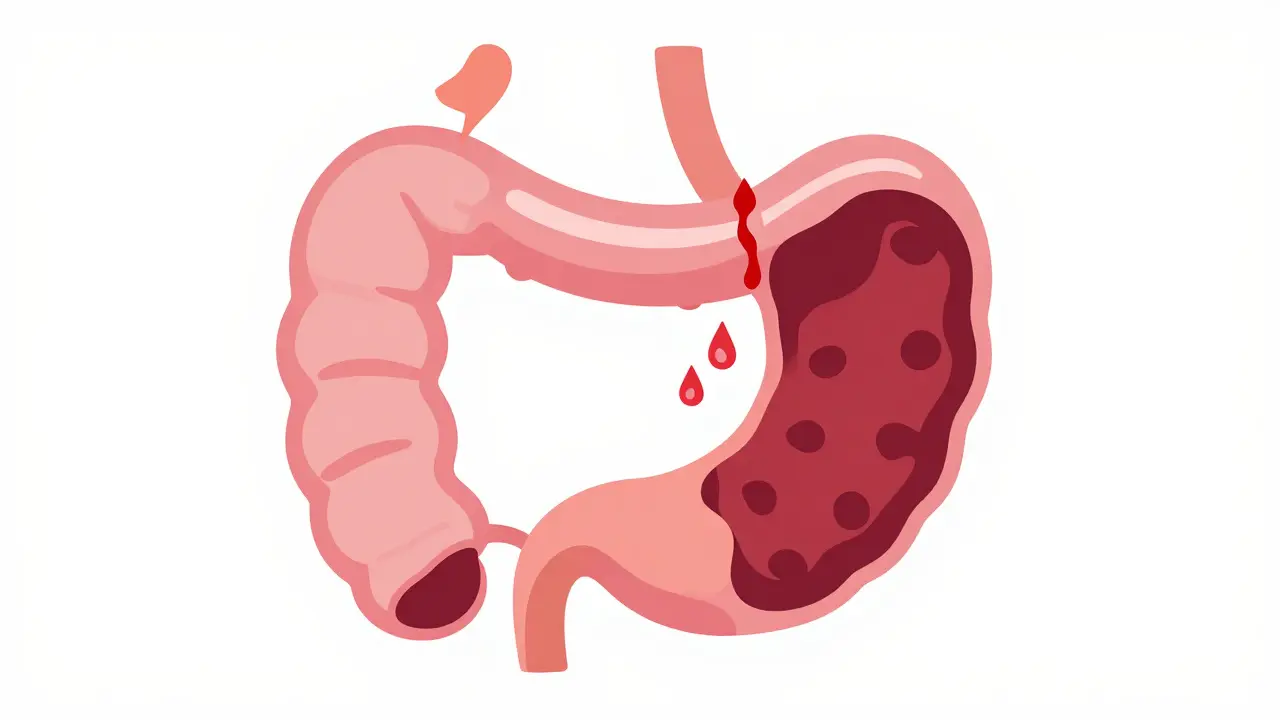
Barrett’s Esophagus happens when the normal tissue lining your esophagus-soft, flat, squamous cells-gets replaced by tougher, columnar cells that look more like the lining of your intestines. This change, called metaplasia, is your body’s attempt to protect itself from long-term acid damage caused by GERD. But it’s not a fix. It’s a warning sign.
It doesn’t happen overnight. Usually, it takes at least five years of frequent heartburn or acid reflux-think weekly symptoms-to trigger it. Studies show that only about 10-15% of people with chronic GERD develop Barrett’s, but among those who do, the risk of cancer jumps dramatically. Men are two to three times more likely than women to develop it. White individuals have a higher risk than South Asian populations. And if you’re overweight, especially with belly fat, your risk goes up again.
Here’s the scary part: esophageal adenocarcinoma is one of the fastest-growing cancers in the Western world. Since the 1970s, its incidence has gone up over 600%. But here’s the hope: if caught early, survival rates jump from 20% to over 80%. That’s why detecting Barrett’s before it turns cancerous is everything.
How Do You Know If You’re at Risk for Dysplasia?
Dysplasia is the term doctors use for abnormal cell changes that aren’t cancer yet-but are heading there. Think of it as a traffic light: green (no dysplasia), yellow (low-grade), red (high-grade).
Low-grade dysplasia (LGD) means some cells look odd under the microscope. It’s not cancer, but it raises your risk fivefold. High-grade dysplasia (HGD) is even more alarming-cells are very abnormal, and the chance of turning into cancer within a year can be as high as 40%. That’s why once dysplasia is found, waiting and watching isn’t enough.
Not all Barrett’s is equal. If your Barrett’s segment is longer than 3 cm, your risk climbs. If you smoke, drink caffeine regularly, or have a hiatal hernia, you’re stacking the deck. A 2023 study showed that people with Barrett’s longer than 10 cm had over 10 times the risk of progression compared to those with shorter segments.
Even if you’re on proton pump inhibitors (PPIs) like omeprazole or esomeprazole, acid exposure can still be happening. Studies found that persistent acid reflux despite medication increases progression risk by over 7 times. That’s why simply taking a pill isn’t a cure-it’s just damage control.
The Ablation Options: RFA, Cryoablation, and More
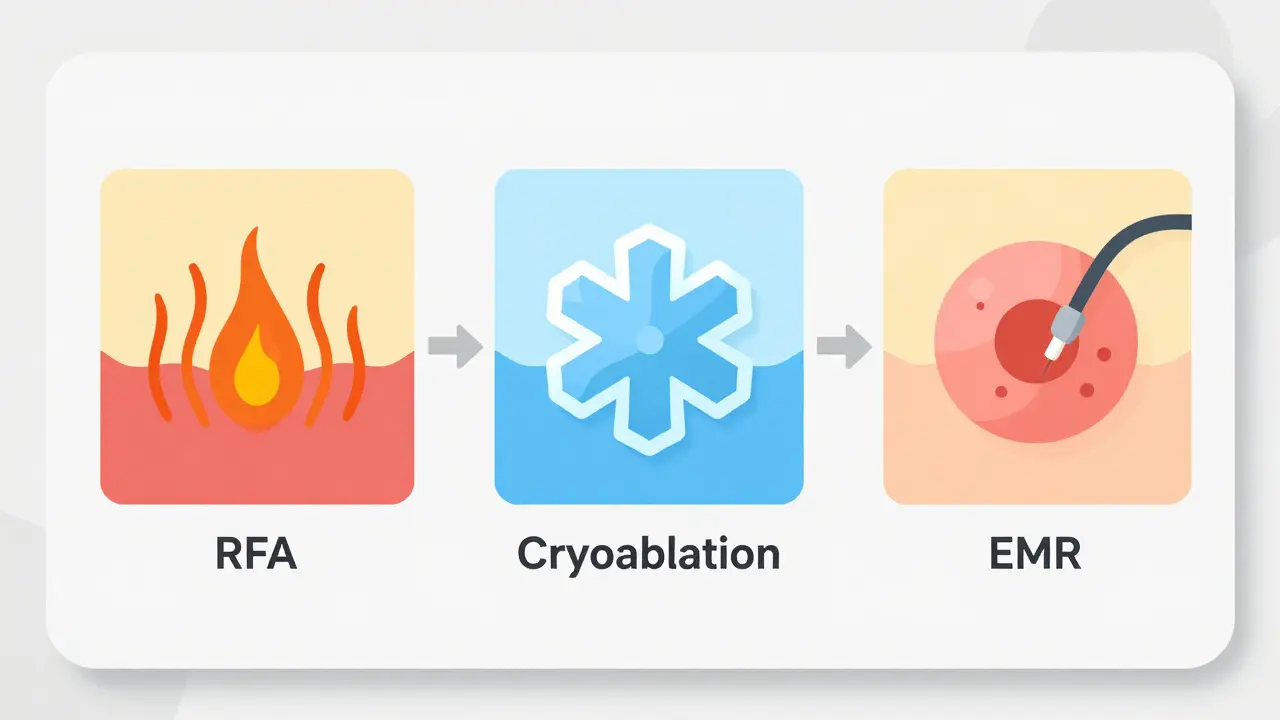
When dysplasia is confirmed, the goal isn’t just to monitor-it’s to remove the bad tissue. That’s where ablation comes in. There are three main methods used today, and they’re not all created equal.
Radiofrequency Ablation (RFA)
RFA is the gold standard. It uses controlled heat to burn off the abnormal tissue while leaving healthy layers underneath untouched. The HALO360 catheter treats the whole circumference of the esophagus, while HALO90 targets specific spots. In clinical trials, RFA cleared intestinal metaplasia in 77% of patients and dysplasia in nearly 88% after one year.
It’s not perfect. About 6% of patients develop strictures-narrowing of the esophagus that makes swallowing painful. Most can be fixed with simple dilation procedures, but it’s not fun. One Reddit user described it: “Four dilation sessions after RFA. The pain was worse than the reflux.” Still, RFA is used in 78% of all ablation procedures because it works consistently and has fewer side effects than older methods.
Cryoablation
Cryoablation uses freezing-nitrous oxide cooled to -85°C-to destroy abnormal cells. It’s newer, less invasive, and surprisingly effective. A 2021 trial showed 82% success in eliminating dysplasia. The big advantage? Lower stricture rates. Only 2.8% of patients had strictures compared to 6.2% with RFA. That makes it a smart choice for people who’ve had prior esophageal damage.
It’s also gentler on the tissue. Some patients report less pain afterward. One user on Inspire said, “My chronic cough from reflux disappeared after cryoablation. Worth every uncomfortable moment.”
Photodynamic Therapy (PDT) and EMR
PDT used to be common. It involves injecting a light-sensitive drug, waiting 48 hours, then shining a laser to kill abnormal cells. But it leaves patients extremely sensitive to sunlight for weeks. Strictures happen in 17% of cases. It’s rarely used now.
Endoscopic mucosal resection (EMR) is different. Instead of burning or freezing, it lifts and cuts out visible lesions-like removing a mole. It’s great for early tumors or large areas of dysplasia, with a 93% success rate in removing tissue in one piece. But it carries a small risk of bleeding (5-10%) and perforation (2%). It’s often used before RFA or cryoablation to clear the worst areas.
Comparing Treatments: What Works Best?
Here’s a quick look at how these methods stack up:
| Method | Dysplasia Eradication Rate | Stricture Rate | Common Side Effects | Cost per Procedure |
|---|---|---|---|---|
| Radiofrequency Ablation (RFA) | 87.9% | 6.2% | Esophageal pain, stricture (manageable) | $12,450 |
| Cryoablation | 82% | 2.8% | Mild discomfort, less pain | $9,850 |
| Photodynamic Therapy (PDT) | 77% | 17% | Severe photosensitivity, strictures | $11,200 |
| EMR (for visible lesions) | 93% (en bloc removal) | 1-3% | Bleeding, perforation risk | $10,500 |
For most patients, RFA remains the top choice. But cryoablation is gaining ground-especially for those with prior strictures or who want fewer complications. The key? It’s not just about which method works best-it’s about which one works best for you.
Why Some People Get Unnecessary Treatment
Here’s a dark secret: a lot of ablation procedures happen without clear need. Why? Because diagnosing dysplasia isn’t as simple as it sounds.
Pathologists-doctors who look at tissue under the microscope-disagree on whether a sample shows low-grade dysplasia about 45% of the time. Community labs get it right only 55% of the time compared to expert centers. That means some people are getting expensive, uncomfortable treatments for something that might not even be real.
Dr. Stuart Spechler from Baylor University found that 25-30% of ablation procedures in Medicare data were done on patients without true dysplasia. That’s not just wasteful-it’s harmful. Every procedure carries risk. You don’t need ablation if you have no dysplasia. Regular surveillance with high-definition endoscopy and the Seattle biopsy protocol (taking 4 samples every 2 cm) is enough.
Bottom line: get a second opinion. If you’re told you have low-grade dysplasia, ask if your slides were reviewed by a GI pathologist who specializes in Barrett’s. Don’t rush into ablation.
What Happens After Treatment?
Ablation isn’t a one-and-done fix. Even after successful treatment, you still need follow-up.
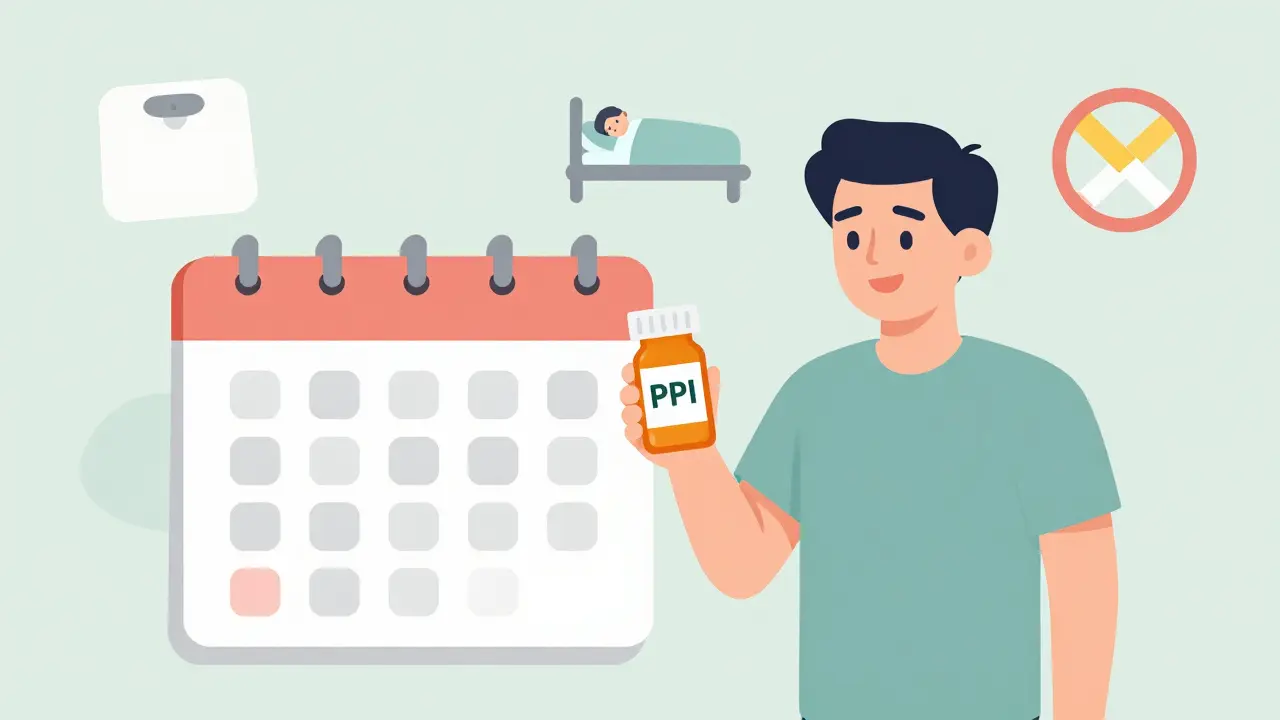
Studies show that 18% of RFA patients need retreatment within two years. With cryoablation, it’s 32%. Why? Because the root cause-GERD-is still there. You still need to take PPIs. You still need to avoid lying down after meals. You still need to lose weight if you’re overweight.
The 2023 CHEERS trial proved something critical: doubling your PPI dose (esomeprazole 40mg twice daily) cuts recurrence risk from 25% down to just 8%. That’s a game-changer. Ablation removes the bad cells-but PPIs stop new ones from forming.
And you’ll still need endoscopies. Usually, one year after ablation, then every 1-3 years after that. The goal? Catch any recurrence early.
What’s Next? AI and Biomarkers
The future is getting smarter. Google Health’s AI system, tested in 2024, spotted dysplasia with 94% accuracy-better than most human endoscopists. That could mean fewer missed cases.
And there’s a new blood test on the horizon: TFF3 methylation testing. It looks for DNA changes linked to Barrett’s progression. Early data shows it could reduce unnecessary endoscopies by 30%. Imagine knowing your risk without a scope.
By 2035, experts predict a 45% drop in esophageal cancer deaths thanks to better screening and ablation. But only if we fix access. Rural patients are 2.3 times more likely to die from Barrett’s-related cancer than those in cities. Why? Fewer specialists. Fewer endoscopists trained in ablation.
What Should You Do If You Have Barrett’s?
- If you have no dysplasia: Stick to regular endoscopies (every 3-5 years) and take your PPIs. No ablation needed.
- If you have low-grade dysplasia: Talk to a specialist. Get a second opinion on your biopsy. If confirmed, ablation (RFA or cryoablation) reduces cancer risk by 90%.
- If you have high-grade dysplasia: Ablation is the standard. Don’t delay.
- Always manage GERD: Lose weight, avoid caffeine, don’t eat before bed, sleep with your head elevated.
- Don’t smoke. It’s one of the biggest drivers of progression.
Barrett’s Esophagus isn’t a death sentence. It’s a chance to act. The tools to stop it are here. The knowledge is here. The question is: are you ready to use them?
Dennis Santarinala
February 16, 2026 AT 18:27Just read through this whole thing, and honestly? I’m impressed. Barrett’s isn’t talked about enough, and the way this breaks down ablation options is actually useful. I’ve had GERD for 12 years-never thought it’d lead to this. But now I get it: it’s not about the heartburn anymore. It’s about the silent rewrite of my esophagus.
And yeah, I’m getting that second opinion on my biopsy. No way I’m letting a community lab make that call. Pathology isn’t magic-it’s messy. And I’d rather be safe than sorry.
Also, 80% survival if caught early? That’s the kind of stat that makes you stop scrolling and start acting. Thanks for this.
Haley DeWitt
February 18, 2026 AT 07:50This is so helpful!! 😊 I’ve been on PPIs for 5 years and thought I was ‘fixed’… turns out I was just masking the problem. Now I’m scheduling an endoscopy next week. Also, cryoablation sounds way less terrifying than RFA-less pain, lower stricture risk? Yes please. 🙌
Also, I’m gonna start sleeping with my head elevated. No more midnight snacks. No more wine after 8. This is my new life now. 💪
Liam Earney
February 20, 2026 AT 03:32Let me tell you something, because I’ve been there-twice-and I’m not just some guy on the internet. I had RFA, then I had a stricture, then I had three dilations, then I had another round because the dysplasia came back. And you know what? The whole time, I was still drinking coffee, still eating pizza at midnight, still lying down after dinner. So don’t pretend ablation is a cure. It’s a band-aid on a hemorrhage.
The real issue? We treat the tissue, not the lifestyle. We fix the cell, not the cause. And that’s why recurrence rates are what they are. I’m not against the tech-I’m against the delusion that it’s enough. You need to change how you live. Not just how you swallow.
And yes, I still take PPIs. Twice a day. And I still hate it. But I’m alive. So I’ll keep doing it.
Sam Pearlman
February 21, 2026 AT 08:36Wait, so you’re telling me that the ‘gold standard’ RFA has a 6% stricture rate, but cryoablation has 2.8%? And it’s cheaper? And less painful? Then why is RFA still the #1 choice? Huh. Maybe because the companies that make the HALO devices have bigger marketing budgets? 🤔
I’m not saying cryoablation is better-I’m saying we’re being sold a narrative. And I’m tired of being told what’s ‘standard’ when the data says otherwise. Someone check the financial disclosures on those 2021 trials. I bet there’s a pharma logo hiding in the footnotes.
Steph Carr
February 23, 2026 AT 04:18Okay, I’ll be the one to say it: if you’re a 50-year-old guy with belly fat and you’ve been ignoring heartburn since 2010, you’re not ‘just acidic’-you’re a walking cancer risk. And no, ‘taking a pill’ doesn’t make you invincible.
Also, the 600% increase since the ‘70s? That’s not a coincidence. That’s a diet. That’s a couch. That’s a soda habit. We’ve turned our bodies into landfill sites and then act shocked when they start rejecting us.
And yes, I’m talking to you, Dave. The guy who thinks ‘I don’t have GERD’ because I don’t have ‘burning.’ You have reflux. You just don’t feel it. That’s worse.
Brenda K. Wolfgram Moore
February 25, 2026 AT 03:52I’m a nurse in GI, and I see this every day. People come in terrified because their doctor said ‘dysplasia’ and immediately booked them for ablation. But half the time, the biopsy was from a community lab with one pathologist who’s never seen Barrett’s before.
I always tell them: get your slides sent to Mayo, Cleveland Clinic, or Johns Hopkins. Pay out-of-pocket if you have to. A $200 second opinion beats a $12,000 ablation you didn’t need.
Also-PPIs aren’t optional. Doubling the dose? Yes. It’s not ‘over-treatment.’ It’s prevention. And if you’re still smoking? Stop. Now. Not tomorrow. Now.
Linda Franchock
February 25, 2026 AT 09:42Wow. This post reads like a textbook. But you know what? It’s also the most honest thing I’ve seen on this topic. I’ve been on PPIs since 2018. I thought I was doing everything right. Then I read about the 7x higher progression risk even on meds. That hit me.
And the AI thing? Google’s 94% accuracy? That’s wild. Imagine if your next endoscopy was done by an algorithm that never gets tired, never misses a spot, and doesn’t have biases. I’d trust it before my third-year resident.
Also, rural access? Yeah. My aunt in West Virginia had to drive 3 hours for her first endoscopy. She died last year. Not because she ignored it. Because no one was there to catch it.
Prateek Nalwaya
February 25, 2026 AT 17:31As someone from India, I find this fascinating. We don’t talk about Barrett’s here-mostly because GERD is treated as ‘just acidity,’ and endoscopy is seen as expensive and scary. But the stats? The 600% rise in the West? We’re not immune. Urban Indians are getting more reflux, more obesity, more hiatal hernias. And no one’s screening.
And the TFF3 blood test? That’s the future. Imagine a simple blood draw instead of a scope. No sedation. No fasting. Just a vial. That’s the kind of innovation that changes lives in places where endoscopists are scarce.
Also-PPIs are not the enemy. The enemy is thinking they’re a cure. They’re a shield. You still need to fight the war. And that means changing your plate, your posture, your life.