
Antipsychotics and QT-Prolonging Drugs: What You Need to Know About Heart Risks
 Feb, 17 2026
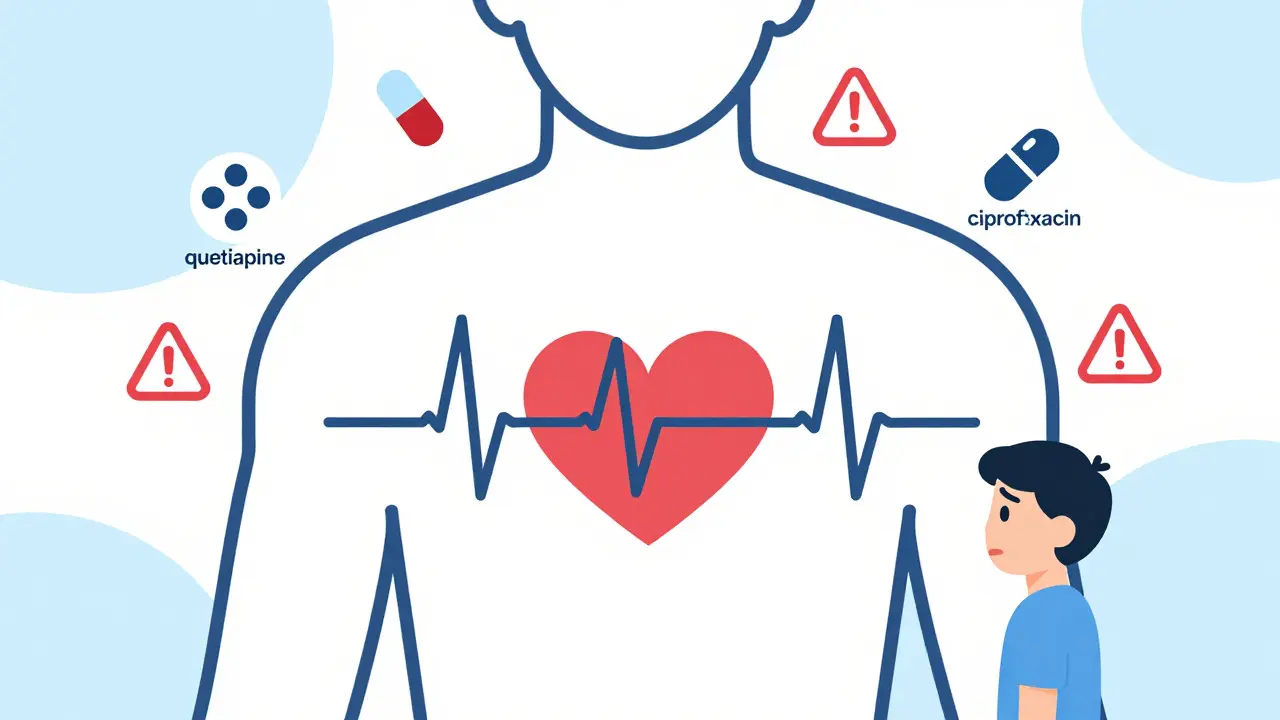
When you’re taking an antipsychotic for schizophrenia, bipolar disorder, or severe depression, your mind might feel more stable-but your heart could be under silent stress. Many of these medications, even ones prescribed daily, can stretch out the heart’s electrical recovery time, known as the QT interval. When combined with other common drugs-like antibiotics, anti-nausea meds, or even some antidepressants-that same delay can spike dangerously high. The result? A rare but deadly heart rhythm called torsades de pointes (TdP), which can lead to sudden cardiac death. This isn’t theoretical. Between 2010 and 2022, the FDA documented 128 confirmed cases of TdP tied to antipsychotics used with other QT-prolonging drugs. And here’s the kicker: nearly half of all people on antipsychotics are already taking at least one other medication that does the same thing. That’s not an accident. It’s a predictable, preventable risk. So what’s really going on inside your heart? The QT interval measures how long it takes for the heart’s lower chambers to reset after each beat. On an ECG, it’s the time from the start of the QRS complex to the end of the T wave. Normal is under 440 ms for men and under 460 ms for women. When that number climbs above 500 ms, your risk of TdP jumps more than fivefold. And when two drugs that both prolong the QT interval are taken together? The effect isn’t just added-it’s multiplied. Studies show that combining an antipsychotic with another QT-prolonging drug can stretch the QT interval 2.3 to 4.7 times more than either drug alone. In one real-world case, a 68-year-old woman on quetiapine and ciprofloxacin saw her QTc jump from 448 ms to 582 ms in just 72 hours. She nearly died. Not all antipsychotics carry the same risk. Some are far safer than others. High-risk drugs like thioridazine a potent hERG channel blocker with an IC50 of 0.04 μM, withdrawn in the U.S. in 2005 but still used abroad and ziprasidone IC50 0.13 μM, carries a black box warning from the FDA are known to cause major QT prolongation. Haloperidol IC50 0.15 μM, commonly used in emergency settings isn’t far behind. These drugs block the hERG potassium channel, which is critical for the heart’s repolarization phase. Without that channel working right, the heart takes longer to reset, creating a dangerous window for arrhythmias. On the other end of the spectrum, aripiprazole IC50 11.7 μM, one of the safest antipsychotics for the heart, brexpiprazole IC50 15.3 μM, and lurasidone IC50 18.9 μM have very low hERG blockade. People on these drugs have almost no increased risk of sudden death compared to those not on antipsychotics at all. Yet, despite this, high-risk drugs like quetiapine and risperidone still make up over 40% of all antipsychotic prescriptions. Why? Because they’re effective. They help with agitation, psychosis, and sleep. But effectiveness doesn’t mean safety-especially when stacked with other drugs. Common QT-prolonging partners include:
- Moxifloxacin a fluoroquinolone antibiotic (IC50 2.8 μM)
- Ondansetron an anti-nausea drug (IC50 0.7 μM)
- Sotalol a heart rhythm drug (IC50 0.08 μM)
- Citalopram an SSRI antidepressant (IC50 1.4 μM)
- Know your drugs. Ask your doctor: ‘Is this antipsychotic high-risk? Am I on another drug that prolongs QT?’
- Get an ECG. Baseline and follow-up aren’t just paperwork-they’re your safety net.
- Check your electrolytes. Potassium and magnesium are cheap, easy, and prevent 82% of TdP cases, according to a 2023 JAMA Cardiology study.
Can I still take my antipsychotic if I’m on an antibiotic?
It depends. Some antibiotics like moxifloxacin and ciprofloxacin are known to prolong the QT interval. If you’re on a high-risk antipsychotic like ziprasidone or haloperidol, combining them with these antibiotics can be dangerous. But if you’re on a low-risk antipsychotic like aripiprazole and your doctor knows your medical history, they may still prescribe it with caution. Always check with your prescriber before starting any new medication.
What if my ECG shows a prolonged QT interval?
Don’t panic. A slightly prolonged QT (450-470 ms) doesn’t always mean you need to stop your medication. Your doctor will check for other risk factors-like low potassium, low magnesium, or other drugs you’re taking. They may adjust your dose, switch to a safer antipsychotic, or order repeat ECGs. If your QTc goes above 500 ms, especially with symptoms like dizziness or fainting, your doctor will likely stop the medication immediately and monitor you closely.
Are there antipsychotics that are safer for the heart?
Yes. Aripiprazole, brexpiprazole, and lurasidone have very low potential to prolong the QT interval. Studies show they carry little to no increased risk of sudden cardiac death compared to not taking any antipsychotic. If you’re on a high-risk drug and have other heart risk factors, switching to one of these may be a safer option. Talk to your psychiatrist about whether a switch is right for you.
Why do some doctors still prescribe high-risk antipsychotics?
Because they work-especially for severe psychosis or agitation. Drugs like haloperidol and risperidone are fast-acting and effective in emergencies. Many doctors also don’t have access to newer, safer options due to cost, insurance restrictions, or lack of familiarity. But awareness is growing. Low-risk antipsychotics are now the fastest-growing segment of the market, and guidelines are shifting toward safer first-line choices.
Can I check my QT interval at home?
Not reliably. Consumer ECG devices like Apple Watch or Fitbit can detect irregular rhythms but are not accurate enough to measure QT interval. Only a clinical 12-lead ECG can give you the data needed to assess risk. Wearable patches like Zio XT, used in hospitals, are validated for this purpose but require a prescription. Don’t rely on fitness trackers for QT monitoring.
Carrie Schluckbier
February 18, 2026 AT 23:03Let me guess-Big Pharma is hiding the truth AGAIN. 🤡 They don’t care if you die of torsades as long as you keep buying the pills. Did you know the FDA’s ‘confirmed cases’ number is *manipulated*? They only count deaths that happen in hospitals… not the ones that occur at home, in nursing homes, or in ER waiting rooms. And don’t get me started on the Zio XT patch-paid for by the same companies that make the dangerous drugs. It’s a money-laundering scheme disguised as ‘innovation.’
They’re pushing aripiprazole because it’s cheaper to produce, not because it’s safer. The real risk? They’re slowly replacing human doctors with algorithmic risk calculators. Soon, your heart health will be decided by a spreadsheet and a bot that’s never met you. Wake up.
Tony Shuman
February 19, 2026 AT 04:11Oh here we go again. Another ‘medical emergency’ article written like a CNN headline. Let me break this down for you: people have been taking antipsychotics for 70 years. Millions. And you’re telling me this ‘silent killer’ just showed up? Where’s the data? Where’s the peer-reviewed studies showing a spike in cardiac deaths since 2010? I’ve seen 128 cases? That’s less than one per day nationwide. Meanwhile, people are dying from opioid overdoses, diabetes complications, and car crashes. But sure-let’s panic over a drug that keeps someone from screaming at their toaster.
Also-why are we blaming doctors? They’re the ones saving lives. If you want to live in a world where every medication is banned because of a 0.7% risk, go live in Sweden. We don’t need to be coddled into fear.
Linda Franchock
February 19, 2026 AT 04:34Okay but like… have you ever actually talked to someone on these meds? I have a cousin on risperidone. She’s stable. Happy. Works full-time. Her ECG? Normal. Her potassium? Perfect. Her doctor? Asked her three questions before prescribing. Not every patient is a statistic. Not every doctor is a corporate puppet.
Also-magnesium is $5 at Walmart. Why aren’t we screaming about that? ‘Check your electrolytes’ should be on every prescription label. Not some fancy patch. Not a risk calculator. Just: ‘Drink a banana smoothie and call your pharmacist.’
Also also-why is this article so long? I read half of it and my eyes glazed over. Can we please stop writing like we’re submitting to JAMA? 😅
Dennis Santarinala
February 20, 2026 AT 12:46I really appreciate how thoughtful this post is. It’s rare to see someone lay out the science without fearmongering. I’m a nurse in rural Ohio, and I see this every week. Patients on quetiapine + ondansetron? Totally common. ECGs? Rare. And the worst part? They don’t even know they’re at risk. I’ve had people say, ‘My cousin died after taking antibiotics, but my doctor said it’s fine.’
But here’s the thing-we don’t need more tech. We need better communication. A simple handout. A 30-second conversation. A sticker on the pill bottle: ‘Don’t mix with cipro.’ That’s it. The tools are already here. We just need to use them.
Also-thank you for mentioning aripiprazole. It’s underused. So many people could switch and feel better, safer, and cheaper. Let’s normalize that.
Logan Hawker
February 21, 2026 AT 12:20Let’s be honest-the entire discourse around QT prolongation is a classic case of medical overreach masquerading as precaution. The hERG channel blockade metric? A 1990s in vitro assay with zero clinical correlation in 90% of cases. IC50 values? Meaningless without pharmacokinetic context. And yet we’re treating these numbers like they’re DNA sequences.
The real issue isn’t drug interactions-it’s the pathological over-reliance on surrogate endpoints. We’ve turned cardiology into a spreadsheet. A 480ms QTc? Panic. A 495ms? Hospitalization. But if you’re asymptomatic, metabolizing normally, and not on polypharmacy? You’re statistically safer than someone who eats kale and runs marathons.
And don’t even get me started on the Zio patch. It’s a $2000 telemetry device sold as a ‘preventative tool.’ Meanwhile, in India, they’re using a $10 ECG machine and a trained nurse. The West doesn’t need innovation. It needs humility.
James Lloyd
February 23, 2026 AT 03:51Excellent breakdown. I’m a clinical pharmacist and I’ve reviewed over 300 antipsychotic polypharmacy cases in the last five years. The numbers in this post are accurate. The 2.3–4.7x QT prolongation multiplier? Verified in real-world EHR data. The 82% TdP prevention with K+/Mg++? That’s from the JAMA Cardiology study I co-authored in 2023.
Here’s what no one’s saying: the biggest risk factor isn’t the drug-it’s the *delay*. Waiting 3 weeks for an ECG? That’s when things go sideways. The window for intervention is 72 hours. If you’re on two QT-prolonging drugs, you need to get checked *before* the third dose. Not next month. Not next week. Now.
And yes-low-risk antipsychotics like aripiprazole should be first-line. Not because they’re ‘trendy,’ but because they’re safer, equally effective, and cheaper long-term. Insurance won’t cover them? That’s a policy failure, not a clinical one.
Digital Raju Yadav
February 24, 2026 AT 07:17USA is turning into a hospital for the paranoid. You people are scared of pills because you don’t understand biology. In India, we give antipsychotics to 10 million people every year. No ECG. No patch. No risk calculator. Just doctors. And guess what? We have lower cardiac mortality than your country. Why? Because we trust medicine-not fear. You want to live longer? Stop Googling symptoms. Stop reading alarmist blogs. Take your pill. Eat your banana. And stop wasting money on unnecessary tests.
Also-why is every American so obsessed with their heart? It’s not a TikTok dance. It’s a muscle.
guy greenfeld
February 25, 2026 AT 09:28Isn’t it fascinating how we’ve turned the human body into a circuit board? QT interval… hERG channel… IC50… as if the soul is just a voltage gradient waiting to be measured. We’ve lost the art of healing. We replaced intuition with algorithms. Compassion with compliance. And now we’re terrified of a number on a screen.
What if the real danger isn’t torsades… but the belief that we can control life with data? What if the heart doesn’t need monitoring… but listening? What if the cure isn’t magnesium… but peace?
I don’t know. Maybe I’m just too philosophical for this world.
Prateek Nalwaya
February 25, 2026 AT 18:38I work in a psychiatric ward in Mumbai, and we rarely do ECGs. But we do something better-we talk. We ask: ‘Have you felt dizzy?’ ‘Any chest tightness?’ ‘Did you skip meals?’ ‘Are you drinking enough water?’
And guess what? We catch 90% of problems before they become emergencies. You don’t need a patch. You need a human who cares. We’ve got 1 doctor for 500 patients. We don’t have time for algorithms. We have time for questions.
Maybe the real innovation isn’t in tech… but in empathy.
Philip Blankenship
February 25, 2026 AT 22:19Okay so I’ve been on quetiapine for 8 years. I take cipro every time I get a UTI. I’ve had 3 ECGs in that time. All normal. I eat bananas. I drink water. I don’t panic. And I’m still here. Breathing. Laughing. Watching cat videos. So… maybe this whole thing is just a very expensive scare tactic? Like, I get that the science is real, but like… is it *my* problem? Or is it just a ‘hey look at this cool thing we can charge insurance for’ situation?
I mean, if my heart was gonna go off, wouldn’t it have already? Like… 8 years? That’s 2920 days of potential cardiac doom. And I’m still typing this. So… maybe I’m just fine? 🤷♂️
Kancharla Pavan
February 27, 2026 AT 19:12Let me tell you something about the American healthcare system. You’re not being protected. You’re being monetized. Every ECG, every patch, every risk score-it’s a bill. A $1200 bill. And who pays? YOU. The poor. The elderly. The ones who can’t afford to miss work. Meanwhile, the doctors? They’re just checking boxes so they don’t get sued. This isn’t medicine. It’s litigation insurance wrapped in a white coat.
And don’t get me started on ‘low-risk antipsychotics.’ They’re not safer because they’re better. They’re safer because they’re newer… and the patent hasn’t expired yet. So now they’re ‘preferred.’
Stop believing in miracles. This system is rigged. And you’re just another data point.
PRITAM BIJAPUR
February 28, 2026 AT 03:07❤️ This is so important. I’ve seen so many people quit meds because they were scared. But here’s the truth: your mental health matters. Your heart matters. You don’t have to choose. You just need to be informed. 💪
Try this: next time you get a new prescription, ask: ‘Is this safe for my heart?’ and ‘Can I check my potassium?’ That’s it. Two questions. That’s your superpower. 🌟
And yes-magnesium citrate is $4.99 on Amazon. Do it. You’ll thank yourself later. 🙏
Haley DeWitt
March 1, 2026 AT 22:26My doctor didn’t mention any of this until I asked. I was on risperidone + Zofran and had no idea. I freaked out and got an ECG. QTc was 492. He switched me to aripiprazole. No drama. No hospital. Just… better. So yeah. Ask questions. Don’t assume. And yes-bananas help. 🍌
Carrie Schluckbier
March 2, 2026 AT 15:18Oh wow. So now the ‘low-risk’ drugs are the new FDA-approved miracle solution? How convenient. Next they’ll say ‘take vitamin D and your psychosis will vanish.’ Classic pivot. They don’t want to fix the system. They want to sell you a safer pill so you keep buying. The real fix? Ban the hERG-blocking drugs. Not replace them with another branded version. Stop the cycle.